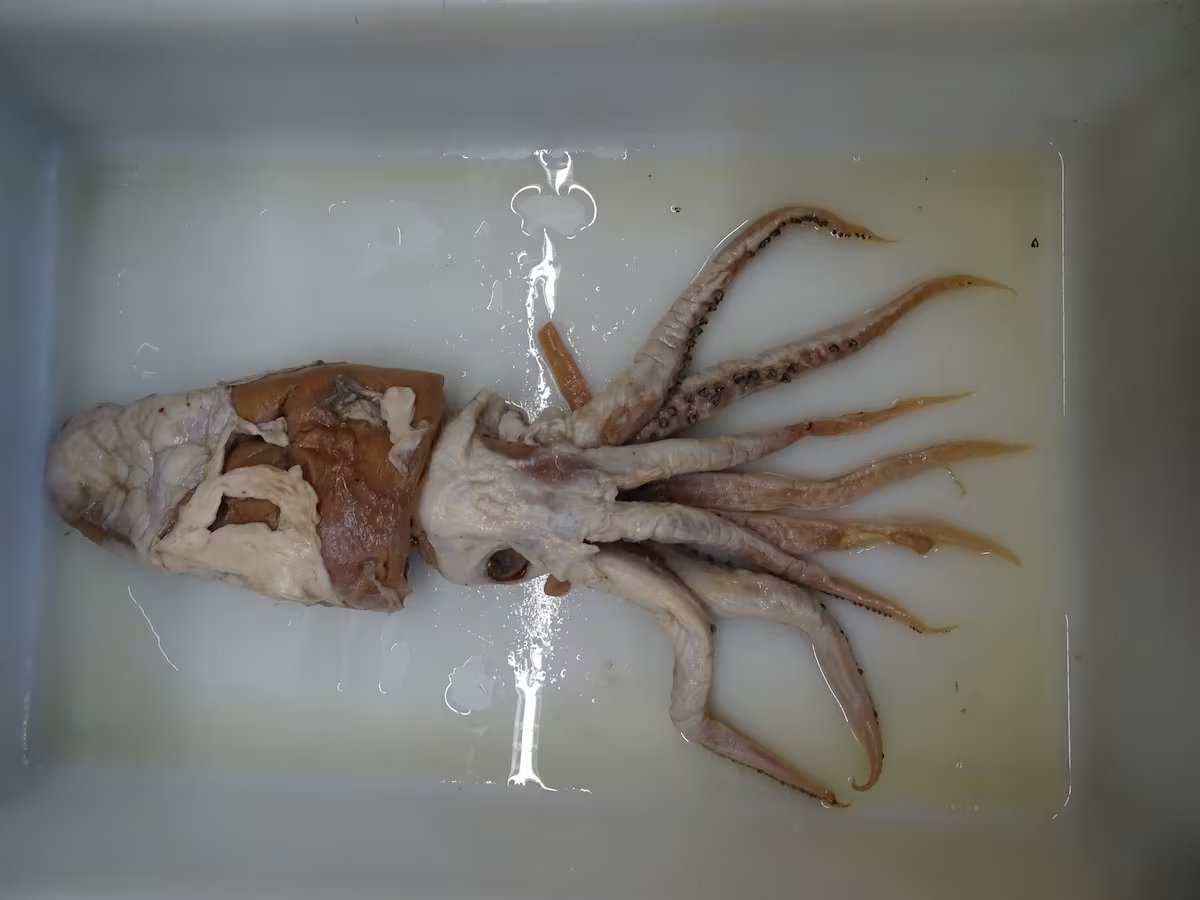
70 years ago, a squid was removed from the stomach of a sperm whale during a whaling campaign. A Spanish team discovered that the Poseidon squid is a new species unknown to science and was included among the ten most extraordinary marine species of 2025.
Its scientific name is ‘Mobydickia poseidonii’ and it remained in the collections of the Natural History Museum in London, incorrectly cataloged until it was carefully reviewed by student Sam Arnold and researcher Fernando Ángel Fernández-Álvarez, from the Spanish Institute of Oceanography.
These scientists realized that he did not fit the species they had assigned him. “We started to look at its morphology and saw that it did not fit with that of any family of cephalopods described so far,” he explains to EFE Fernandez-Alvarez.
The specimen is relatively large and, although it is missing two tentacles, it can be estimated that its total length was around 40 or 50 centimeters.
In addition, it is depigmented, except in the eye area, and has hooks on the suction cups of its arms with lateral cusps that resemble the shape of a trident.
Its origin and color reminded them of the white whale from ‘Moby Dick’ and the hooks of the Greek god Poseidon, two figures that ended up naming this squid.
First family of squid in 27 years
The research, carried out entirely in the Marine Biological Reference Collections of the Institut de Ciències del Mar (ICM-CSIC) in Barcelona, allowed a new family to be named for the first time in 27 years.
“It is an extraordinary event to find a family of oceanic squid at this altitude,” defends the biologist.
The discovery, together with the story of how it was found, has catapulted it to the list of the ten most extraordinary marine species of 2025 of the World Registry of Marine Species (WoRMS), which also includes crustaceans, worms and corals, among others.
“The discovery of an entirely new family of squid by a single preserved specimen underlines how much remains unknown in the deep ocean and how important museums and biological collections are as a repository of Earth’s biodiversity,” noted WoRMS.
An importance that Fernández-Álvarez agrees on, who highlights that it is a “wonder” that humanity has come to respect cetaceans in such a way that they are no longer hunted.
“But it is also a very fortunate event that someone took that animal, preserved it, and that a museum kept it in proper condition for 70 years until we arrived,” he adds.
Mysteries of the unexplored depths
Poseidon’s squid is not the only one that has an exciting story behind it. Precisely the last family of these cephalopods that had been described 27 years ago, the Magnapinnidae, remained unidentified until underwater videos linked to oil prospecting began to be made.
In those “very shocking” images, you could see a kind of “alien emerging from the nebulous background,” according to the biologist’s description.
The alien was actually a squid with filaments on its arms that it uses for fishing and that, when stretched, can reach six or seven meters in length.
These alien-looking squids jumped into popular culture and can be seen in underwater exploration video games such as subROV, developed in Pontevedra by Galician José González and for which he was advised by Fernández-Álvarez. It remains to be seen if Poseidon’s squid story also conquers any screens.