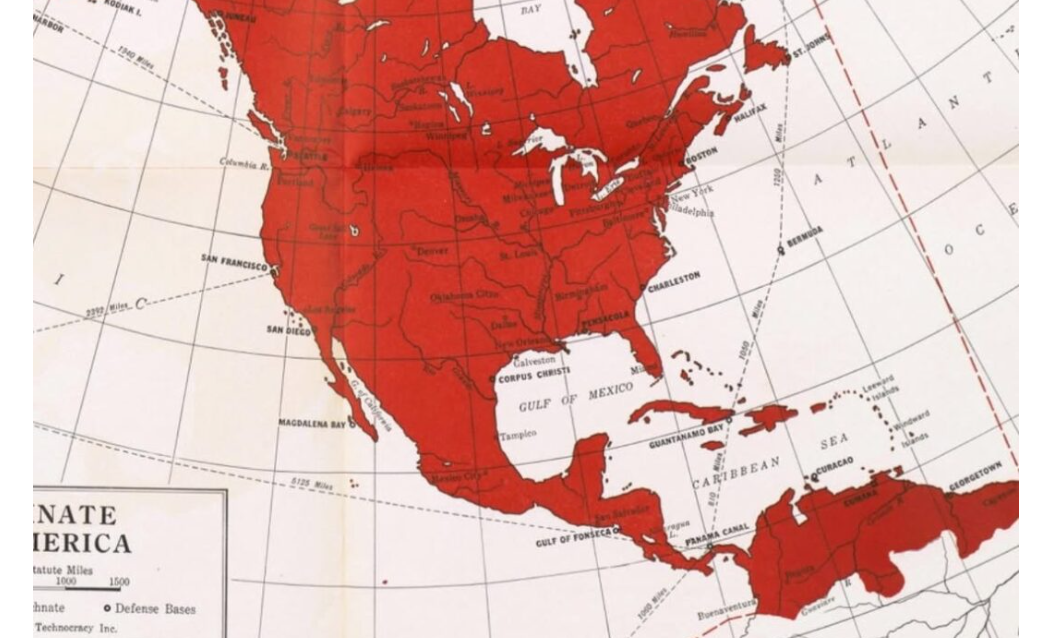
The recent presentation of the strategy called “Greater North America” by the United States Secretary of DefensePete Hegseth, reopens the debate on the hemisphere’s security architecture. The proposal defines a perimeter that extends from Alaska and Greenland to the equator and includes Central America, the Caribbean, Guyana, Suriname, Venezuela, Colombia and Ecuador. Delimitation uses natural barriers, such as the Amazon rainforest and the Andes mountain range, to separate areas of responsibility.
Washington maintains that this approach seeks to restore military cooperation in order to protect “Western civilization” from the growing influence of external powers. He also states that he intends to confront narcoterrorism, international crime and irregular migration. The initiative is reminiscent of the continental defense schemes of World War II and is presented as a pragmatic effort that does not alter current trade agreements.
This announcement takes on special relevance due to our position on the world map. The country concentrates geographical and strategic features that specialized literature considers exceptional. Its location on the northern fringe of South America allows immediate access to the Caribbean Sea and the Atlantic Ocean. From that coastline it maintains direct communication with the United States, Europe and the Pacific through the Panama Canal. Such condition allows it to operate as a link point between the Caribbean space and the South American continent.
Physical geography adds additional value. The country has an extensive maritime façade. A coastline articulated with the Caribbean arc. The Orinoco Delta and the Orinoco Oil Belt form a corridor that combines energy resources, access to the sea and control of hydrographic basins.
Strategic value
The nation has a high energy capacity. It has the largest proven oil reserves in the world and abundant natural gas deposits in the Western Hemisphere. To these two fossil fuels must be added their extensive hydroelectric potential, visible in the Caroní basin. Such attributes give it the status of a relevant actor on the globe. The magnitude of these natural resources explains the constant interest of various international actors.
The national territory also houses underground resources of high strategic value. Significant reserves of gold, iron and bauxite are found in the Guyana Shield, along with technological minerals such as coltan, nickel, rhodium, titanium and uranium. This diversity is complemented by deposits of coal, copper and diamond. The breadth of this offer strengthens the country’s position within the global chains of vital supplies.
Maritime access complements the aforementioned factors. It has direct access to the Caribbean, whose geopolitical weight has been maintained uninterruptedly since the 19th century. This area has always been a commercial and military transit space. By occupying the southern edge of that maritime system, Venezuela has proximity to the main interoceanic corridors and access to vital nautical routes, which reinforces its importance within the hemisphereeither.
At the same time, its easy access to the Atlantic increases and facilitates the connection with high-traffic trade routes, improving the country’s projection within the economic, energy and mineral geography. The combination of resources and ocean access configures a profile that keeps the country on the radar of the main international decision-making centers.
The internal diversity of the territory adds another dimension. The country combines plains, mountain ranges and jungles. The Andes function as a natural barrier, the plains allow mobility and the Venezuelan Amazon links with Brazil and the largest rainforest on the planet. This variety of terrain provides maneuverability, complicates any attempt at external control and reinforces the strategic interest of the region.
The border limits add another element. Its cartography unites it with Colombia, Brazil and Guyana. This location links three areas of great importance on the continent. The Caribbean, the Andes and the Amazon. The western border connects with the Andean corridor. The southern one opens the way to the Amazon system. The eastern one links with the Guyana shield and with the North Atlantic. The uniqueness of this territorial convergence in the region expands its strategic value.
The maritime dimension provides additional advantages. The continental shelf and archipelagos guarantee access to a vast wealth of highly productive fish. Control of the southern tip of the Caribbean favors fishing exploitation and the use of regional resources. In addition, the location in the intertropical belt keeps the country out of the paths of destructive cyclones. This climatic condition allows continuous port activity and reduces vulnerabilities.
The challenge: protect sovereignty
In this context, the “Greater North America” strategy takes on a particular meaning for the Republic. The combination of considerable natural wealth and the position on the southern edge of the Caribbean places the country among the best located in the hemisphere and with the greatest strategic value. These features make it a relevant territory within any continental security scheme. Although geography does not determine politics, it conditions the options for international insertion and explains why our country once again appears at the center of geopolitical discussions in the region.
Beyond the geographical factor, Venezuela’s weight in this scheme lies in its role as an energy support in the face of the volatility of international markets. In an environment where strategic autonomy depends on the control of critical raw materials, reintegrating Venezuelan production into the Western sphere seeks both to stabilize prices and to stop the advance of extra-regional powers. So, hemispheric security transcends the military to focus on the creation of a self-sufficient bloc, capable of protecting its supplies in the face of growing geopolitical frictions in Eurasia.
In short, the “Greater North America” is not an isolated phenomenon, but rather the ratification that control of the Western Hemisphere continues to be a vital priority for Washington. The Venezuelan nation, with its combination of borders and reserves, is consolidated as a key piece on this regional and global board. The upcoming challenge will not only be managing resources, but also the use of diplomacy and control to protect sovereignty in the face of a world order that urgently seeks to guarantee loyalties and supplies in its immediate environment.
***
The opinions expressed in this section are the sole responsibility of their authors.
From the same author: Fanb, leadership, relief and institutional stability