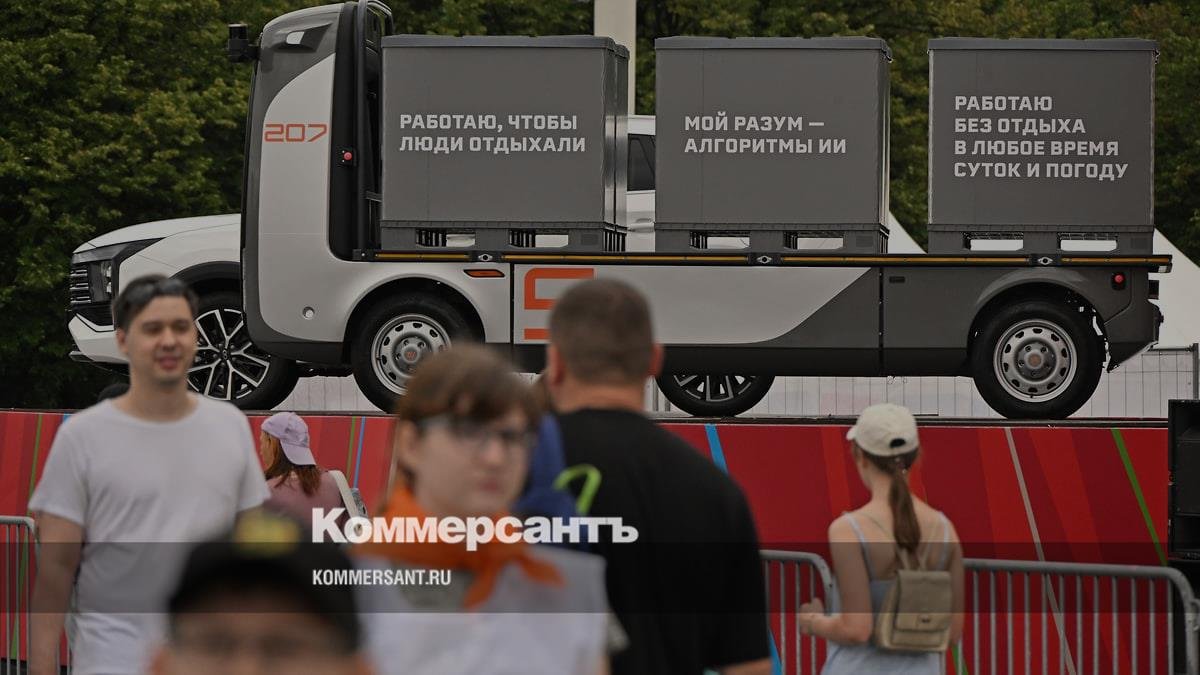
The Ministry of Transport has prepared a new version of the bill, which will establish rules for the movement and operation of unmanned vehicles from 2027. Judging by the document that Kommersant has reviewed, in the event of an accident involving an autonomous vehicle, the owner of the car will compensate for damage to the health of citizens and their property, who will be able to file a recourse against the manufacturer or service center. Responsibility for incidents will be distributed between the owners of drones, road services and “operators”.
The head of the ministry, Andrei Nikitin, said on Thursday, June 4, in an interview with Vesti on the sidelines of SPIEF that the Ministry of Transport is developing a draft law “On Highly Automated Vehicles.” The document, according to Kommersant, was discussed at an analytical center under the government of the Russian Federation and is sent for further approval. The Ministry of Transport itself does not comment on its development.
Driverless trucks, taxis and trams are now operating on the roads under experimental legal regimes (ERRs). To legalize the movement of drones and allow them to travel on all roads (including without a driver at the wheel), a separate law is needed. Since 2021, several versions of it have been introduced. The Ministry of Economy, the Ministry of Internal Affairs, regions, cargo carriers, private business and experts are involved in its development.
Kommersant got acquainted with the current version of the project. It stipulates the responsibilities between the subjects of regulation, including owners of highly automated vehicles (VATS), manufacturers, operators, drivers, “operators”, etc.
Damage caused to life, health or property will be compensated in any case by the owner of the VATS.
He, in turn, will be able to file a recourse claim against the actual culprit of the accident (for example, the manufacturer) and demand compensation. If an administrative or criminal case is opened based on the fact of causing damage, then responsibility will be distributed. The owner of the VATS will bear it if, for example, the design of the machine was illegally changed; service center – if the car was poorly serviced; manufacturer – if the software that affects traffic safety was not updated in a timely manner; the owner of the infrastructure – for incorrect transmission of data (for example, from weather sensors and vehicle detectors) to an unmanned vehicle. Sanctions will be imposed in accordance with the Code of Administrative Offenses and the Criminal Code, which will also be amended.
The article on restrictions for unmanned vehicles has also been changed. The Government of the Russian Federation will establish bans and restrictions on federal roads, subjects of the federation – on regional or intermunicipal routes, owners of private and toll roads – on their routes. The division of powers will be described in the law “On the organization of road traffic”.
According to Kommersant, the authorities of St. Petersburg insisted on this, arguing that it was necessary to have a tool for introducing operational bans for VATS on certain streets (for example, when SPIEF and naval parades are taking place) or during the liquidation of a major accident. The document also provides for the ability to identify sections of streets where drones are prohibited from driving.
Another amendment concerns the designation of VATS on roads. Now, as part of the EPR, a triangular sign with the letter “A” is hung on cars: it was originally planned that this requirement would be transferred to the law. Now, during the discussion, experts drew attention to the fact that the sign may not be visible in the dark. The Ministry of Transport agreed with this – additional ways to designate VATS are expected to be indicated in a separate resolution. Among the options being discussed is the mandatory equipping of cars with special lights (ADS marking lamps), which light up turquoise at the rear when the autonomous driving mode is turned on.
Some of the innovations in the latest version of the bill concern security. An amendment has been added, according to which the VATS operator must “immediately” comply with the requirements of the Ministry of Internal Affairs, the State Traffic Safety Inspectorate, Rostransnadzor and other services to suspend or restrict the operation of the vehicle. In a separate document, the government will approve the rules for the “forced” termination of the movement of an unmanned vehicle. Access to data on the functioning of unmanned vehicles will be provided at the request of the Ministry of Internal Affairs and other law enforcement agencies.
At the initiative of the Moscow government, the Ministry of Transport will prepare amendments to the law “On the Status of the Capital,” which will allow city authorities to set their own requirements for the interaction of VATS with road infrastructure.
Moscow, we recall, has been using driverless trams for several years as part of the EPR and plans to begin transporting passengers on driverless trains in the metro in 2027. It is unknown what specific requirements will be applied in the capital and how they will differ from the “federal” ones.
Speaking on June 4 at one of the SPIEF sessions, the first deputy chairman of the Federation Council Committee on Constitutional Legislation and State Building, Artem Sheikin, complained that the slow transition from EPR to “sustainable legal regulation” is one of the problems for the development of unmanned transport. He drew attention, in particular, to the search for solutions on the distribution of responsibilities in the operation of VATS, which has been going on for several years.
At the same time, Artem Sheikin said that the document will, in any case, be supported by legislators sooner or later. The Ministry of Transport expects that the law will come into force on September 1, 2027, although the draft has not yet been submitted to the State Duma. According to the ministry’s forecasts, which are given in the materials for the project, by 2035 the fleet of cargo VATS will amount to 6.69 thousand units. By 2050, the share of driverless vehicles in the entire vehicle fleet could reach 50%.