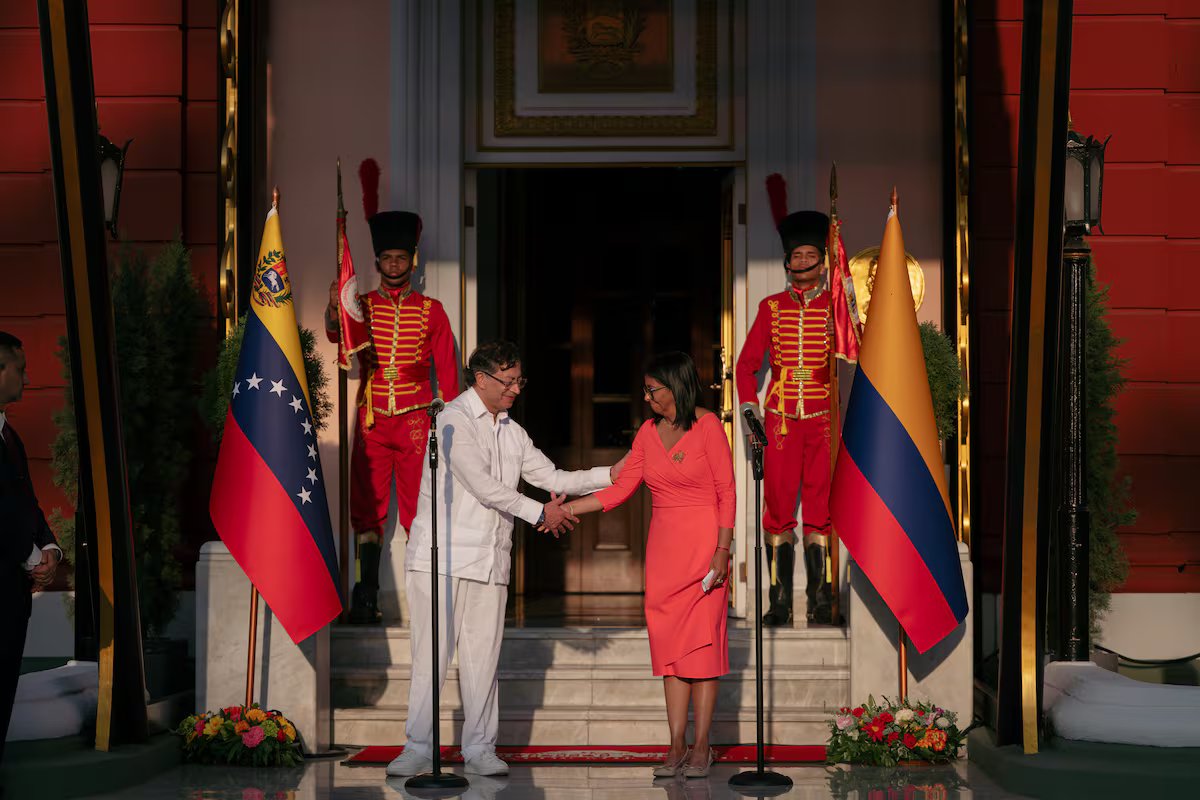
It was a bilateral meeting, but a third country was very attentive to what was announced there. This Friday’s meeting in Caracas between the president in charge of Venezuela, Delcy Rodríguez, and the Colombian president, Gustavo Petro, was sealed with an important announcement: the two countries will develop joint military plans and open mechanisms to share intelligence information “immediately.” This is a milestone in terms of security, because, despite being neighbors, Bogotá and Caracas had not shared information for decades, military sources say. It remains to be seen how this declaration of intent is taken on the ground, but the announcement sends a message in two directions: on the one hand, to criminal groups and, on the other, to Donald Trump, who needs a stable and safe Venezuela to continue with his plans.
Bilateral cooperation has two clear enemies: the Second Marquetalia, one of the dissidents of the extinct FARC, and the National Liberation Army (ELN), a guerrilla group over 60 years old. Both armed gangs have Colombian origins, but they move and commit crimes interchangeably in both countries. His war has spread terror on the border and its tentacles have taken over not only transnational drug trafficking, but also the illegal mining business, a sector that is now especially strategic for Trump. “What foreign investor is going to come to these areas dominated by these gentlemen?” asks a diplomatic source. “None”.
Among the declared interests of the White House after intervening militarily in Venezuela on January 3 and taking away Nicolás Maduro, is oil exploitation. But also rare earths and gold extraction, businesses in the hands of organized crime. “This is how capricious and paradoxical politics are,” says this diplomatic source. “Trump has, of course, interests that in this case coincide: he needs gold and stability for investors. But gold, unlike oil, is not under state control, but in some areas where the ELN reigns“, he adds. The plan, he assures, serves the three countries.
Trump needs stability to attract investors and Venezuela understands that, as long as there are groups classified as narcoterrorists by the State Department in its territory, the US has the door open to stay. For its part, for Colombia, after the failure of the negotiations with the ELN that the Petro Government launched in style in 2022, any solution for the decades of that war goes through the neighboring country. “As long as the Venezuelan government continues to support the Colombian insurgent group, it cannot be completely defeated nor is it likely to sign a peace agreement,” the specialized media Insight Crime explained in December. The change of ruler in Venezuela precisely opens an opportunity to change it.
This Friday’s bilateral summit brought together Petro and Rodríguez, two old friends who had been separated for too long. She thanked the Colombian president for having been one of the first people she called to “stand in solidarity” with the Venezuelans. that traumatic January 3. But the meeting had a special role from the Colombian Minister of Defense, Pedro Sánchez, who will have to implement the roadmap. It was striking, however, that his counterpart was not on the other side, the newly appointed Gustavo González. While the meeting was taking place, an official publication on social networks—now deleted—showed González at an event commemorating the 216th anniversary of the Ministry of Popular Power for Defense and the Bolivarian National Armed Forces. In his place was the all-powerful Diosdado Cabello, Minister of the Interior and third most important figure in Chavismo after the Delcy brothers and Jorge Rodríguez.
As soon as she said goodbye to Petro, a publication from the North American embassy showed the moment in which Delcy Rodríguez met for the first time officially with the new representative of the United States in Venezuela, John Barrett. The trade manager is the actor on the ground who must accompany the implementation of Trump’s stabilization, recovery and transition plan.
“This has a very strong impact on criminals on the border. No government tolerates them,” a senior Colombian military source assured EL PAÍS about criminal groups. “In terms of intelligence and operations, an opportunity was opened to exchange information and develop mirror (simultaneous) operations, each in its own territory but articulated,” he explains. But once the message is launched, the challenge will be to implement it. “It’s not going to be easy, but the important thing is to start,” says this source.
Years ago the ELN crossed the border to stay. The Colombian guerrilla spread in Venezuela thanks to what would seem to be a tacit agreement with the government of Nicolás Maduro. They could operate freely in exchange for protecting him against a hypothetical incursion by Colombia, a historic military ally of the United States. Thus, the guerrillas settled like ticks in the states of Vichada, Amazonas, Apure and Arauca, and to drug trafficking they added illegal gold mining with which they destroy the jungle and contaminate the rivers with mercury. Two circumstances paved the way: the breakdown of relations between Bogotá and Caracas in 2019 — which left the border without military cooperation and ended the so-called “hot pursuit” — and the weakness of a Venezuelan State focused on controlling the cities and containing a largely urban opposition.
The ELN, which At the time it was inspired by the Cuban Revolutionwas also a key piece in Maduro’s contingency plans for the possible invasion of the United States, according to several sources consulted by EL PAÍS in Caracas. While Trump deployed planes and combat ships in the Caribbean Sea, Chavismo believed that the US offensive, if it arrived, would arrive by land, using Colombia as a launching pad. They considered that the ELN could serve as a retaining wall or a generator of chaos in the face of the invasion. But no one heard a shot from the guerrillas in defense of the revolution.