Four days before Tuesday’s Democratic Senate primary, State Representative Angie Nixon did what she has always done in Florida: Organize activists.
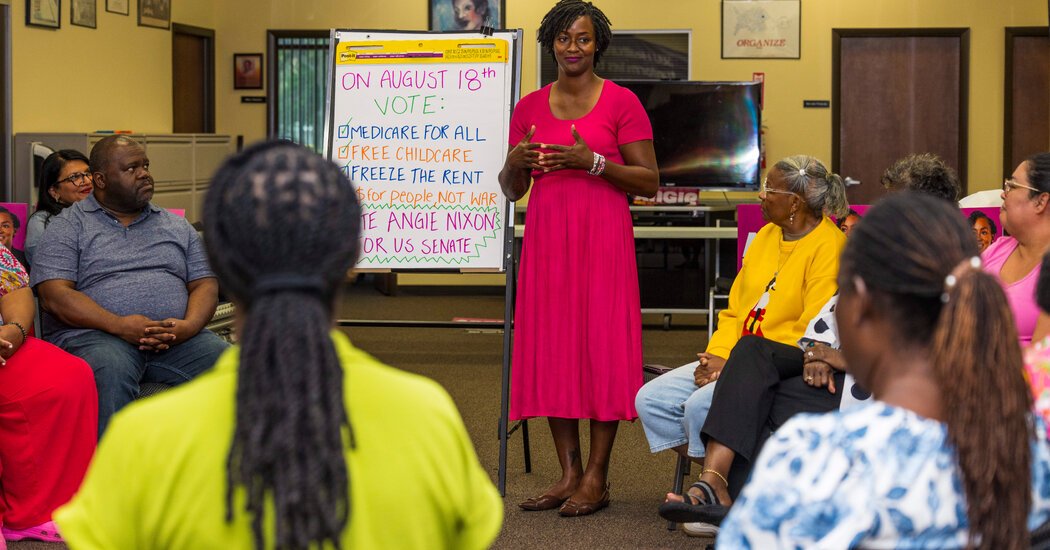
The group of volunteers for her underdog Senate campaign sat inside a union office in suburban Broward County, a liberal stronghold in the increasingly Republican-leaning state. It was a small group, maybe a dozen people.
But don’t worry, Ms. Nixon’s political director, Rachel Gilmer, reassured them: “This tiny room is part of many, many tiny rooms” across the state, she said, with more volunteers also ready to knock on Democratic voters’ doors.
Ms. Nixon, 42, walked in, wearing a big smile and dressed in her signature hot pink, the same color splashed on her van, campaign signs and fliers. She rallied her limited troops.
“This is a people-powered movement,” she told the volunteers, “that is built on the shoulders of working families, on the shoulders of union workers, on the shoulders of folks who have been marginalized for so long.”
Ms. Nixon proved she was right on Tuesday, defeating Alex Vindman, the presumed front-runner, in a stunning upset that energized progressive Democrats in Florida for the first time in years. She won as other candidates from the political left have done across the country, by focusing on the grass roots. She did it with incredibly limited resources.
The flip side to Ms. Nixon’s victory is that it may turn what was widely seen as a long-shot goal for Democrats — defeating a sitting Republican senator in comfortably red Florida — into an even longer shot. The Cook Political Report has consistently rated the race this year as “solid R.”
For now, the left is rejoicing in Ms. Nixon’s triumph. And others are examining the outcome to figure out how the heck she did it.
The huge disparity between her fund-raising and Mr. Vindman’s was nowhere to be seen in the results. Ms. Nixon won by 12 percentage points, besting Mr. Vindman in every major metropolitan area except West Palm Beach. She won big not only in Duval County, where she lives, in Jacksonville, but also in Miami-Dade County, the state’s most populous, and in Broward County, where Mr. Vindman lives.
“If you’re from Broward, you can’t lose Broward and Dade,” Mitchell Berger, a Fort Lauderdale lawyer who has been a major Democratic fund-raiser for decades, said on Tuesday night at Mr. Vindman’s election night event, as his loss left attendees looking bewildered. “You can’t lose your home area.”
Ms. Nixon also did particularly well in areas with high concentrations of young voters and progressives, including Gainesville, where the University of Florida is, and Tallahassee, home of Florida State University.
A three-term state lawmaker and mother of five, she joined the Democratic Socialists of America in June, though the group has not endorsed her candidacy. Even before then, she was known as a progressive firebrand and thorn in the side of Gov. Ron DeSantis, a Republican. This year, she staged a sit-in at the governor’s office in the State Capitol to protest a Republican gerrymander of the state’s congressional map. She was eventually arrested and removed from the office. She also interrupted a State House vote on the map by protesting with a bullhorn.
The incident drew a reprimand from state lawmakers — but also some attention to her Senate candidacy. She chronicled much of her campaign online, as she drove herself from one event to another in a van. At one point, she shared video as she figured out how to change a flat tire.
Over the summer, Mr. Vindman’s campaign stumbled twice. During a Democratic Party fund-raiser gala, he fled from a group of social media influencers, in what later appeared to have been a miscommunication. But the video was not flattering for a first-time candidate still little-known to many Democratic voters.
Then, his wife, Rachel Vindman, wrote a social media post using a vulgar term that, without naming Ms. Nixon, appeared to insult her and mock her clothes and shoes. Ms. Vindman deleted the post and apologized, but not before it angered many grass-roots Democrats. (Ms. Nixon, who campaigned in sneakers, later posted a photo of heeled sandals with the caption: “Are these ok?”)
Last week, as the final weekend of early voting approached, Ms. Nixon and two House candidates running as democratic socialists planned a big weekend in South Florida. Representative Rashida Tlaib of Michigan joined them on the trail and at a rally for Gen Z voters. The rally changed venues because of pressure over Ms. Tlaib’s and Ms. Nixon’s anti-Israel stance in Broward County, which has a large Jewish population.
At the union hall in Miramar, where her volunteers gathered on Friday afternoon, Ms. Nixon said the fallout over the rally suggested Democrats were running “scared.”
In a brief interview that day, she did not predict victory. Her campaign did not have money to poll, she acknowledged, and no public polls had been conducted in the primary race. She could not know exactly where she stood against Mr. Vindman.
But she knew Mr. Vindman’s campaign had polled at least once. He had not spent money attacking her, which many Florida Democrats assumed meant he was not worried about her candidacy. Ms. Nixon, however, noted that his campaign had also not released its internal poll, suggesting that perhaps the race was closer than expected.
By the time the rally began, late into the night at a downtown Fort Lauderdale wine bar packed with hundreds of mostly young people, including social media influencers, Ms. Nixon was losing her voice.
“Throughout this country’s 250 years, every time we have been faced with oppression, we have matched it with resistance,” she told the crowd, urging them to spend the last few days of the campaign mobilizing. “We have nothing to lose.”
Susan Cooper Eastman contributed reporting from Jacksonville, Fla.; David Ovalle from Orlando, Fla., and Ruth Igielnik from New York.