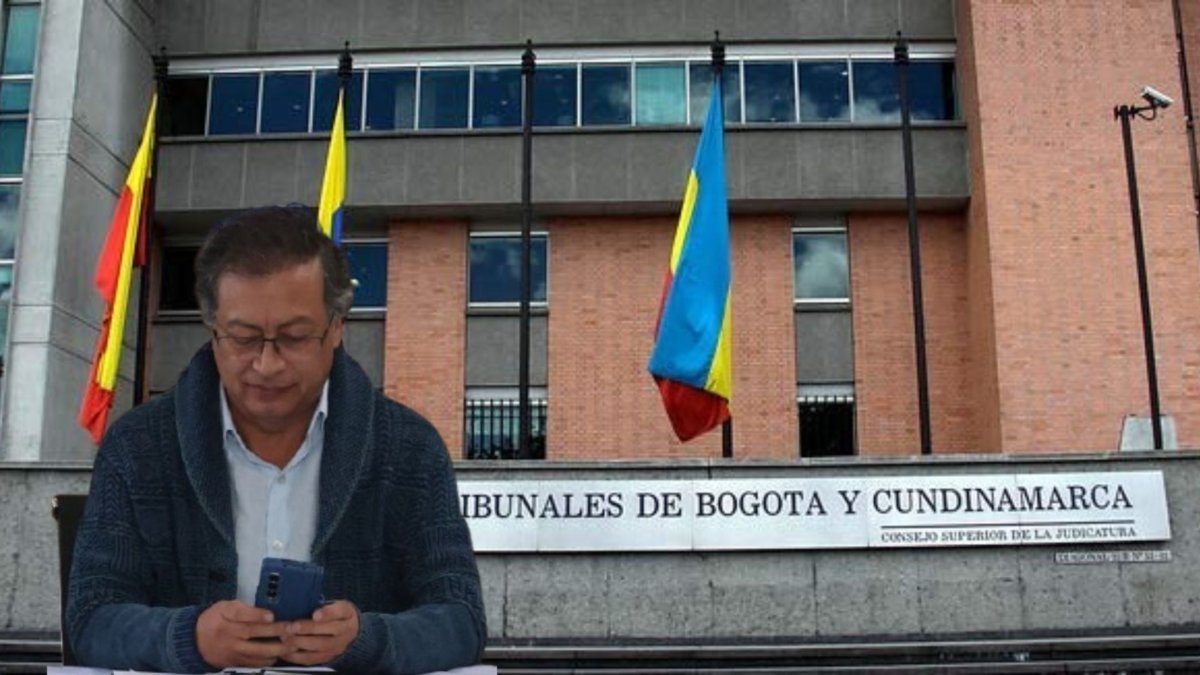
In a decision that puts limits on the statements of the head of state in the middle of the electoral situation, the Administrative Court of Cundinamarca ordered President Gustavo Petro rectify statements about alleged electoral fraud and refrain from repeating them without evidence “solid and reasonable.”
The ruling, with a presentation by Judge Luis Manuel Lasso Lozano, occurred after a lawsuit filed by Ramiro Bejarano Guzmánin which the requests for precautionary measures of the Attorney General’s Office.
President Gustavo Petro. Photo:Vanexa Romero / EL TIEMPO
The Court went beyond the orders and examined the basis for the president’s claims. According to the decision, the standard of truthfulness is not met in published messages.
Regarding the 2014 elections, he specified that the Council of State did not conclude that there was fraud nor structural failures of the system.
Regarding 2022, he reiterated—as he had already done in a ruling of January 2023—that there was no fraud against the Historical Pact. He explained that the difference between the pre-count and the scrutiny was due to errors in the design of the E-14 formwhich affected the initial vote report, but not your final count. The votes, he pointed out, were always recorded and were correctly consolidated in the counting.
This conclusion coincides with what was reported by the observation mission of the European Unionwho realized that the detected inconsistencies were due to failures in the completion and design of the E-14 form, and not to an alteration of the results.
Administrative Court of Cundinamarca. Photo:Private file
In relation to the elections of March 8, 2026, the Court was also emphatic: the available reports show differences between the pre-count and the scrutiny less than 1%which he considers a positive indicator on process reliability and the way in which it has been conducted by the National Registry of Civil Status.
A call for institutional prudence
The decision insists that President Gustavo Petro’s statements are problematic because they are based on interpretations that “changed the message” of judicial decisions, especially in the case of 2014, and because they convey to the citizen the idea that there is a judicial support for allegations of fraud that, according to the Court, do not exist.
In that sense, it warns that invoking decisions of the Council of State as proof of irregularities generates wrong perceptionby presenting them as conclusions of an impartial third party who in reality did not declare the existence of fraud or structural failures in the electoral system.
The ruling not only imposes the rectification of the messages already issued, but also establishes a criterion for the future: the head of state may rule on the reliability of the electoral system, but only if he has “solid and reasonable” empirical evidence and after having gone, preferably, to the institutional channels created for that purpose.
The Court also leaves open the possibility for the President to resort to other means, provided that a lack of response from the competent authorities to sustained concerns has been previously verified. Otherwise, he warns, he puts himself in collective right at risk from citizens to trust the election results.
The precautionary measure seeks balance two principles: the President’s right to freedom of expression and the need to protect the credibility of the Electoral Organization at a key moment in the democratic calendar.
Along these lines, the corporation emphasizes that citizens “deserve certainty” about the results of the elections and that this trust can be affected when the Head of State issues decisions. statements without sufficient support about fraud or system weaknesses.
Therefore, he concludes, the President must adjust his public actions to the constitutional duties that they demand contribute to national unity and to institutional stability, especially in the face of ongoing electoral processes.
Justice Editorial