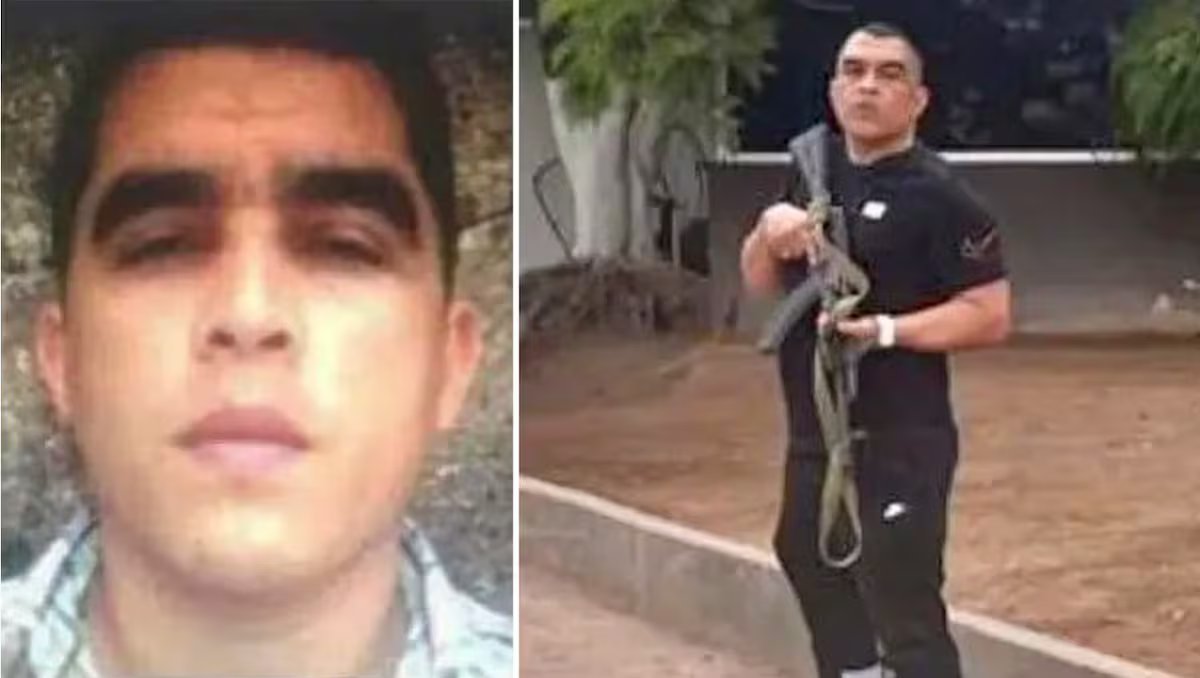
The video, taken from the air, shows a modest green roof construction in a clearing in the jungle in southeastern Venezuela. And, as in the dozens of recordings that Donald Trump has released in the last year of alleged drug boats jumping into the air in the Caribbean Seathe house disintegrates with a missile strike. The plume of black smoke rose above the trees and was visible for miles. Ten seconds is what it took to kill Héctor Rusthenford Guerrero Flores, alias Niño Guerrero, 42 years old, the head of the Tren de Aragua, the most powerful criminal gang in Venezuela that for years operated with the complicity of the authorities.
The operation was announced on Friday night, but nothing else had been talked about in Venezuela for three days. On Tuesday, Venezuelan security forces had deployed an opaque operation on the gold mines of the state of Bolívar, territory controlled by the Tren de Aragua. Videos recorded by neighbors showed helicopters—apparently Venezuelan—flying over the area, launching bursts or leaving dozens of agents on the ground. They also showed hundreds of men fleeing through the mud of the open pit mines, enormous scars in the jungle. which different criminal factions have turned into their main source of income.
The Government did not give any explanations and in that silence the theory that many still maintain grew: that behind the operation they were Washington’s interests in Venezuelan gold.
The police-military operation remains mysterious, but official sources in Caracas assure that it had a single objective, to neutralize Guerrero, and that it was the result of months of searching. A persecution that began, they say, even before Washington bombed Caracas on January 3 to capture Nicolás Maduro and his wife, Cilia Flores.
The Venezuelan authorities, according to sources familiar with the operation, had been searching for Niño Guerrero for nine months. They knew that he had been a refugee in neighboring Colombia and that he was now installed in the south of the country, trying to take over the million-dollar mining business in that border area with Brazil and Guyana. It was precisely in Guyana, country with which Venezuela maintains a territorial conflictwhere he had his hiding place, although he crossed the border whenever he required it.
El Niño Guerrero fell into that shack in the middle of a clearing and days passed until, on Friday morning, the Venezuelan authorities were able to verify that it was him. “They found him near the house and identified him by a tattoo on his leg,” explains a source with details about the operation. Trump went ahead to Caracas and on Friday night claimed responsibility for the death in a joint operation with “our friends in Venezuela.” The United States Southern Command, Truth wrote on its social network, had killed the “infamous leader” of the Aragua Train in a “rapid and lethal military attack.”
The question that Trump left in the air was still floating hours after the announcement: had US troops entered Venezuelan territory? If so, the tutelage to which Washington has subjected Venezuela Since Maduro’s capture it had just escalated to another level.
Washington Post quotes “a person familiar with the attack” who claims that it was forces from the Joint Special Operations Command that launched the missile, and that the CIA worked with Venezuelan forces on the ground. But sources familiar with the operation in Caracas assert in conversation with EL PAÍS that “there was never” a “US military presence” in Venezuelan territory for that operation. The collaboration with the United States, they suggest, was above all technological, but the operation on the ground “was completely directed and worked on” by Venezuela. When asked who fired the shot and whose weapon it was, silence.
In the announcement that followed two hours after Trump’s, The Government of Delcy Rodríguez did not deny its forced ally. His statement was a balancing act: he did not confirm that it was foreign troops that killed the ringleader, but rather he spoke of a “combined operation” and “confrontations” with the criminals in which Héctor Rusthenford Guerrero Flores “was neutralized.” According to the Chavista Executive, the operation had “specialized technological support” and the exchange of intelligence between both countries.
Trump turned the Tren de Aragua into his main public enemy, arguing that the gang was Maduro’s armed wing on US soil. But there are many doubts that this is the vertical, omnipotent organization that Washington described. According to Andrés Antillano, a researcher at the Central University of Venezuela, it was more of a brand: a hard core in the State of Aragua and dozens of gangs in different countries that used the name to instill fear, without responding to any central command.
The Warrior Boy He started early in the world of crime And at the age of 17 he was already trafficking drugs in Maracay and killing police officers. The first time he was captured, in 2010, it was in front of a liquor store, with a stolen gun, ammunition, and watches. From prison he collected extortions from prisoners and nearby companies and, when the gang expanded throughout Colombia, Peru, Chile and the United States, he replicated the model of collecting vaccines (extorting) from merchants in exchange for security. He then became involved in the trafficking of Venezuelan migrants, his easiest and most numerous victims.
In 2012 he escaped from the Tocorón prison, in the State of Aragua, paying $400 to some guards. They captured him again almost a year later and that was when he finished building his empire from prison. When the authorities took over the prison in September 2023 and demolished the office and the theme park that had been set up in the prison facilities – zoo, nightclub, baseball stadium – the Warrior Boy disappeared.
After some time outside the country, he ended up hiding between Guyana and southern Venezuela, where the underworld controls illegal gold extraction in collusion with local authorities. According to an InSight Crime investigation, during the 2024 election campaign, Maduro’s propaganda reached those mines and miners were coerced to vote for him.
Venezuelan authorities defend that the crime scene has been changing in recent months. They have been trying to clean the area of criminals for a long time because with them in charge it is impossible to attract investment. “Everything that happened before, when there were criminal bosses dominating everything, is no longer the case,” they say. The same sources explain that for more than a year they have been trying to compile a census with the nearly 200,000 miners who work in the area to convert them into formal workers for companies that settle there.
It is the bet of the new Venezuela: that, without Niño Guerrero and other henchmen, the Orinoco Mining Arc can finally be worth what it is worth. The same bet from Washington.