While the nation’s 250th birthday may have passed, the pitched partisan battles over how to tell the country’s history — in particular the founding story of 1776 — are hardly over.
On July 4, hours before President Trump gave an address on the National Mall in Washington, the White House posted a lengthy report on its website accusing the Smithsonian Institution’s National Museum of American History of engaging in “extreme political activism.”
The 162-page report, credited to the White House Domestic Policy Council, was the latest salvo in the Trump administration’s long-running campaign to gain influence over the broader Smithsonian, which includes 21 museums plus the National Zoo. And it quickly drew strong criticism from historians.
“In another example of executive branch overreach, the White House is seeking to coerce Smithsonian leadership to shape its presentation of U.S. history so that it serves the administration’s political agenda,” the Organization of American Historians said in a statement on Monday.
Here are some of the report’s main charges, and how they relate to the administration’s broader push to promote what President Trump has called “patriotic” history.
The 250th Anniversary
The report has harsh words for the museum’s approach to the recent anniversary, which it says neglects the centrality of the founding. The museum, it said, failed to create “any exhibit dedicated to presenting a general narrative of American history or telling the story of any of our founding fathers, the Second Continental Congress, the Declaration of Independence, the American Revolutionary War, or the achievement of independence and the establishment of the constitutional rule of law.”
It states that the museum’s main offering for the 250th, “In Pursuit of Life, Liberty and Happiness,” a scavenger-hunt style display of 250 objects from across American history, is a hodgepodge that “fails to actually celebrate America’s founders or founding.”
The report also faults leadership for not moving “remarkable items” like the portable desk where Thomas Jefferson drafted the Declaration to a special place within the American history museum. It states that the desk remains in its usual case in the museum, with the only change being a new bilingual sticker.
But in fact, the desk has been moved across the Mall to the Smithsonian Castle, where it is the centerpiece of an exhibit called “American Aspirations,” curated by Lonnie G. Bunch III, the Smithsonian’s secretary.
In a recent article in The Atlantic, Bunch called Jefferson’s desk the exhibition’s one “nonnegotiable” and its “gravitational force.”
“The desk was where this nation was born, where life, liberty and the pursuit of happiness became our promised land,” he wrote.
The Country’s Founding
The report accuses the museum of avoiding “a unified, national narrative,” while encouraging debate about questions the authors believe are settled.
In particular, the report faults a wall text titled “Revolution and the National Story,” which asks how Americans should remember the founding.
“Was it a complete, perfect, sacred event led by a great patriot who, as American children would learn, never told a lie?” the text asks. “Or was it part of a wider, unfinished movement for liberty — deeply imperfect but with sacred aspirations?”
Debate over the meaning and legacy of the Revolution began almost the moment it ended, historians have shown, and has continued through the 250th anniversary. But the report chides the museum for not “providing an answer” or giving “definitive information.”
The Founders and Slavery
The report criticizes what it sees as the museum’s overemphasis on slavery, particularly when it comes to the founders. It faults an exhibition about Benjamin Franklin’s electricity research, which closed in November, for including a section focused on enslaved people.
That section, according to text still on the museum’s website, notes that Franklin owned roughly a half dozen enslaved people over the course of his life, and only publicly embraced abolitionism in his later years. The text also speculated on whether enslaved people in his household may have played a role in his famous experiments, while noting there is no evidence either way.
The complaint about the exhibition reflects the administration’s broader approach to slavery, which has not been to suppress information about the founders and slavery entirely but to focus on aspects that paint them in a more favorable light.
Earlier this year, the administration removed signs from the President’s House Site in Philadelphia relating to George Washington’s ownership of slaves. The proposed replacements emphasize Washington’s private distaste for slavery, and the fact that his will ultimately emancipated the more than 120 people he enslaved. But the proposed new signs omit previously offered information about the ways Washington aggressively pursued and sometimes harshly punished enslaved people who tried to escape his household.
Christianity and the Founding
The report accuses the museum of quoting the Declaration of Independence and the Constitution selectively, “in ways that mute their claims about equality, ordered liberty, natural rights and the divine source of those inalienable rights.” It also accuses the museum of depicting Christianity only as an instrument of oppression, while ignoring “the constructive role of Christian belief and Christian institutions in shaping the nation and its freedoms.”
The claim that the founders intended the United States to be a Christian nation is sharply challenged by most mainstream historians, and it is not universally embraced across the political right. But it has been heavily emphasized by the Trump administration as part of its events for the 250th anniversary.
In May, it organized Rededicate 250, a large prayer event on the National Mall, featuring mainly Christian evangelical speakers and iconography. The idea of a Christian founding is also emphasized in the Freedom Trucks, a fleet of Trump-backed federally funded mobile history museums currently touring the country.
Immigration and Activism
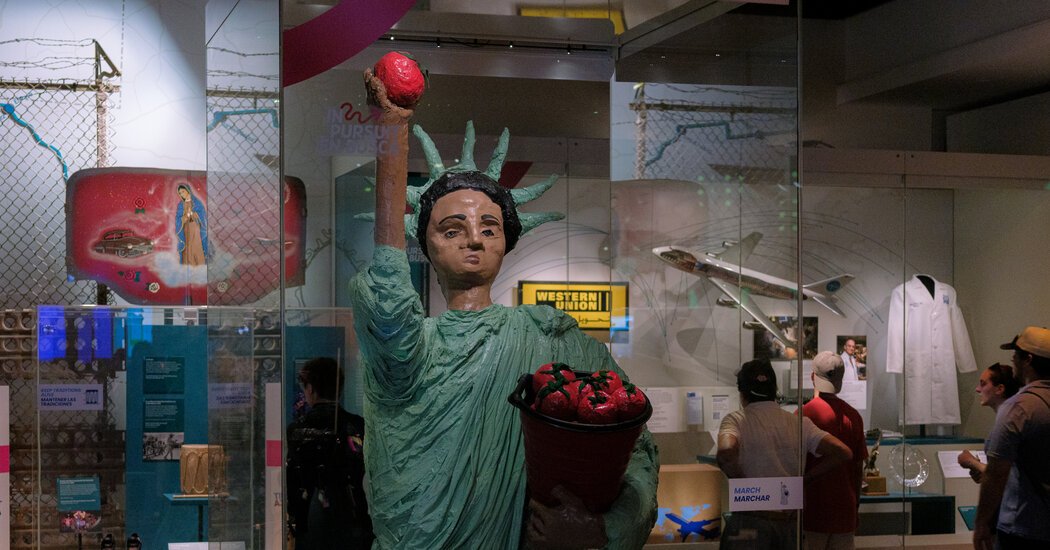
The report criticizes the museum’s depiction of immigration, particularly in an exhibit called “Many Voices, One Nation.” The exhibit explores the ideal of “E Pluribus Unum” and how waves of arrivals of different groups joined the Native Americans who were already here to create the American people.
The report accuses the exhibit, which incorporates artifacts relating to a wide variety of ethnic groups, of diverting proper focus away from Christopher Columbus, the pilgrims and the founders and toward “political activism and modern-day grievances.”
According to the report, the “ultimate goal” of the exhibit is “to convince visitors that illegal aliens are entitled to citizenship, voting rights and ‘belonging’ in America.” Evidence for that claim includes the fact that among the exhibit’s three renditions of the Statue of Liberty is a papier-mâché version, made for immigrant farmworkers, that shows her carrying a basket of tomatoes.
The White House report objects to the exhibit’s statement that “early leaders envisioned a country that promised opportunity and freedom — but only for some.” The report sees this as evidence of the museum’s broader “anti-white animus.” But exhibit’s claim is supported by historical evidence.
The Naturalization Act of 1790, signed by George Washington, said that only “free white persons” could become citizens. In the early years of the republic, many leaders, including Thomas Jefferson, suggested that people of African descent were a “separate nation” that could never live alongside whites and should be sent back to Africa after emancipation.