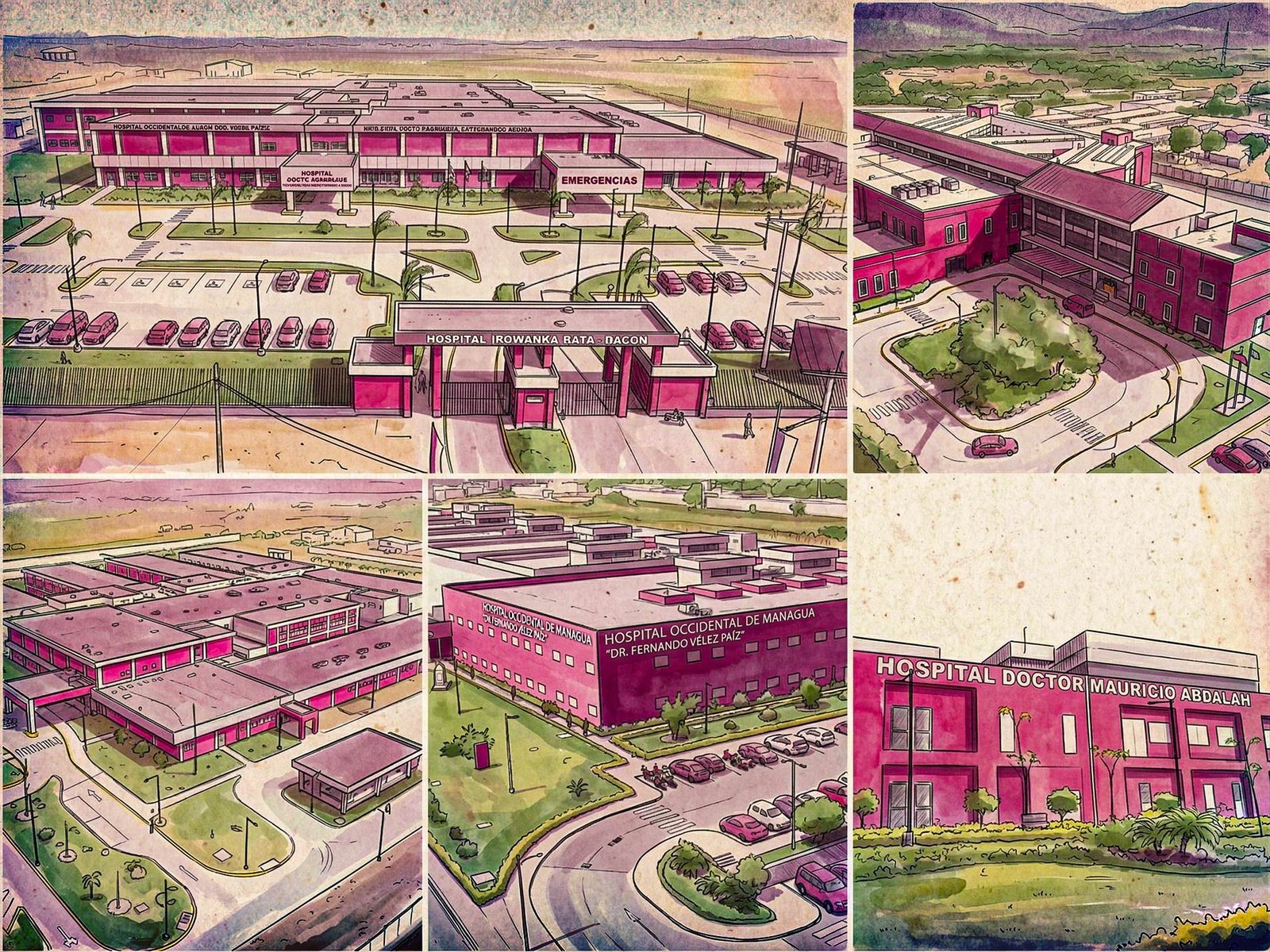
Nicaragua’s hospitals stopped being white buildings and became dyed “chicha pink” and black and red. Under the aesthetics imposed by Rosario Murillo, the hospital network functions as an extension of the Sandinista Front’s propaganda apparatus. However, behind the facades hides an opaque financial reality: the “megahospitals” of recent years had cost overruns of up to 74%, also marked by the break with international donors and the discretionary reorientation of external loans.
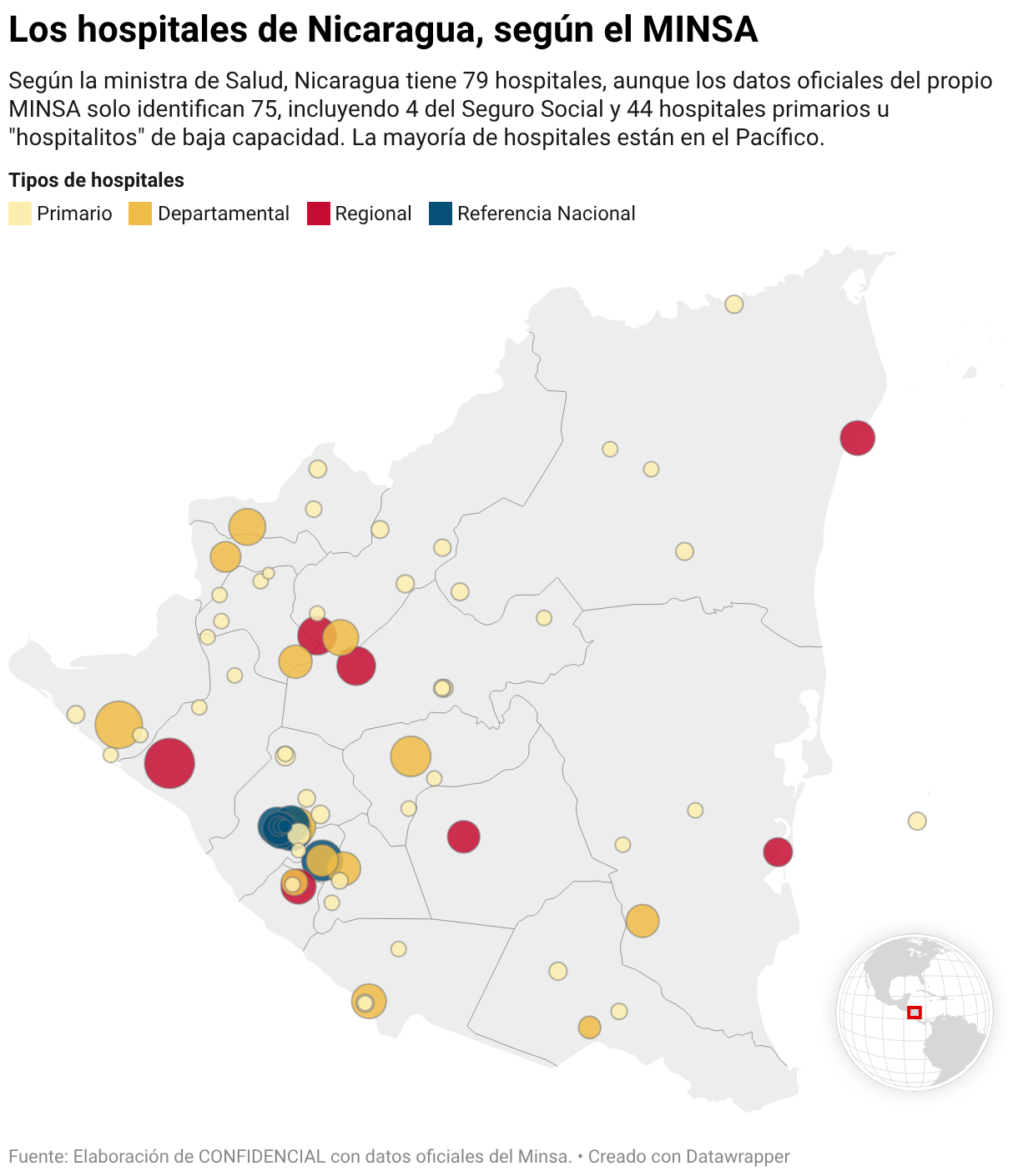
An investigation of CONFIDENTIALbased on data analysis and verification, reveals that it is false that Nicaragua has the largest hospital network in Central America. The regime inflated its figures from 33 to 79 units using “hospitals” and Social Security clinics, while real capacity remains stagnant: the country has barely one bed per thousand inhabitants and the lowest average number of doctors in the region.
“Megahospitals” cost 112.7 million dollars more
Of the 71 hospitals that actually make up the entire public hospital network in the country—including 42 “little hospitals”—at least 48 have had renovations or changes in infrastructure since the return to power of Daniel Ortegain 2007, as verified CONFIDENTIAL.
Dr. José Antonio Delgado, a Nicaraguan doctor in exile and a master’s degree in Public Health, explains that “what there is is a replacement of hospitals, because the population is larger, the centers that were there can no longer cope and other buildings had to be built.”
For this research, CONFIDENTIAL built its own database with all the hospitals in Nicaragua, the record of their foundation, their category, installed capacities, state of the infrastructure, remodeling and replaced or expansions registered during the last two decades.
Of those 48 renovations, it was confirmed that 42 correspond to minor constructions of primary hospitals or renovations in existing hospitals such as Lenín Fonseca, in Managua, or San Juan de Dios, in Estelí.
However, there are five completed constructions that stand out with a total investment of 494.6 million dollars. The problem is that this amount is 112.7 million more than originally budgeted. An extra cost of almost 30%.
These “megahospitals”—as the dictatorship calls them to oversize their capacity—were also built in more time than expected and even They were inaugurated when they were not yet completely ready for healthcare.
The Fernando Vélez Paiz Hospital, in Managua
The first work was the Fernando Vélez Paiz Hospital, in Managua. The investment served to replace the old building built in 1944. Seventy years later, in 2014, the old hospital was demolished due to irreparable damage to its infrastructure due to time and earthquakes in the capital.
The hospital was built by the SGHO consortium, made up of two Nicaraguan companies: Dudley Guerrero and Llansa Ingenieros, and the Spanish company Sacyr and the Portuguese company Somague.
Initially, the regime said that the new hospital would cost 76.5 million dollarsof which 40 million would be lent by the Central American Bank for Economic Integration (CABEI), 20 million were donated by the Infrastructure Development Fund (ORIO) of the Netherlands, and 13.1 million would be from a national counterpart.
However, when the hospital was inaugurated in January 2018, it was detailed that the state contribution was 30 million, meaning that the public allocation increased by almost 130%, raising the final cost to 90 million dollars.
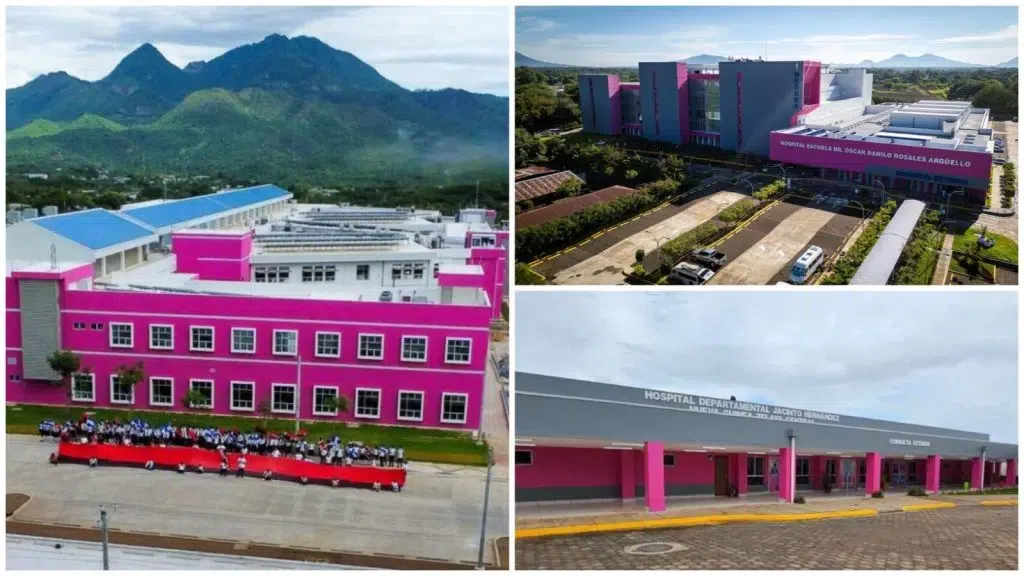
The Oscar Danilo Rosales Argüello School Hospital, León
The same happened with the Oscar Danilo Rosales Argüello School Hospital (HEODRA), in León. The original building was from 1960 and was already obsolete. So in 2014 the Inter-American Development Bank (IDB) approved a loan for 85 million dollars with which a new building would be built and equipped.
Later, the dictatorship claimed that the amount was not enough and added a state allocation of 5.5 million dollars, for a new cost of 90.5 million.
However, when the hospital was inaugurated in September 2025, Rosario Murillo revealed that the total cost was 105.8 million dollars.
Health sources also confirmed CONFIDENTIAL that the hospital was opened in a hurry by “orders from above,” even though it was not ready to provide hospital care.
The hospitals of Ocotal and Chinandega
The construction of the “Héroes de Las Segovias” Hospital was also to replace—and rename—a hospital that already existed, but had already given up its useful life: the Luis Alfonso Moncada Departmental Hospital, in Ocotal, Nueva Segovia.
The replacement project had an initial investment of 72 million dollars, but ended up costing 21 million more.
As with previous hospitals, the cost overrun was known until its inauguration, when Murillo gave the final amount.
In Chinandega, the Dr. Mauricio Abdalah Departmental Hospital was also a replacement for other previous infrastructure and had a final cost of 107 million dollars, with an extra cost of 9 million.
Official propaganda promotes this hospital as the largest in Central America, because it has 591 beds. However, Guatemala’s Roosevelt Hospital has twice the inpatient capacity and is larger.
The Bilwi Hospital: controversy and the biggest cost overrun
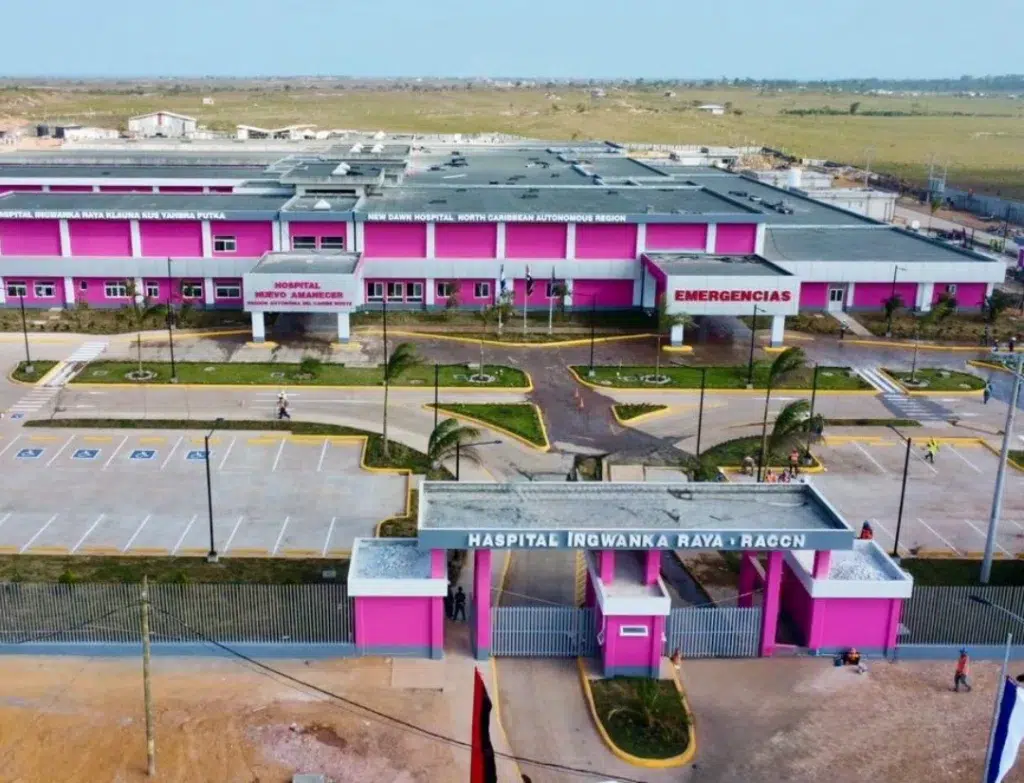
In Bilwi, the capital city of the Northern Caribbean Coast of Nicaragua, a “megahospital” that promised to bring public health to one of the most vulnerable areas of Nicaragua, ended up with a cost overrun of 45.1 million dollars and with the breaking of diplomatic relations with the Netherlands, one of the main cooperators of the Nicaraguan private sector.
The work, named Nuevo Amanecer Regional Hospital, was announced in 2015, with a cost of 60.9 million dollars. Of these, the State would contribute 7.8 million and the rest would be covered by a loan approved by the Central American Bank for Economic Integration (CABEI).
The hospital promised to provide care to more than half a million inhabitants, with 207 census beds and cutting-edge technology. Among this, a hyperbaric chamber, which is used to save artisanal divers who suffer from decompression syndrome after deep dives to fish for lobsters or the exotic sea cucumber.
The construction was inaugurated on February 21, 2026, eleven years after the approval of the loan of 52.9 million dollars to begin its construction, which was marked by the end of diplomatic relations with the Netherlands.
The diplomatic break with the Netherlands
In May 2017, the Netherlands joined as co-financier of the Bilwi hospital, after signing a donation agreement for 18.4 million euros, equivalent to 20 million dollars.
The signing of the cooperation agreement was described by the propaganda as “a historic day”.
“Building a hospital on the Caribbean Coast after years of marginalization is a great challenge for us and a smaller sample, but immense in values, for the entire population of the Northern Caribbean Coast that is really going to have a hospital,” said the then Minister of Health, Sonia Castro.
But in 2018, The Netherlands decided to freeze the disbursement of funds for a period of three years, due to state repression against the April Rebellion protests and “complaints about obstruction and serious delay in access to medical care for protesters in Nicaragua.”
In parallel with the diplomatic tensions, the work increased in cost. In 2019, when construction finally began, the dictatorship said the cost would be $82 million and not $60.9 million, as previously projected.
In 2022, the dictatorship did not get the Netherlands to “unfreeze” the disbursement and in retaliation broke diplomatic relations, accusing the European country of “interference, interventionist and neocolonialist.”
The break with the Netherlands and several million more
“That man (the ambassador) came here to tell us ‘there is no hospital’. Oh, and they believe that we are not going to do anything… Of course we made and continue to make the Hospital, with our fingernails, but there is the hospital,” said Murillo on October 4, 2022.
That same day, Murillo assured that the hospital was being built with funds from the General Budget of the Republic and with the CABEI loan. But its cost was no longer 82 million dollars, but 99.3 million. The president did not explain the extra cost, or how much of that amount would come from the state budget.
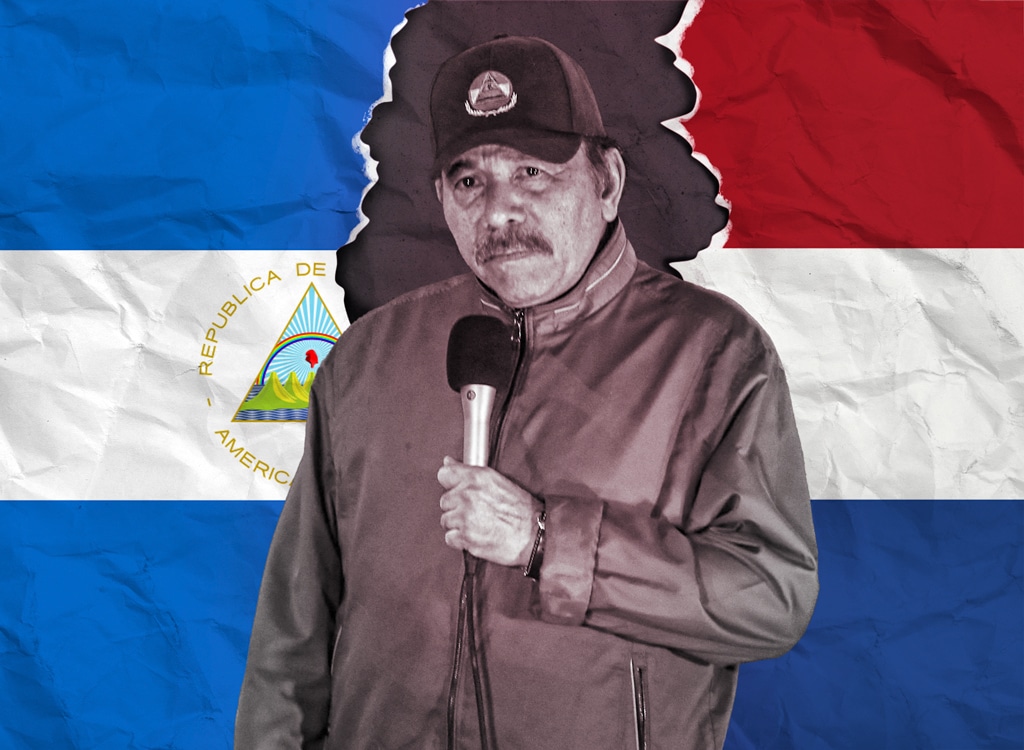
The fourth and final increase was revealed on February 21, 2026, when Daniel Ortega and Murillo inaugurated the Bilwi hospital, from Managua, through an event at the Olof Palme Convention Center, linking images of the Sandinista Youth from the hospital center.
At the event, Ortega limited himself to saying that this medical unit cost more than 100 million dollars. Later, before the propaganda media, Murillo detailed that the final amount was 106 million dollars.
“The people of Nicaragua are bigger than any of those human miseries,” Murillo disqualified. “And we were able, on our own, to continue building it, step by step. Therefore, it is a source of pride, it is a demonstration of the quality, capacity and strength of our people,” he celebrated.
Without explaining why the Bilwi hospital cost 74% more than the initial amount and how its financing was completed, Murillo thus sealed the opacity of the million-dollar cost overruns of the “megahospitals,” the same ones that he ordered to be painted chicha pink and decorated with the Sandinista Front party flag.
But the increase in concrete and painting works cannot compensate for the decline in critical indicators: Nicaragua still has not overcome the deficit of one bed per thousand inhabitants and maintains the lowest health personnel in Central America. Behind the official figures, effective access to health continues to be the great debt of a stagnant system.
This report is part of the special series of CONFIDENTIAL: “The hospital deception”an investigation that denies official propaganda about Nicaragua’s health network. The series analyzes the lies and human cost of a system that claims to have the largest hospital network in Central America, while hiding a critical deficit in beds and doctors.