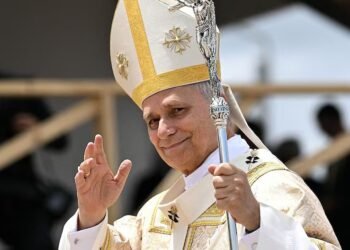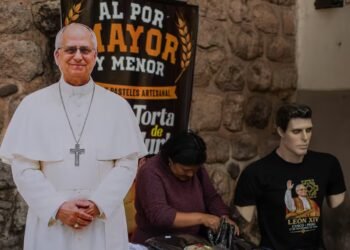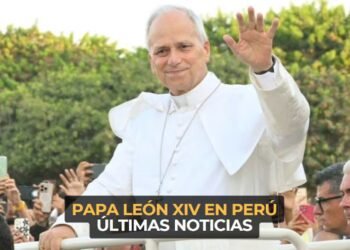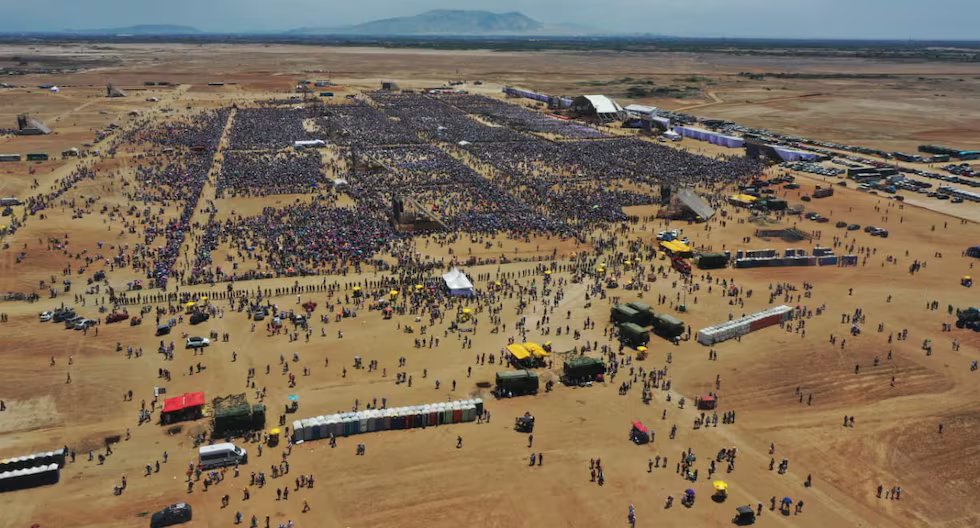
Before Leo XIV set foot on Chiclayan soil, the city was already paralyzed. One night before his arrival, the streets of the center and the main access roads to the Pampas of Pimentel, where the mass mass was celebrated, were packed with people who shared the same feeling for the pontiff. For the first time, Chiclayo would receive a Pope and, furthermore, one he considered his own: a nationalized Peruvian, resident of the northern city. His return to a land that for years was also his home raised the hope that his visit would bring a message of peace to the northern people.
Thousands of pilgrims advanced with their tents in their hands and their shoes full of sand. In the midst of the darkness of the pampas, the lights continued to illuminate the entrances to the premises. The weight of their belongings or the humidity of that space near the sea did not matter. They just wanted to find a place to settle down and try to sleep, if excitement allowed.

Several kilometers away, the music and tumult that had accompanied the activities in front of the Chiclayo Cathedral for days disappeared little by little. The faithful returned to their homes to regain strength. Police and military personnel remained in the streets, while, from time to time, the sirens of official vehicles interrupted the music alluding to the Pope that was still heard in some sections of the center. I would dare say that the city did not sleep.

Photo: Alonso Chero/El Comercio
Very early, around 6:30 on Friday morning, long lines began to form outside the Chiclayo airport and the air base. Everyone was expectant before the arrival of who until a few years ago was their bishop, Robert Prevost. Father Prevost, the one with whom many preserve memories, photographs and teachings.
The heat above their heads didn’t matter. Nor that visibility was reduced. Everyone wanted to have, even for a few seconds, the chance to greet him. In Pimentel, the pilgrims accelerated their pace before the closure of the accesses scheduled for 8:00 am. In Chiclayo, others were looking for a privileged place from which to observe the pontiff’s departure from the air base.
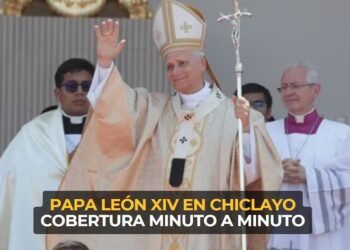
At 9:10 am, the wait was over. A LATAM flight began its landing and excitement took over the attendees. Just 13 minutes later, Leo XIV left aboard a black Chevrolet truck, from which he greeted the Chiclayanos, the same people he accompanied for years as bishop.

Among those awaiting the departure of Leo XIV were the brothers Mayra and Kevin Ramírez. In 2017, when Robert Prevost was still bishop of Chiclayo, both received baptism, first communion and confirmation at his hands. The ceremony was initially planned in another church, but a last-minute change took them to the cathedral, where they ended up meeting the then bishop.

Ramirez Brothers. Photo: Abby Ardiles/El Comercio
“We have not had the experience of being baptized as babies, but with the full knowledge that we accepted God in our hearts,” Mayra recalled. Nine years later, the brothers again found themselves among the faithful who were waiting to see him, this time becoming pontiff. “We are very happy, very happy to have received that great blessing, that he is now a Pope,” he added.
Memories of that stage accompanied the wait of many Chiclayanos. Some kept photographs and experiences shared with Prevost; others had arrived with religious objects that they hoped to bring, at least symbolically, closer to the pontiff. Liliana Tuxe Torres, a resident of the La Victoria district, held a rosary in her hands. He wanted Leo XIV to bless him during his journey, even from a distance.
“I have a rosary that I hope, God allows, I can have that luck that I can bless it from afar. Here it is. I have it, I have brought it and God allows that he can bless it from afar,” he commented. He also wanted to pray for his health and that of his children, grandchildren and father.
Before saying goodbye, Liliana left a message for the visitor. “Welcome to your house, Papa León, with all this heart and in all the hearts of the Chiclayanos, who unites coast, mountains and jungle and unites the whole world. Thank you, thank you, Robert Prevost.”
The familiarity with which attendees referred to the Pope also appeared in conversations about his years at the head of the diocese. Derly Silvia Montoya Soto, a teacher from Chiclayo who had been waiting since 7:00 am, remembered the masses that Prevost celebrated in the cathedral and a ceremony that he presided over at the Señor de Sipán University.
“Always with a clear, simple message and inviting us to also be missionaries of the word of God,” he noted. The teacher had also followed the pontiff’s meeting with the young people in Lima the previous day. “As a teacher I think that there is still hope in a youth that will forge a new just, free and peaceful society,” she said.
The masses in the cathedral were, precisely, one of the most present memories among those who knew the former bishop. A parishioner who used to attend the 10 a.m. celebrations recalled that Prevost entered the temple along with the other attendees, without major differences.

“When I arrived at the cathedral to hear my mass, which I am a 10-year-old, he entered like any Catholic citizen. He entered and we there next to him, we entered with him and he accompanied us and blessed us. That is something that we are not going to forget,” he said.
That Friday, the woman also expected to see him pass through the streets of Chiclayo. His message, however, was not a farewell. “Holy Father, thank you for being with us. We will never forget you. Always keep in mind. Come live in Chiclayo, because we love you here,” he expressed. Around them the cries of “Papa León” could be heard.
Ireime Alvarado knew Robert Prevost long before he became Leo XIV. As a catechist and member of the youth ministry, she coincided with him during the confirmations that he presided over in the Chiclayo Cathedral. Last year he participated in one of his masses as part of the liturgy team, without imagining that months later that religious man would be elected Pope.
“I had that joy, that honor of being there without knowing that months later I was going to be elected Pope. It is an immense, great emotion that someone like him has been elected,” he recalled.
During his time in the diocese, Ireime highlighted the relationship he maintained with the community. “Despite the position he may have, he still has (…) that great human side that he has, which is very empathetic, he is very good, he has that closeness with people that characterizes him a lot,” he said.
The eve of a mass expected by thousands
While in Chiclayo the faithful remembered the bishop they had known for years, in the Pampas de Pimentel the wait had begun the previous afternoon. There, among tents, sandy paths and pilgrims arriving from different cities, thousands of people were preparing to participate in the mass.
Viviana had arrived from Colombia after a tour that began in Bogotá and continued through Medellín and Lima, before taking a last flight to Chiclayo. The transfers and the hours of waiting were part of a trip that he had decided to undertake to participate in the meeting with Leo XIV.
The pilgrim had followed the pontiff’s celebrations from the Vatican through broadcasts and especially remembered the moment when he mentioned Chiclayo during his first appearance as Pope. His visit to Peru was also related to a difficult personal experience that he had gone through a year ago and for which he now wanted to thank God.
“A message of reconciliation, a message of unity, of peace, of equality to these Latin American peoples who need it so much,” he expressed when referring to what he hoped to hear from the pontiff.

Entry to Pampas de Pimentel was free and had the supervision of authorities pending the ceremony of the return of Pope Leo XIV to Chiclayo being a success. (Julio Reaño / @photo.gec)
Not everyone had traveled so many kilometers. From Piura, Olinda Sánchez arrived with a delegation of 50 people from the Virgen de la Encarnación chapel, located in the Ignacio Merino urbanization and belonging to the San Pedro and San Pablo parish. They left at 9:30 in the morning on Thursday and reached the Pampas de Pimentel around 4 in the afternoon.
The group planned to remain at the venue all night, waiting for mass on Friday. “We have come to listen and strengthen our faith, to listen to our Holy Father Leo XIV, because he is a Pope, our Peruvian Pope,” commented Olinda.
As the hours progressed, the pilgrims continued to arrive with backpacks, tents and warm clothing. Some were looking for a space to settle; others still walked through the illuminated entrances in the middle of the darkness. The proximity of the sea was felt in the humidity of the environment. There were several hours until the celebration, but many had already decided that they would spend the night there.
The meeting in the Pampas de Pimentel
On Friday morning, the pilgrims resumed their journeys to the site. The entrances closed at 8:00 am and the mass was scheduled for 10:30 am. Those who had arrived since the previous afternoon shared the space with the faithful who continued to approach during the first hours of the day.

Pope Leo XIV moved through the crowds in the popemobile, greeting faithful as he passed. (Photo: Alonso Chero / @photo.gec)
The celebration brought together those who had known Robert Prevost personally during his years in Chiclayo and pilgrims who had traveled from other regions and countries to see him as Leo XIV. In the Pampas de Pimentel, a wait that, for many, had begun long before Thursday night ended.