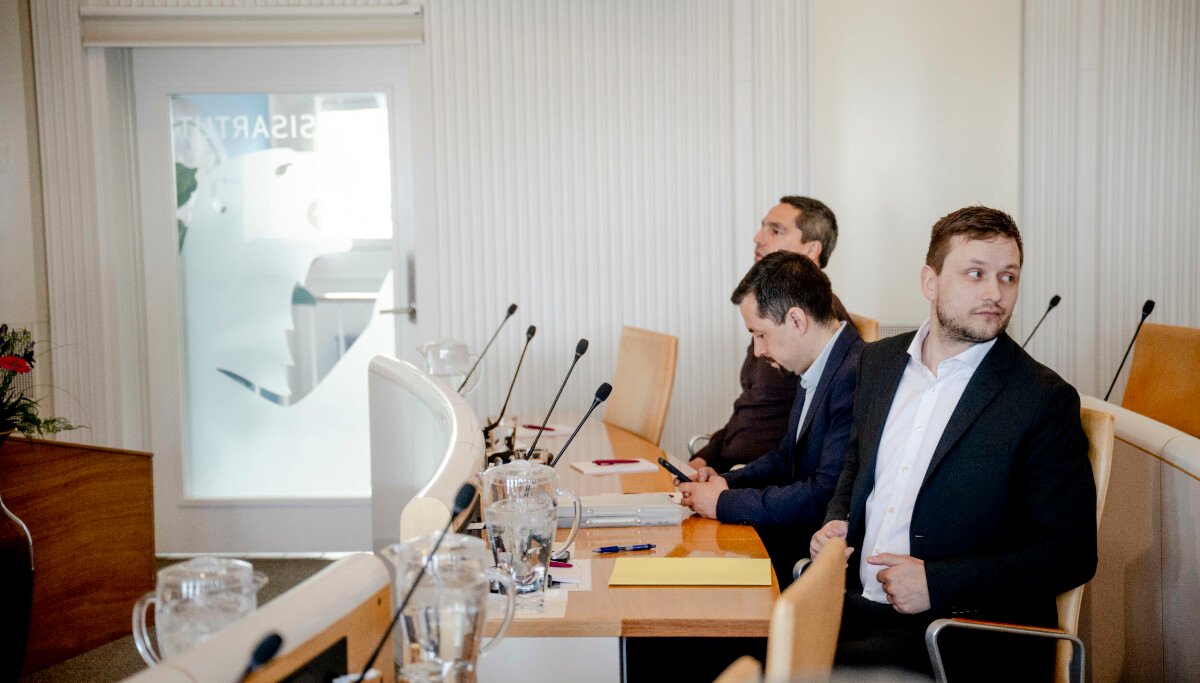
Tuesday 13 October voted 18 members of Inatsisartut – including the chairman of Naalakkersuisut, Jens-Frederik Nielsen (D) – to change the time zone back to UTC-3 and abolish daylight saving time.
With this, everything suggests that changes will be adopted when Inatsisartut has to debate the subject for the last time on Wednesday this week.
In an article earlier, Sermitsiaq was able to explain the many consultation responses that have come to this change in the law, and how the vast majority are negative.
During the latest debate, Jens-Frederik Nielsen also presented a wide range of negative consequences for the economy and patient waiting lists if the time zone is changed.
That is why we have conducted an interview with Jens-Frederik Nielsen about why he apparently supports the proposal.
– This is a bill from parties in Inatsisartut. These are not legislative proposals put forward by Naalakkersuisut. So it is the parties’ arguments that are important here.
– From Naalakkersuisut’s side, we made it clear during both the first and second readings that there are some consequences to changing the time zone now. There are both occupational and financial consequences. But we have of course also recognized in the process the parties that have put forward the legislative proposals, and that the debate in Inatsisartut is the one that will be decisive, he says.
– That’s just the way it is
Jens-Frederik Nielsen maintains that Naalakkersuisut’s job is to support the decision that is made in Inatsisartut, and that as such they have no influence on how the coalition parties vote. He says that Naalakkersuisut can only appear with the negative consequences that can be.
– And we did that too, but the parties in Inatsisartut have argued that summer time must be abolished immediately on 1 January and that we move smoothly to UTC-3 again. And as far as I can see, there is a massive majority for it down in parliament, and that’s just the way it is.
During the debate on 13 October, the chairman of Naalakkersuisut says that it is a pity that the consultation responses to the legislative proposals did not have more weight in the decision.
– But the argument from the parties, which of course you have to have some understanding of, is that there are also a whole, whole lot of citizens who have submitted consultation responses, he says to Sermitsiaq.
There are 46 citizens who have sent consultation responses, and then there are over 4000 who have signed a petition, which was mentioned several times during the debate in Inatsisartut on Tuesday.
4,000 make up around 10 percent of those entitled to vote in Greenland. Do you think that policy should be made that takes into account the wishes of 10 percent of those entitled to vote?
– I think it is set up a bit simplistically. I acknowledge that in a very short time there were 4000 people who signed. But I have also been open about and said that there is also a contradiction. There are people in this country who are actually happy about the new time zone.
Is it a good idea?
When Jens-Frederik Nielsen from the lectern in Inatsisartut only talks about the negative consequences of a time zone change, one can doubt whether he thinks it is a good idea. But it’s not something to be completely smart about.
Do you think it’s a good idea for us to go back to UTC-3 and do away with DST?
– In Naalakkersuisut, we think that the parliament’s decision must of course be respected. Naalakkersuisut, it is not me; we are talking about an entire government.
– We have government rule in this country. We think that the debate has run its course, and we think that we have presented the possible consequences that could be. When the parliament has adopted what they have, it is our duty to implement it, and of course that also includes the adaptations that now also have to be financial after this.
But as chairman you have a vote in Inatsisartut, and you voted for it on Tuesday. So am I to take it that you are in favor of the changes?
– No, I think you should take it as if it has now been dealt with in parliament. And Naalakkersuisut of course respects what the parliament has adopted, and then we have to do our duty, which is to implement it as the executive power, and we intend to do that.
– Of course, we also intend to have a close dialogue with the parties in that process about how and how we handle the consequences that may now arise from the fact that we have adopted what we have done.
Where will the money come from?
It will cost the national treasury at least DKK 19 million per year to change the time zone. Added to this are the financial consequences for the economy, which both Jens-Frederik Nielsen and the business community have warned about.
Where will that money come from?
– Well, it’s clear, after this decision has been taken, I of course strongly expect that all the parties that have now voted this change through again, we will find that funding together.
– In addition to the 19 million estimated as a direct financial law effect, well, the business world has also shouted that it will have negative consequences for their earnings. It will also cost the bottom line, says the chairman of Naalakkersuisut.
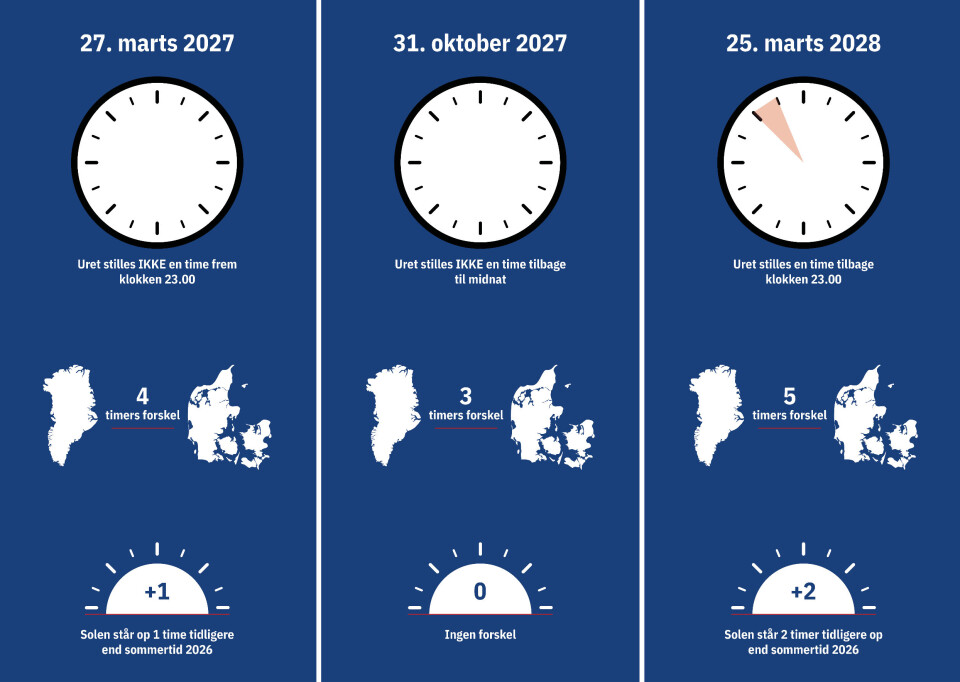
If Inatsisartut finally adopts the changes to the determination of time on Wednesday, it will mean that summer time will be abolished from next year and that in 2028 we will go back to UTC-3.