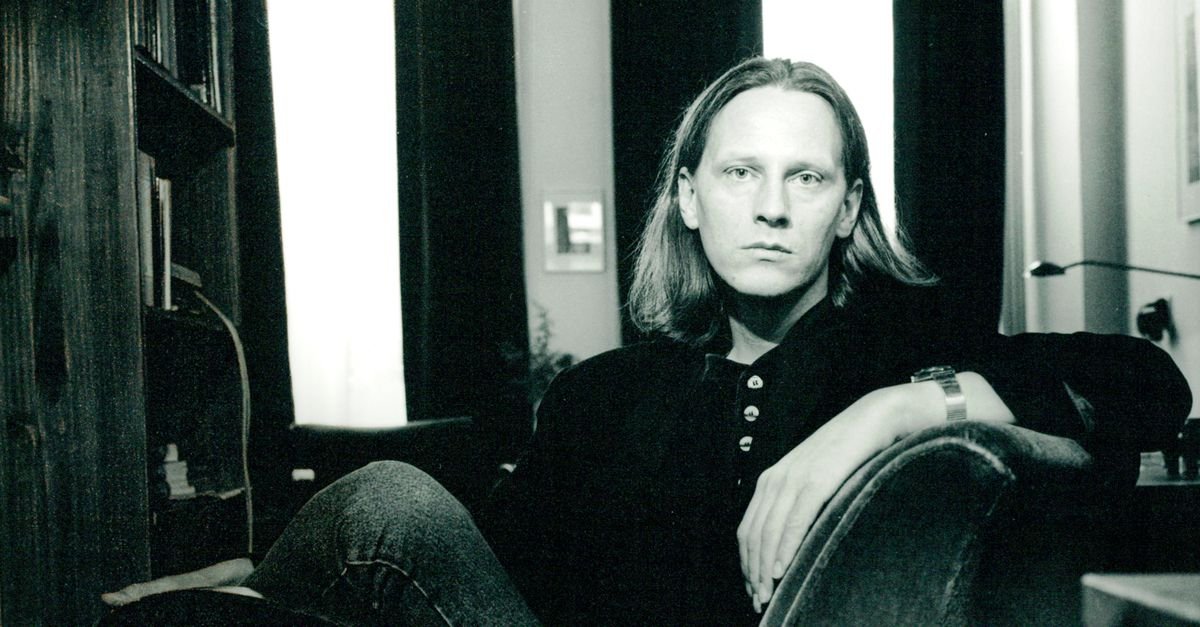
What it was, wasn’t completely clear yet, but that what was was beyond dispute. Not that the reviews were entirely positive when it was released The eternal hunting grounds (1995), the debut of Groningen writer Nanne Tepper (1962-2012). But the ingeniously designed love story between a brother and a sister was recognized as evidence of “a considerable talent as a storyteller and as a stylist” (de Volkskrant) and as a book from which the reviewers could effortlessly pick out the references and influences: Salinger, Reve, Chateubriand, Poe, Mahler and – of course, of course – Nabokov; the author’s great hero.
“This novel mercilessly misleads the unsuspecting reader,” writes Tepper’s biographer Lodewijk Verduin (1994, only a year older than the novel) in the chapter he devotes to the spectacle debut. Unintentionally, that sentence also reflects the tragedy of Tepper’s writing, because anyone who thought that a new great chapter in Dutch literary history had begun here was disappointed.
The bibliophile published novella followed in 1998 The adventures of Hilliebillie Veen and the second novel The fathers of thoughtbut Tepper did not write another novel after that: his story became the story of the writer who could no longer write. In 2012, exhausted, he took his own life. Published three years later Art is my battlefieldan impressive collection of letters, almost all of which were written in the few years that the novelist Tepper flourished.
Those – let’s say – five years in which Tepper did succeed are about halfway through the four hundred pages of the biography. So rich and crushingwhich makes you gradually realize that the main question is not where this writing came to a standstill, but what the secret was of that short period in which it did flow.
Relocation
The run-up was far from smooth. Nanne Tepper was born in Hoogezand in an unremarkable family that was expanded with a brother who was one and a half years younger. A youth with football, books and music, but also with a trauma that Tepper later generously published in his texts: the move, around the age of ten, from the safety of Hoogezand to a desolate new-build neighborhood in Veendam, which Tepper quite consistently referred to as Gomorra. “Ah, that longing. Was it true that my banal exile had given me a heart that was as melancholy as it was resentful?” His parents did not notice the suffering of their sensitive child.
Verduin gives ample scope to Tepper’s account of ‘the drama of his life’, but does not fail to mention that “for the outsider passing through” the essential difference between Hoogezand and Veendam is, well, not easy to determine. It illustrates the working method of the biographer, who makes no secret of his admiration for Tepper’s work, but without relinquishing control of his story: Tepper’s personality, as exciting as it is impossible, clearly emerges.
Verduin tells the story almost chronologically and generously gives his hero the floor: the book is full of long quotes from Tepper’s work, letters and legacy. These are insightful, but because Tepper is almost always in overdrive, the fragments sometimes become a bit monotonous and, well, also a bit adolescent. In that respect, the biographer should have spoken more emphatically.
Back to Veendam/Gomorrah. There it becomes clear at the Winkler Prins school community that Nanne is a boy for the arts, where his musical talent (nothing was comparable to his discovery of Frank Zappa) finds it difficult to express itself due to a certain stage discomfort. There is love: at the age of fourteen he loses his heart to thirteen-year-old Annette, although ultimately her friend Sonja will be his life partner for half his life. He describes himself as a schoolyard hunk and although his grades are not going so well, he seems like the kind of boy who, with or without a stumble along the way, will know his way in the world.
But it stops. At teacher training (but that is logical – Tepper was also a Cruijff adept), but the vocation of writing also does not get off the ground. Tepper moves to Groningen, is plagued by fears and insecurities, smokes pot and drinks to calm things down – and so that big leap forward is delayed. He compiled a four-hundred-page autobiographical novel, but had it buried in Colorado by a friend, which, as far as Verduin could determine, he actually did – although to the biographer’s luck that was not the only copy.
It was only when Tepper broke away from the substances that he found himself – as if in a new stupor, indeed – able to write a novel in a few months. Another element was the peace he acquired after his parents bought him a house, whereupon he immediately moved to Ardis Hall (after the country house in Nabokov’s Ada) in his letterhead. In the same period he managed to have several short texts appear in print for the first time. It already shows So rich and crushing that the enthusiasm of publisher Mizzi van der Pluijm for The eternal hunting grounds was indeed large, but that a major editing round by writer Atte Jongstra was necessary to shape the first version into a publishable novel: “long-winded passages, word repetitions and copious Nabokov references had to be deleted.”
‘Hamsterdam’
In the meantime, Tepper had entered into correspondence with a whole series of literary figures and that also seemed to happen in a daze: one letter after another left ‘Ardis Hall’, epistles full Schwungexaggeration and sharp literary judgments – plus numerous invectives at what Tepper took to be the closed bastion of the literary order: the abject ‘Luiletterland’ in ‘Hamsterdam’.
When The eternal hunting grounds once it was published, the gates in the literary world appeared to swing open. Tepper started writing (often razor-sharp) reviews, first about literature, then hundreds about pop music – including for NRC Handelsblad. There were immediately an awful lot of them: he was in danger of overworking himself journalistically and barely got around to writing novels. His psychological complaints were combated with numerous medications, which did not do the writer’s brain any good.
When alcohol and drugs returned to Tepper’s life, the decline became inevitable, despite some near revivals. At a certain point, Tepper is picked up by an Amsterdam reader; he even moves to the capital to live unhappily with her and her son for a few months.
In that part of the otherwise very successful biography, some questions remain open. Verduin extensively quotes the reasons that Tepper himself gave for his literary unproductiveness – such as lack of money and informal care obligations. But with the writer who loves to exaggerate, you actually want to know more about how exactly that worked – if only because Tepper’s landlord, for example, was his father. Somewhere Verduin writes that he was better at worrying than at worrying, but I would have liked to hear more about that. You also get the impression that Tepper’s partner Sonja told a lot, but also wanted to keep quite a bit out of the book (such as her surname).
Verduin describes Tepper’s death at the very beginning of the book because he did not want that scene to determine the reader’s final image, but the ending is sad enough. In recent years, Nanne Tepper had become increasingly lonely (unfortunately his talent for chasing away friends never left him), more addicted and more emaciated. Sometimes he tried something (such as starting a record label) or he started a fight on a forum for hard rock enthusiasts, but in the end Nanne Tepper inevitably slid to the end. Only The eternal hunting grounds were forever.