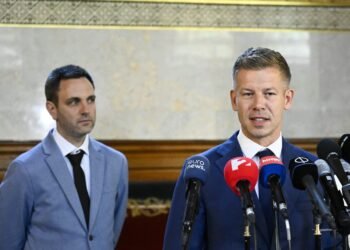
“The management of the National Tax and Customs Administration did not deny our information that the execution of several billion HUF transfers related to Antal Rogán’s circle was suspended on the grounds of suspicion of money laundering. Since then, we have also become aware that the accounts of several Stromans close to NER have also been frozen,” Péter Magyar said on Monday. In a video uploaded to Facebook.
Magyar also spoke about the fact that the NAV can only suspend the funds for 4+3 days, and can freeze the funds involved in the transfer only in case of police proceedings. He therefore called on the president of the NAV to file a police report on the transfers reported by the banks so that the investigative authorities can investigate the origin of the billions involved, and he also asked the banks to strengthen their compliance departments and confirm all suspicious transactions to the NAV.
We have also sent questions to several banks operating in Hungary regarding Hungarian claims. We wanted to find out whether they make the announcements in relation to the affected transactions and whether, in the current situation, more attention is paid to the identification of suspicious financial movements in the compliance departments.
In its response, Unicredit Bank wrote that, in accordance with their legal obligations and supervisory expectations, they will take the necessary measures in all cases where suspicion of money laundering arises in connection with a transaction. “We constantly monitor transactions, carry out internal investigations related to money laundering, report or report suspicions of money laundering to the competent authority (NAV), and we always cooperate with the authorities and supervisory bodies,” writes Unicredit. “During the screening of transactions, we take into account the aspects specified in the recommendations of both the MNB and the EBA, so in the case of riskier customers, we apply enhanced customer due diligence from the outset, and we also apply these principles during transaction monitoring.”
The OTP said that they “cannot answer the questions without violating bank secrecy”. In general, however, they said that maximum compliance with current legal requirements, including anti-money laundering rules and regulations, was and is being treated as a top priority by OTP Bank. For this reason, as well as in order to monitor transactions, a separate anti-money laundering department operates within the bank.
MBH Bank pays special attention to the prevention of money laundering in accordance with current Hungarian and European Union legislation, writes MBH. If they detect data or circumstances that suggest an act punishable under the Act on the Prevention and Suppression of Money Laundering and the Financing of Terrorism, a report is made to NAV. In order to comply with the rules, “the most frequent cases of money laundering in practice are monitored, such as suspicious ATM use, large cash withdrawals from ATMs, transfers to and from countries on the watch list, unusual transactions (amount, frequency, currency, country of transfer), further transfer of significant amounts of credits received on the account, characteristics typical of transit accounts”.
“During its operation, Gránit Bank treats compliance with legal regulations, such as anti-money laundering laws and other regulations, as a top priority,” the bank wrote to Telex after the publication of our article. Gránit takes into account the current Hungarian and EU legislation, as well as the guidelines issued by the Magyar Nemzeti Bank and the EBA, when deciding on the establishment of suspicion of money laundering, the notification to the financial information unit and the suspension of the execution of the transaction, as well as their other related obligations. “In accordance with its legal obligations and supervisory expectations, the bank carries out continuous transaction monitoring, conducts internal investigations, reports to the competent authority in case of suspicion of money laundering, and also continuously cooperates with the authorities and supervisory bodies.”
Update: we added Gránit Bank’s answer to our article.