-
By Sun Wei-jung, Kan Meng-lin and Jonathan Chin / Staff reporters, with staff writer
The Taipei City Government yesterday defended policies around designated smoking areas in Ximending (西門町), after the limited access to the newly unveiled booths sparked an outcry among smokers.
The Ximending shopping district is to go completely smoke-free on June 1, becoming the city’s first permanent smoke-free district.
According to the Taipei City Department of Health, the smoking ban covers the area bounded by Zhonghua Road Sec 1 to the east, Xining S Road to the west, Chengdu Road to the south and Hankou Street Sec 2 to the north, including the sidewalks. Violators could be fined between NT$2,000 and NT$10,000 under the Tobacco Hazards Prevention Act (菸害防制法), it said.
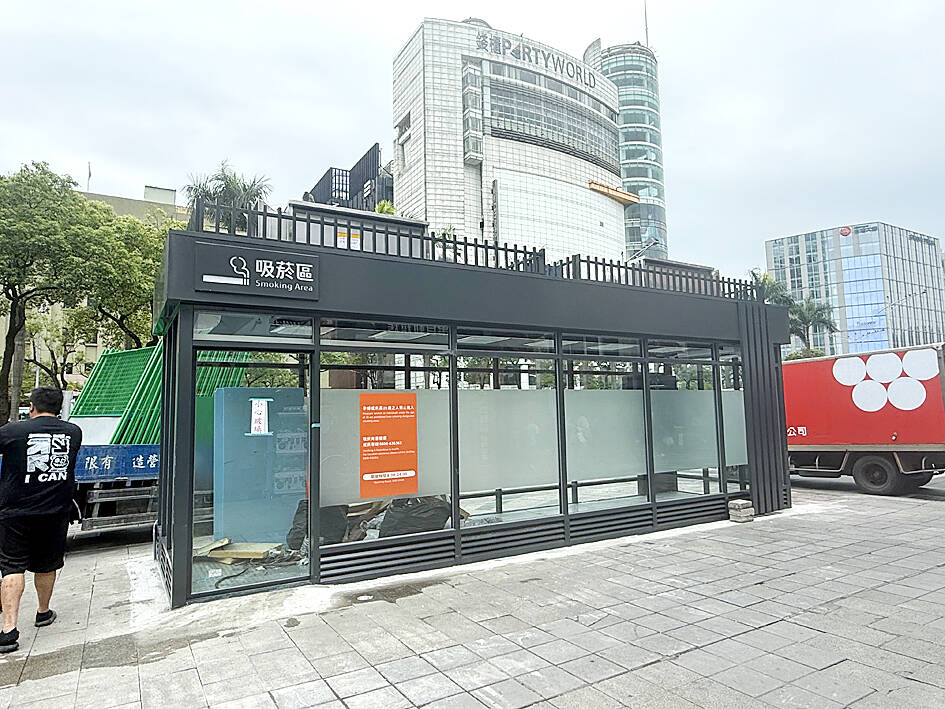
Photo: Sun Wei-jung, Taipei Times
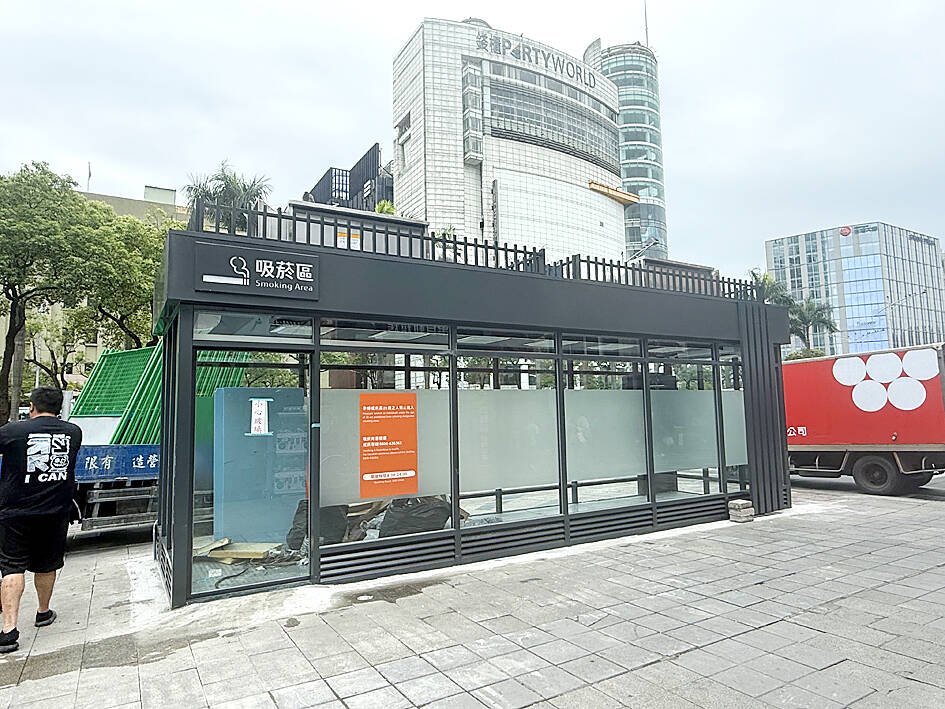
The area has three outdoor negative-pressure smoking booths, scheduled to open on an unspecified day this month. They are located at Exit 4 of Ximen Station, the intersection of Zhonghua Road and Emei Street and at the intersection of Wuchang Street and Hanzhong Street. They should open from 8am to midnight.
The smoking areas have already drawn complaints from smokers, who say their scarcity, location and limited operating hours could make their use impractical.
Taipei Research, Development and Evaluation Committee head Yin Wei (殷瑋) said that limits must be placed on the smoking area’s operating hours for maintenance and public safety.
Japanese cities that enforce outdoor smoking bans and established dedicated smoking zones impose similar restrictions on the availability of smoking zones, he said, adding that such policies are commonplace internationally.
The municipality selected smoking areas within a three-to-five-minute walk from MRT stations, he said.
Concerns about booth size do not appear reasonable, as each booth could accommodate more than 10 people, he added.
A Ximending eatery owner surnamed Yang (楊) said he agrees non-smokers should be protected from tobacco fumes, but the city’s smoking booth locations leave much to be desired from the perspective of local residents.
“Commuting to and from [the designated smoking area] would use up my entire break time, and that is not counting waiting in line if the place is full,” he said.
The limits placed on the opening hours — supposedly designed to keep homeless people out — is unrealistic, as people do not stop smoking at night, he said.
Wang Yu-yang (王郁揚), a representative of the Taiwan Smoke-Free Association, said: “If smoking areas have limited hours, does that mean that once they close — like Cinderella’s pumpkin carriage disappearing — people would simply return to smoking outside?”
In response to media queries yesterday, Taipei Mayor Chiang Wan-an (蔣萬安) said the smoke-free city project is intended to protect non-smokers from second-hand smoke while giving users a legal option to smoke.
The city selected the busy shopping areas of Zhongshan (中山) and Ximending to run the trial for designated smoking areas as a proof-of-concept, and Xinyi Road and Dunhua Road would be next for the ban, he said.
The end goal is a city-wide smoking ban supported by designated smoking areas throughout Taipei, he said.