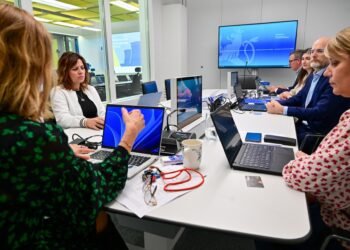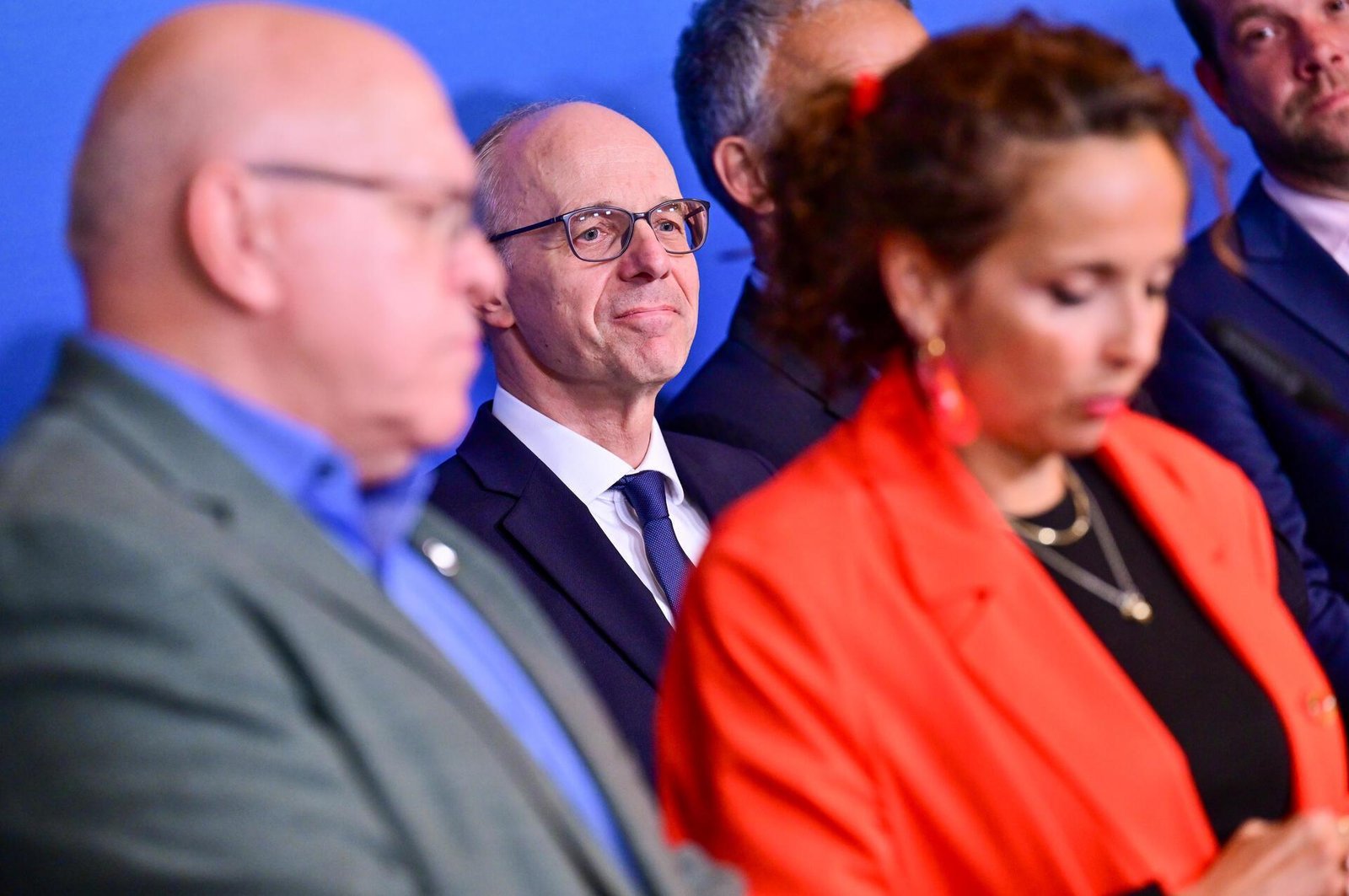
At the end of the day it’s about “wéivill d’Leit um Minimum Loun net hunn,” said CSV Prime Minister Luc Frieden after the tripartite on Thursday evening in Senningen Castle. He was visibly proud to have found a fundamental agreement with the quarreling social partners – one of the rare triumphs of his two and a half years in office. Unlike the DP-LSAP-Greens government in the Tripartites three or four years ago, the “captain” enjoyed the moment in the spotlight alone – without Deputy Prime Minister Xavier Bettel and Economics Minister Lex Delles from the DP, without Finance Minister Gilles Roth and Labor Minister Marc Spautz from his own party. In Luc Frieden’s social media posts about the Tripartite, only Luc Frieden can be seen from the government.
“All minimum loan recipients are entitled to this Styrian loan, in two stages, until July 1, 2027, without the index, structurally 200 euros net,” the Prime Minister continued. The minimum wage was between the social partners the has been a controversial topic in recent months. This week in Senningen Castle, this was the main focus of negotiations; agreement was quickly reached on all other topics. The “Energy Tripartite” was actually a minimum wage tripartite.
Because OGBL and LCGB demanded a structural increase of 300 euros, while the UEL didn’t want any, the government decided in April to only make the legally stipulated adjustment to real wage development of 3.8 percent (105.3 euros), pay companies around a third (1.3%) of it and sell it together with the index tranche (67.6 euros) that was due this month as a “substantial” increase in the minimum wage. The unions criticized this approach and therefore prematurely broke off a meeting with the labor minister at the end of March.
On Thursday, Luc Frieden repeated this coup. The “structural increase in the minimum wage by 200 euros” he announced is only half structural. It includes the adjustment to real wage developments of 105 euros that was announced in April. The remaining 95 euros are financed net via a tax credit from the state treasury. The tax credit is not a structural increase because it does not contribute to improving pension rights, as “déi Lénk” criticized in a statement on Friday. Unlike in March, the unions remained seated this week. After long negotiations, they accepted the government’s last offer (the first was 27 euros), and 95 euros more is acceptable to them.
“Et sense of the vill, the behaapt hunn, the unions, the unions, the vehemence, the aggressiveness, the opinion, ass and silence, the unions are chattering, they are always looking for an agreement,” said LCGB President Patrick Dury on Thursday. With the signing of the agreement in principle, the trade union union has freed itself from the defensive into which the UEL and the government had put it in the last two years when they wanted to challenge its representativeness. Now they have returned from the streets to the institutional path. If their demands for new Tripartite bodies such as the one on housing, the “Cellule Nationale de reclassement”, the “Comité de suivi” for the implementation of the Tripartite measures are actually implemented according to the principle of “codécision”, which the Prime Minister promised on Thursday, they would further expand their influence in the neo-corporatist state. The UEL too.
The LSAP has a problem with this, as its co-party president Georges Engel told radio 100.7 this week: “Mär hunn e Parliament (…) an do nierwendru never have to go to a second parliament.” The trade union union has become a political threat to the LSAP. In a statement on Friday, she called for a special parliamentary committee to oversee the implementation of the Tripartite measures. “I have given up my job as the largest opposition party and, quite well, will see that the measurements will still come into play with the leaders,” writes the LSAP.