Editorial
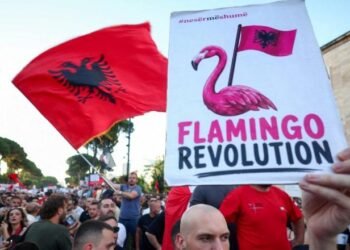
Since May 31, under the name of the “Flamingo Revolution”, a group of protesters continues to challenge the government through protests in the streets of Tirana. About 170 days have passed, almost six months, and during all this time we have seen people wandering the streets, with demands and objectives that, despite the duration of the action, have not yet taken the form of a clear political platform.
Among the main demands of the protesters are the cancellation of legal acts related to investments in protected areas, the ban on development plans in Zvrnec and the island of Sazan, projects related to the family of American President Donald Trump, as well as the resignation of Prime Minister Edi Rama.
Paradoxically, despite the demand for the removal of the prime minister, the protesters do not demand early elections. In a democratic system, a government that came to power through legitimate elections and supported by a parliamentary majority of 83 mandates, as happened with the Socialist Party on May 11, 2025, is challenged politically through a vote. But “Road Movement” seems to pre-empt any scenario of this nature.
Her message is clear, it demands the removal of Rama and the creation of a caretaker government with a one-year mandate. Only after the end of this mandate would the possibility of extraordinary elections be discussed. But what does this movement really stand for, and who takes responsibility for taking it beyond street protest?
In these almost six months, no leader with persuasive skills, political articulation and the necessary credibility to represent the protesters has stood out. No figure has appeared on the scene who is able to clearly explain what this movement is looking for, how it intends to achieve its objectives and what it offers as a governing alternative.
It lacks a governing board, lacks a real political team and, above all, lacks a platform or program to give citizens a concrete idea of what would happen if this movement took the responsibility to govern. There is not even a group of representatives that comes out publicly, takes responsibility and creates a distinct political identity. Without these elements, it is difficult for citizens to create real expectations for its future.
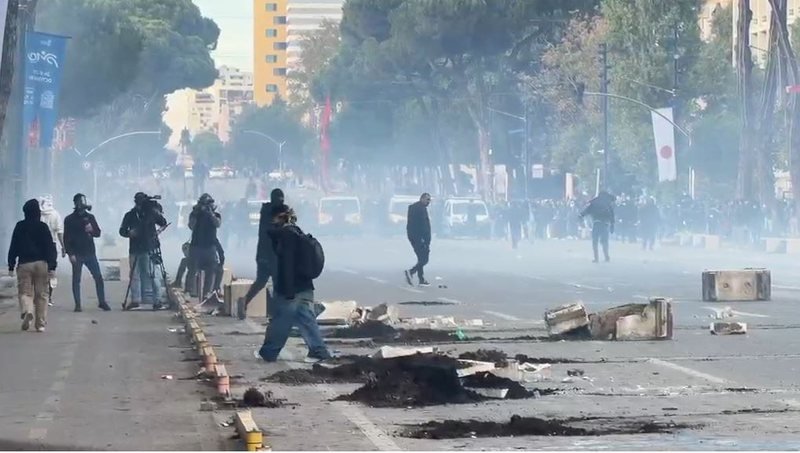
On the contrary, even after six months, a part of the organization continues to operate under conditions of anonymity, through groups on WhatsApp and Telegram, where, according to the denunciations and materials published now, instructions are shared for violent actions on the streets of Tirana, as we have seen from October 13 onwards.
This is another weak point of the movement.
An action that claims to fight for democracy and good governance cannot build its identity on violence, destruction and lack of transparency. If it aims to be a political alternative, it must prove that it knows how to respect democratic rules, take public responsibility and offer a vision beyond overthrowing the opponent.
Finally, who are these people and what guarantees do they offer that they know how to govern? Destruction of public property, attacks on private businesses in Tirana, clashes and violent acts are not evidence of the ability to build institutions or administer a country. On the contrary, they raise serious questions about the governance model that can be offered. It is like asking the Taliban in Afghanistan to build a democratic system, when they have taken power and are holding it through force and violence.
Therefore, the “Road Movement” is facing a decisive test. If it fails to be formalized as a political formation, with identifiable leaders, public representation, program and a clear strategy, it risks remaining just a street protest, until its complete extinction.
This would be the fatality of an almost six-month action, if it failed to impose itself on the current government and system, not due to lack of time or citizen dissatisfaction, but due to the lack of organization, vision and a concrete political alternative.
If we are dealing simply with the inability to organize, then this movement needs a political consultancy from abroad, for people who know how to set up communication channels, build a structure, design a platform and turn citizen discontent into a political alternative. But if the disorganization is deliberate and this movement has no intention of becoming a political formation, preferring to wander the streets day after day, then a much more serious question arises; maybe its objective is not political change, but the destabilization of the country?
Doubts about such a scenario are fueled by what we saw in the first days of the protests, when the wave of violent acts spread in several cities of the country, for three or four days in a row, before it gradually died down in the districts. This episode raises questions about the way of organization, coordination and the true objectives of an action that, even after almost six months, has not been able to clearly define what it seeks to build beyond the protest and clash with the institutions.
Because, in the long run, these violent and destructive acts are producing the opposite effect, they are feeding a climate of growing hatred and rejection on the part of the citizens towards this group of protesters. Instead of broadening support and gaining public sympathy, they risk further isolating themselves from the society they claim to represent.
If violent acts in Tirana will continue, damaging public property and private businesses, then the risk is that citizens will feel compelled to take measures themselves to protect what belongs to them, their homes, vehicles, businesses and property from any threat that may come from masked individuals who self-identify as anti-government protesters.
Such a situation would be particularly worrying, as it would shift the conflict from a clash with institutions to a possible clash between the citizens themselves.