For many Peruvians, the fanaticism for “Star Wars“has had some predestination. The mechanical engineer Zlatko Pérez LunaFor example, he says that when he was born in 1984 he already had a laser sword waiting for him. It was a simple toy that his mother had bought in the early 1980s at a Coca-Cola promotion, with the idea that one day she would give it to a son or daughter. Years later, when Zlatko came into the world, the sword was still there, as if the Force itself had set the scene.
They say you never forget your first times, and Zlatko remembers his. The first movie he saw in the saga, one Saturday morning on the TV at home, was “The Empire Strikes Back.” By the time the stunning battle on the frozen planet of Hoth was over, the world had gained a new Rebel Alliance fan. Today Pérez Luna is 41 years old and wears a red imperial guard suit that he estimates he has worn more than a hundred times. It is his uniform as a member of the Legion 501 Garrison Perú, a group of fans who dress in very realistic costumes of villains from the saga, but with the peculiarity that they preach goodness in the world: they attend health centers such as the Hospital del Niño de San Borja or the INEN. There are few things more curious than seeing an imposing Darth Vader more than two meters tall or a dangerous Kylo Ren giving hugs in the pavilions where convalescent children receive them as if the real characters from the film had come to visit them.

Meet the 501st Legion, one of the important Star Wars fan groups. (Peru21)

“Star Wars.” Members of the 501st Legion, during a visit to the San José del Callao hospital. Photo: Facebook.
The Legion 501 Garrison Peru is part of an organization born in the United States in the late nineties, founded on an idea as simple as it is powerful: that characters from a galaxy far away could accompany those who need it most. In Peru, the group has been active since 2012 and today has forty members. All non-profit. The best reward is a donation for the children or a smile from the latter.
Story of a passion
To understand why “Star Wars” touches something so deep in Peruvians, we have to go back to the beginning. A long time ago, in this nearby galaxy, George Lucas’ science fiction film was released. In our country, the film hit theaters on February 23, 1978, just eight months after its world debut. It was a relationship that started early, intense and, like any long relationship, not exempt from its traumatic moments.
The most famous of these traumas occurred in 1980, when Panamericana announced the television premiere of “Star Wars,” as the saga was then called. Entire families were glued to the screen, ready to witness the science fiction work that everyone was talking about. But what they received was the infamous “Star Wars Holiday Special,” two hours of an intergalactic variety show that no one liked. George Lucas has said that he would do everything possible to destroy every existing copy. The Peruvians who saw him that night would probably agree with him.

Since 1978, Peruvians’ relationship with these films has had its peaks and valleys. But none as deep as the one that arrived towards the end of the last decade. After the lukewarm reception of “The Rise of Skywalker” in 2019, Disney began to dismantle its plans for future trilogies, in a silence that seemed definitive. Bob Iger himself, then head of the company, ended up recognizing that they had put too much content on the market too quickly. The word circulating in the industry was “fatigue.”
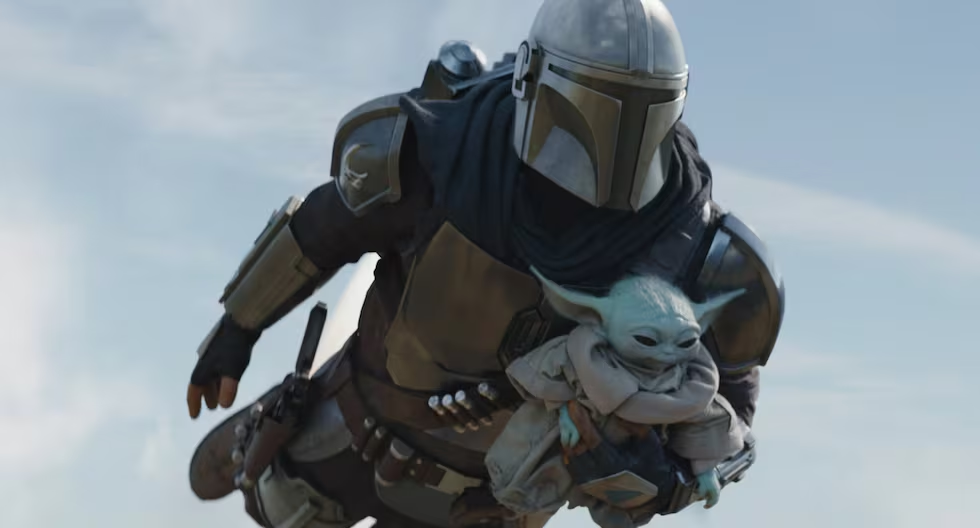
Salvation came, paradoxically, that same year. “The Mandalorian” was ostensibly a minor series: a space Western about a nameless bounty hunter, a green baby and a bunch of dusty planets. But it had something that the last few films had lost: tempo, narrative economy, the genuine pleasure of a good story told patiently. The spectators found her and did not let her go. So much so that in 2026 that same bounty hunter and his little Grogu will make the leap to the big screen in “The Mandalorian and Grogu”, the first film in the saga in seven years. With Pedro Pascal in the leading role, the film will arrive in May, considered “Star Wars” month, when fans hold a series of events to celebrate their passion.

The poster for “The Mandalorian and Grogu”, a film by director Jon Favreau that explores genres such as science fiction and action (Photo: Lucasfilm)
Of course, today no one talks about “fatigue” when referring to the galactic saga. Since “The Mandalorian” several series have been released on Disney+ that have expanded the “Star Wars” universe from very different registers: from “The Book of Boba Fett” and “Obi-Wan Kenobi”, to the celebrated “Andor”, which already has two seasons with resounding critical success. There is also “Ahsoka,” which expects its second season this year, and the misunderstood “The Acolyte,” canceled after its first installment, amid absurd controversy. This same month, in addition, “Maul: Shadow Lord” was released, an animated series focused on the fearsome Sith from “The Phantom Menace”, another sign that the galactic universe still has oxygen for a while.
The power of music
We said that May is the month of “Star Wars” celebrations and, as if to warm up the atmosphere, this April 25 and 26 the Grand National Theater will host Symphony of Force, a concert with sixty musicians that covers the soundtracks of the nine films in the saga. At the helm will be Carlos Ramírez, orchestra director and fan of Lucas’ films since the VHS days. It is not the first time that it has organized it: last year two performances sold out and the response forced it to expand to four in this edition.


The novelty this year is the inclusion of a choir that will perform, among others, the “Duel of the Fates”, that song that since episode I reminds the world that John Williams is capable of making a laser sword fight sound like a Greek tragedy. Ramírez has been thinking about the music of “Star Wars” for years with an obsessive precision that goes beyond fanaticism. For him, Williams’ compositions, more than a happy conjunction of notes, are a work of architecture: a system of ‘leitmotifs’ in the Wagnerian style, in which each character has his musical signature and these are intertwined, transformed and even inherited. Anakin’s theme contains the germ of Darth Vader’s. Luke’s has echoes of Leia’s. “There are links between generations, some topics have the same DNA,” he says.
The show, he warns, is for everyone. Whole families usually go; Some fans come in costume, wielding lightsabers, but there are also many music lovers who may have never seen a complete movie, although they recognize that overture from the first bars. That burst of brass in B flat that opens each film and that Ramírez describes as “one of the most iconic hooks in cinema”: a great orchestral explosion that suddenly becomes a march. As if the entire universe had just started moving. //