
Listen to this article
Estimated 5 minutes
The audio version of this article is generated by AI-based technology. Mispronunciations can occur. We are working with our partners to continually review and improve the results.
Experts across Canada are taking extraordinary measures and using the latest medical techniques to care for soldiers burned at a fire at CFB Wainwright last month.
In Alberta, 21 soldiers remain in hospital, with nine in critical condition and 15 on ventilators to help them breathe, according to Acute Care Alberta.
“It has been … all hands on deck across Canada to provide that support to the front-line staff to be able to provide this care, and part of this has been tapping into the best products and instruments that are out there,” Acute Care Alberta’s interim CEO Dr. Sayeh Zielke said in an interview with CBC News in late October.
Spray-on skin
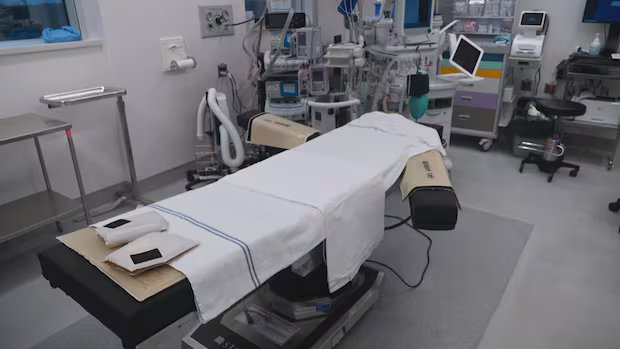
One product being used is called RECELL, a device that makes spray-on skin in minutes.
Doctors put a very thin piece of a patient’s healthy skin into the device, which breaks down the cells and turns them into a suspension that can be sprayed over a burn.
It’s unlicensed in Canada, but Health Canada used the Medical Devices Special Access Program to bring it into the country.

Dr. Julia Slater, medical director at the burn centre at the University of Kansas Health System, demonstrates how a RECELL kit works. (Supplied by University of Kansas Health System)
Dr. Julia Slater, medical director for the Burnett Burn Center at the University of Kansas Health System, has frequently used RECELL over the last five years; it was approved by the U.S. Food and Drug Administration in 2018.
Slater said burn centres can easily get overwhelmed by mass casualty incidents like the one at CFB Wainwright on Oct. 17, when an out-of-control grass fire killed four soldiers and injured dozens more. She commended Health Canada for taking quick action.
“I think it shows how quickly your system was able to recognize how big of a deal this was to have that number of patients with this severe of injuries.”
When a high proportion of a patient’s body is burned, there may not be much donor skin available, Slater said in an interview from Kansas City. RECELL turns a small graft into a spray that can cover a larger surface area.

The entrance of CFB Wainwright as seen in the early hours of Oct. 18, 2026, the day after a fatal grass fire on the military base. (Julia Wong/CBC News)
And the RECELL suspension can be made in the operating room in roughly 30 minutes, compared to weeks for lab-grown skin, Slater added.
“In my practice, it has just revolutionized how we can treat patients with large burns, getting them out of the hospital sooner, less surgeries, getting them healed faster.”
In a statement, AVITA Medical, the company behind RECELL, said its staff travelled to burn centres in Calgary and Edmonton to help surgeons who were using the device for the first time.
Allograft donation
Other provinces also jumped into action to help Alberta hospitals with treatment.
Shared Health, Manitoba’s health authority, provided allografts — tissues harvested from living or dead donors — from Oct. 19 to Oct. 27.
“Provinces really come together in situations like this,” said Nicole Sneath, interim vice-president of quality, patient safety and operations.
“We see how important collaboration across the country really is when there’s some of these unprecedented events that happen and for us to be able to respond and mobilize quickly.”
‘Major team effort’
Burn care typically involves skin grafts, changing dressings and monitoring for signs of infection, Zielke said.

Dr. Sayeh Zielke is the interim CEO of Acute Care Alberta. (Google Meet)
“Multiple surgeries happen thereafter to replace the skin with either artificial skin, or allografts, cadaver skins, until we [are] able to provide the patient with their own lab-grown skin tissue.”
As of Monday, 25 soldiers who were injured at CFB Wainwright were still hospitalized nationwide, the Department of National Defence said.
Last week, four were transported from Alberta to hospitals in B.C. and Ontario, to be closer to family.
At the Ross Tilley Burn Centre at Sunnybrook Hospital in Toronto, medical staff are working around the clock on two soldiers, while a third is an outpatient, said surgeon Dr. Alan Rogers.
He said he estimates that patients with major burns will stay one to two days in hospital for every percentage of their body surface that was affected.

Dr. Alan Rogers is a burn surgeon at the Ross Tilley Burn Centre at Sunnybrook Hospital. (Maxime Beauchemin/Radio-Canada)
“It’s a major team effort to get these patients through effectively,” Rogers said. “Each day can bring new challenges for these patients and ultimately we’re trying to get good quality [skin] coverage of large areas so that they can rehabilitate effectively.”
Recovery will take months to years, he said.
“It is arguably one of the most painful experiences a patient can endure,” Rogers said. “Patients will still require a number of operations and once they’ve had all their wounds closed with their own skin, they will have various challenges in terms of restoring function.”
He said the long-term goal is to get the soldiers to a place resembling their lives before the fire — “returning them to their place in the world … to be as close to the people they were before, physically [and] emotionally.”