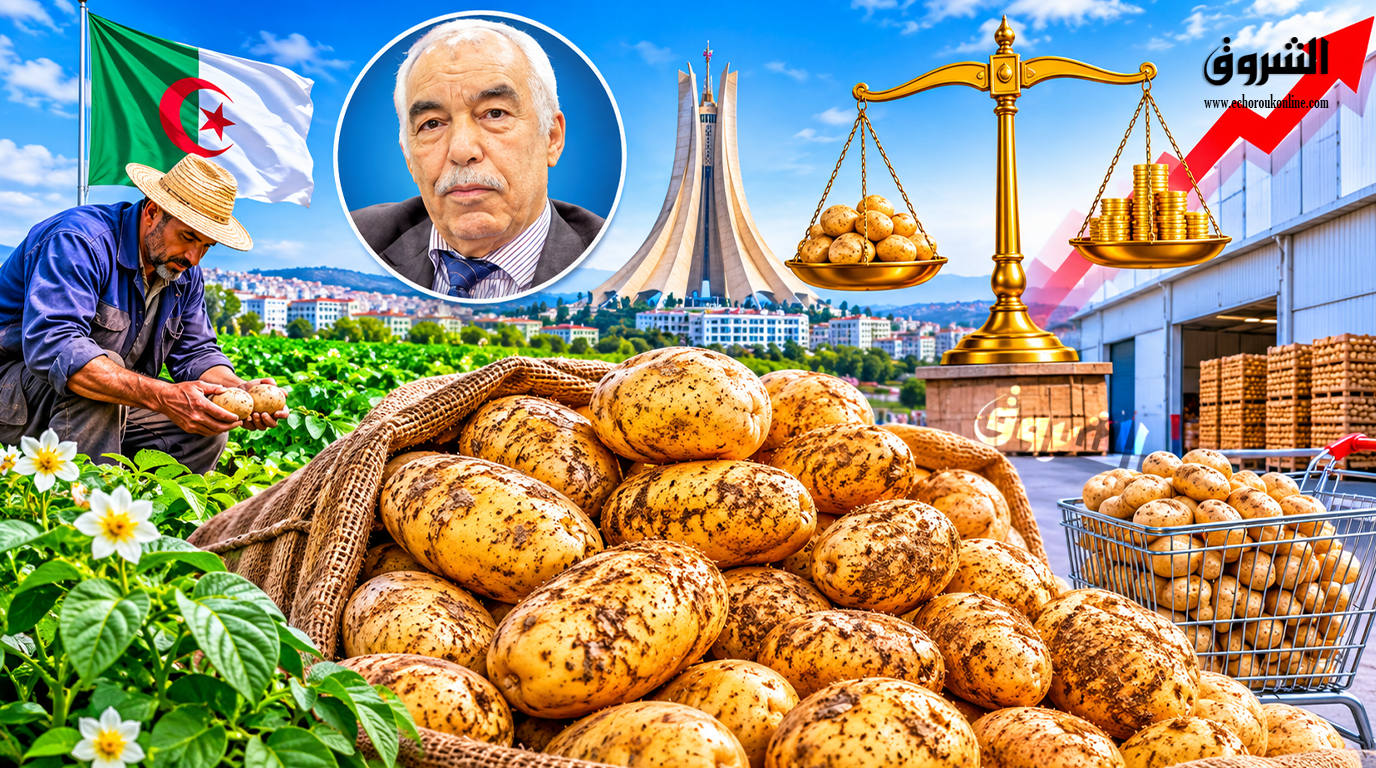
The stability of the potato market in Algeria, despite the productive capabilities that the country now has, is linked to the extent of the ability to organize this division and control the relationship between the volume of production and the needs of the market, in light of imbalances that sometimes cause a surplus that leads to losses for farmers, and at other times a shortage in supply and an increase in prices to levels that exceed the purchasing power of citizens..
The agricultural expert, Ali Boukhalfa, confirmed in a statement exclusively to Al-Shorouk Online that the problem facing the potato division is not related to weak production capabilities and capabilities, but rather to poor management and the absence of field follow-up and oversight, noting that this material, which he described as “the lady of the table,” represents an essential element in the national food, and Algeria relies on it to achieve self-sufficiency and enhance food security.
The spokesman explained that Algeria ranks second in Africa in potato production after Egypt, and that the cultivation of this material is no longer limited to the traditional states that were responsible for the bulk of production, such as Mostaganem, Maskar, Chlef and Ain Defla, but rather has expanded to include various regions of the country, with the states of the south becoming prominent in this activity.
In this context, Boukhalfa pointed out the position now occupied by the state of the Oued, which in some seasons was able to provide about 40 percent of the national potato needs, in addition to the expansion of production in the states of the southwest, such as El Bayadh and Naama, and its arrival even in areas such as Hassi Messaoud, which reflects the expansion of production capabilities and the increasing interest of farmers in this division across the various states.
However, this development in the volume of production and its geographical spread did not prevent the recording of severe imbalances in the market, which were evident recently in the significant rise in potato prices, which exceeded 200 dinars per kilogram, according to the expert, who attributed this mainly to the absence of organization and advance planning, and the failure to reconcile the quantities produced with the actual needs of the market.
Boukhalfa pointed out that these imbalances put the farmer and the consumer facing two opposite problems, as surplus production, in the absence of mechanisms to absorb and market it, leads to the destruction of quantities of the crop and incurs financial losses to producers, while the lack of supply in other periods causes price inflammation, making the acquisition of this basic material a burden on the purchasing power of citizens.
The expert stressed the need to subject the potato division to a careful economic study that determines the productive capabilities available at the national level, the size of the market’s needs, and the quantities that must be produced each season, allowing for the development of clear agricultural programs and avoiding random production that disturbs the market balance, whether through an unabsorbed abundance or a shortage that leads to high prices.
He added that the absence of a clear vision regarding marketing the crop and absorbing the surplus prompts some farmers to reduce the cultivated areas, for fear that they will not be able to sell their production and bear additional losses, explaining that some of them prefer to exploit half of the area they own and leave the other half uncultivated, to reduce the volume of production and avoid the risks of excess supply and low prices.
On the other hand, Boukhalfa considered that the state’s decision to establish a national company to manage surplus production and acquire crops at prices that satisfy farmers represents an important step to overcome this problem, by providing guarantees for marketing the product and encouraging investors and farmers to fully exploit the lands allocated for growing potatoes, instead of reducing the areas due to fears that the crop will not be used.
This approach is related to the trends aimed at reorganizing the agricultural sector, by improving statistics related to the various sectors and providing accurate data on production and needs, in addition to combating the confinement of agricultural products, early preparation for agricultural seasons, providing the necessary equipment, and preventing lands from being left unexploited. These are among the topics that were emphasized during The last cabinet meetingWithin the framework of improving production and supply control and combating imbalances affecting the markets.
For its part, the General Union of Algerian Merchants and Artisans (UGCAA) highlights the importance of cold rooms in this path, as a means of absorbing surplus production during periods of abundance and storing it for resupply when supply declines, which helps overcome seasonal gaps and achieve greater stability. However, the success of this mechanism requires organized management of stocks and transparency in determining the quantities stored and the timing of marketing them, while monitoring practices that may turn storage into a means of withholding the product and speculation.
This issue is of particular importance in view of the seasonal nature of potato production, as the gap period usually occurs during October and November, after the end of harvesting the summer crop and before the entry of the next crop, while the harvest of the southern crop, especially in the state of El Oued, is expected to begin in late November and the beginning of December, with the abundance of production reaching its peak during January and February, which may support the supply of the market and reduce pressure on prices.
In a broader context, Development Adviser Abdel Rahman Hadif said in a statement to the “Def Al-Sabah” program on Radio One that reforming the agricultural sector has become a strategic necessity to enhance food security and economic sovereignty, noting that the directives given by the President of the Republic during the recent Cabinet meeting represent a roadmap for reorganizing the agricultural system. He stressed that controlling markets is not achieved by increasing production alone, but rather requires controlling supply and distribution chains, developing the logistical infrastructure, and relying on accurate statistics and digitizing data related to production, storage capabilities, and the actual needs of each region.
Hadif stressed the importance of counting the various dealers in the division and distinguishing between real producers, intermediaries and speculators, in addition to reorganizing wholesale markets and reducing the multiplicity of intermediaries and marketing costs, while distinguishing between legitimate storage that ensures continuity of supply and monopolistic practices based on withholding products, creating scarcity, and raising prices.
Food and Agriculture Organization data for 2024 indicate that Annual potato production in Algeria It ranges between 4.3 and 4.6 million tons, which places it in second place in Africa after Egypt. Estimates of per capita consumption vary depending on the calculation method, ranging between 60 and 72 kilograms annually when calculating net direct consumption, and between 100 and 111.5 kilograms when relying on the total crop destined for the local market.
Boukhalfa believes that organizing this division and providing guarantees for marketing the production would encourage farmers to raise their productivity and exploit the available spaces, allowing for achieving sustainable abundance and avoiding the crises that the market has witnessed. According to him, the bet is based on an equation that ensures the farmer covers production costs and achieves an appropriate profit margin, while at the same time enabling the consumer to purchase potatoes, as a basic commodity, at prices consistent with his purchasing power.