“A liberal party with Soviet leadership.” Who describes the operation of La Libertad Avanza in this way? An independent journalist? No. An opposition leader, a political scientist? Neither. A former official disgruntled and resentful of the President? Less. The definition corresponds to someone who is part of the very core of power. Therefore, rather than as a criticism, it should be read as a confession. It is the diagnosis of someone who knows, like few others, the internal functioning of the libertarian government and who condenses, in that metaphor, the observation of a privileged witness, but also the experience of a central actor in the mileist scheme.
The phrase – which has already been cited in a sophisticated political analysis of Martin Rodriguez Yebra– summarizes the increasingly accentuated features that the ruling party has acquired: extreme verticalism; subordination or banishment; intolerance of dissent, and a dangerous confusion between loyalty and obedience. If it was something that was suspected, now it is something we know. This is said by someone who has a meticulous record of the methods applied in the shadows of the palace.
The first consequence of the “Soviet leadership” is that it deepens, around the leader, an atmosphere of fear. Many do not dare to say what they think and even feel forced to overreact certain positions, assume other people’s “hatred” and defend things with which they do not intimately agree, to please “the boss” and protect themselves from the wrath and presidential abuse.
In that context many attitudes are inscribed that have become frequent in government officials and leaders: they emphatically deny facts that they know to be true; they applaud with simulated fervor things with which they do not agree; They name the President up to forty times in brief radio interviews, they defend attitudes and situations that actually make them uncomfortable, and they aggressively confront anyone who publicly raises a criticism, blending in, in many cases, with a style they never had. It is the manual that assures them approval at the top of power or at least the modest crumb of a presidential “like.”
The “Adorni case” has revealed this driving system. When the scandal was just beginning – even before the real estate revelations and the decorative trinkets and tourist whims that were paid for “in black” – all the cabinet ministers were forced to write messages of support in Afterwards, they were asked to accompany the official in trouble to a press conference: the most eminent ministers were seen in the front row, converted into “fans.” But since the Chief of Staff needs a new gesture of support every day, something more was demanded of them: that they all go to Congress, with the President at the head, not just to support him, but to applaud him, as if he were not an official forced to give explanations, but a kind of hero who deserves to be recognized and honored.
Does the entire Government agree on this monolithic and stubborn defense? of the chief of staff? Definitely not. But to understand the gestures and behavior of official officials and legislators, we must refer, once again, to the logic and method of “Soviet leadership.” There is no room, in the Government, for a frank conversation. There is no room to express objections, nuances or differences: he who doubts becomes an enemy. He who dares to challenge unanimity runs the risk of being banished. There are plenty of “exemplary” cases. Now we will have to look at what happens with Senator Bullrich, who last night distanced herself from the chorus to demand explanations from Adorni.
Before we encounter this revealing diagnosis about internal conduction methods There were already many signs of the system of blind obedience that is required to belong to the official ranks. The Secretary General of the Presidency, for example, in a meeting she held in February with libertarian legislators, gave them a precise line about how they should act in Congress: “For the Executive’s projects, you vote on them first and then read them,” she told them with brutal honesty. When the phrase spread and caused a certain sting, he entrusted “an errand” to some legislators: that they go out and deny it in X and say that he had never told them what he actually told them; It was – once again – a feverish invention of journalists. A participant in the meeting, however, had told a prominent parliamentary reporter in his own office. Denying what is known to be true is part of the survival instinct in “a liberal party with Soviet leadership.” Truth is sacrificed on the altar of submission.
“Do they ask so much of you?” they once asked an ally of the ruling party. who was forced to put on a purple sweatshirt for a campaign photo. “Yes, they ask you for as much and much more.”he responded with some frankness. Many times, even the dignity of the leaders is compromised by these methods of political leadership. That chromatic uniformity functioned as more than just a metaphor.
We must return to another phrase from the general secretary, which in this case was written in his personal account of X: “Here he comes to defend the President’s ideas tooth and nail. And in that battle, Loyalty is not an option: it is a condition. Whoever questions those who carry that flag (us) is not criticizing an armed group; He is questioning the President himself and the cause that brought us here.” The message was unequivocal: it cannot be questioned; there is not the slightest loophole for debate or internal dissent. Loyalty is understood as compliance and subordination, as if it were a concept equivalent to obsequence. Nothing that is not said in the brilliant novel by Giuliano da Empoli The Kremlin Wizardwhich just opened in theaters: “It doesn’t matter what you believe, it matters if you obey.”
The definitions, apparently dispersed, describe a conception of power. Behind a rhetoric that exalts freedom, hides a centralized and verticalist idea that exceeds the party dimension to color the praxis government and condition decision-making. Everything points to a government with increasing difficulties in listening to different voices and even analyzing its own progress with a certain flexibility and breadth. “The boss’s word is not disputed.” That sentence has become dogma. And it poses the risk of a leadership that is increasingly stubborn and closed in on itself, more impervious to criticism and revision of its “absolute truths.” Has the President stopped listening yet? Perhaps the revelation of Sunday Cavallo: “He totally blocked me, on WhatsApp and on the networks,” the former minister just said in an interview with Maximiliano Montenegro. He is someone – of course – who shares the Government’s broad guidelines on economic and international policy matters, but has committed what for the ruling party is a mortal sin: thinking independently, raising doubts, criticizing methodological aspects. Perhaps because he was never obedient, he forgot the maxim of Karina Milei: “Loyalty is not an option, it is a condition.” From that worldview, saying things with intellectual honesty is an audacity that has nothing to do with loyalty.
Many phrases of “libertarian culture” rhyme, curiously, with others that have remained in the memory of Kirchnerist dogmas: “You just have to be afraid of God, and of me a little bit,” he was sincere one day Cristina Kirchner by national network. “You don’t talk to the President, you listen to her,” he used to warn. Carlos Zannini to occasional visitors to the Olivos residence. They seem like verses of the same song. Just like personalism, which is beginning to take shape as another trait that connects apparently antagonistic political cycles.
It is true that the characterization as “Soviet” could generate objections. The concept refers to a solid bureaucracy and a rigid institutionality, when mileism seems more comfortable in a kind of unpredictable, chaotic and disruptive caudillismo than in an orthodox and disciplined ideological machinery. It is more improvisation than “apparatus,” more irascible impulse than a cold and rigorous system. Perhaps that is why the account of
However, it is not coincidental that within the Government there is talk of “Soviet leadership”: exposes an essential contradiction, but describes, at the same time, the submission of officials to accept a reality tailored to the boss, “edited” for him, which proclaims what is true and what is not, even against the grain of all evidence.
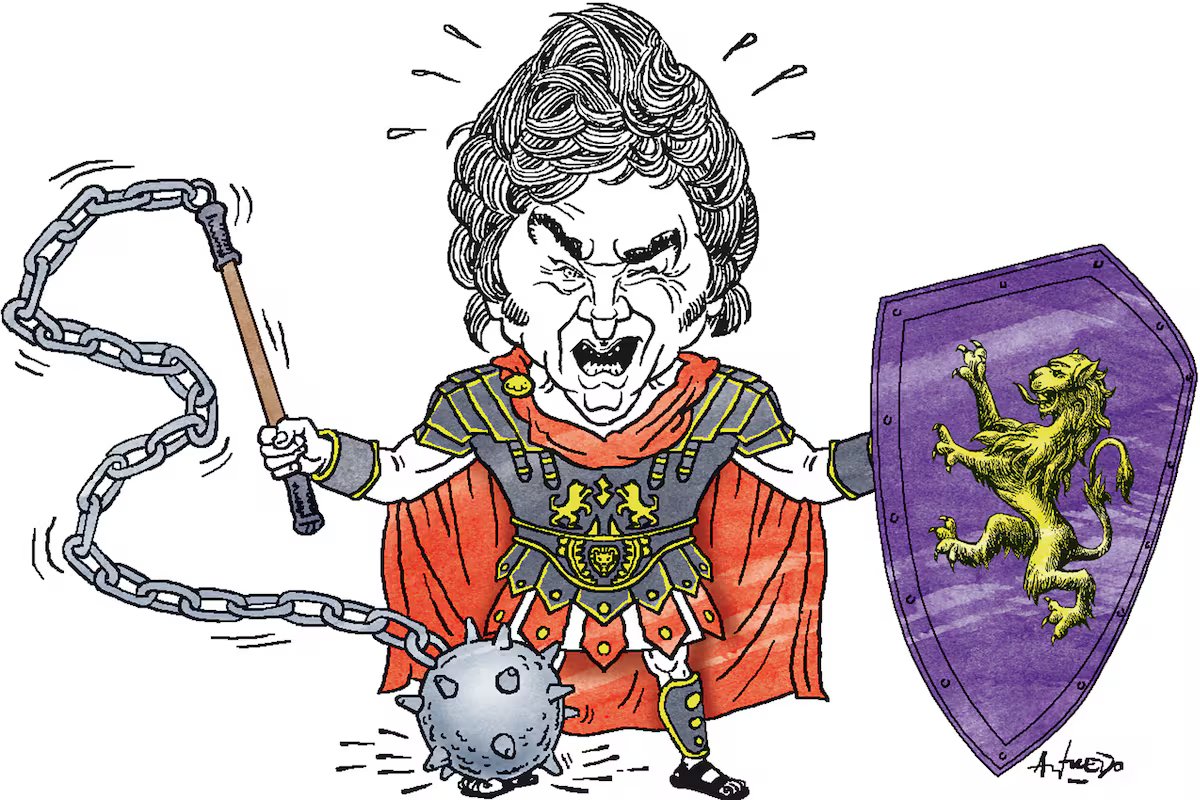
“I am not here to guide lambs, but to awaken lions,” Milei repeated. during the election campaign. Now, from within power, they confirm the abyss between that speech and internal practice, between the story and the facts. “Here you are part of a herd; he who deviates will pay the consequences,” they tell officials and legislators in one way or another. The result is translated into a public choreography, where everyone follows the step and sticks to the script, with no room for gestures of autonomy or to exercise their own voice. Those who have raised nuances today see power from the outside. There is a risk, however, that hides behind this apparent uniformity: the repression of differences can incubate, within the ruling cast itself, discomfort and paralysis; a kind of internal withdrawal that leads to a certain immobility and discourages creative energy. It also stimulates deaf inmates, hypocrisy as a defense mechanism, secrecy and intrigue as a form of preservation. Nothing that is not inherent to the microclimates of power, but that in exacerbated doses can be a dangerous combination.
When talking about “Soviet leadership”, there is no tone of denunciationbut of description. “It’s like that.” Behind this resignation, however, some underlying questions loom: how much damage can these methods do to the government itself? And something even more disturbing: How much can they damage the democratic fabric?
Of course an administration needs discipline and internal coherencebut when dissent is penalized, inside and out, we fall into the authoritarian temptation. There are borders that seem blurred: between loyalty and obedience, between support and concealment, between courage and anger, between conviction and dogmatism. Accelerating through curves can be audacious or reckless. What defines a good pilot is noticing the difference.