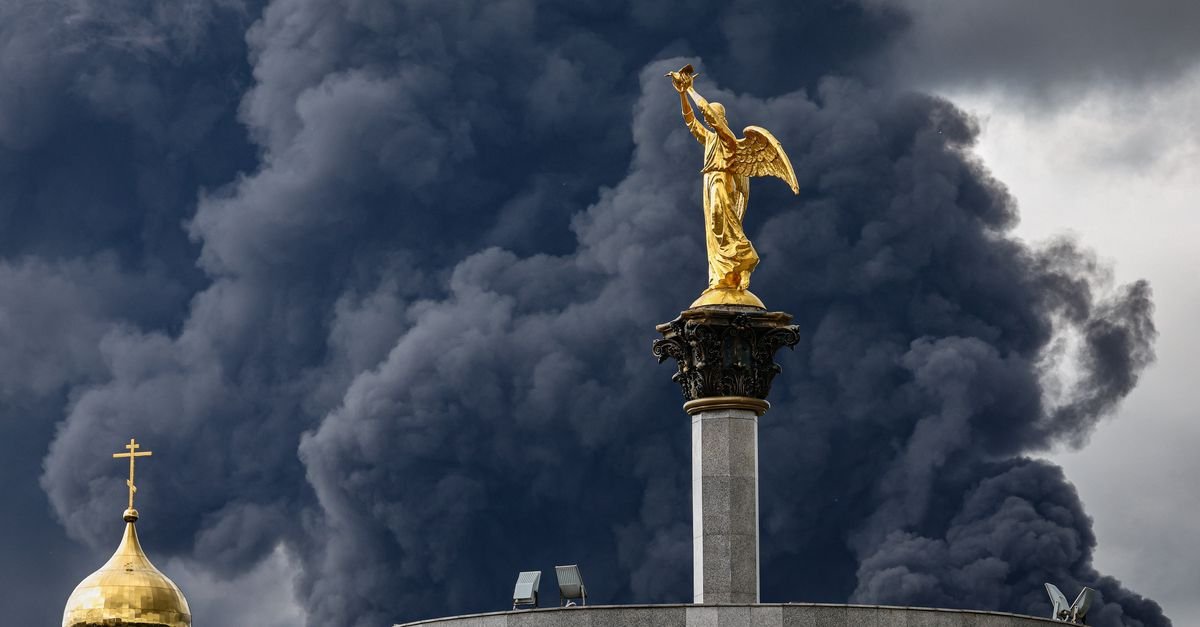
There seems to be no end to the Ukrainian army’s drone attacks on Russian cities and infrastructure, and with it the flow of spectacular images from Russia. Large fires with billowing plumes of smoke, images of drones and flying debris, emergency services that have been deployed to receive victims. After the major impacts near St. Petersburg at the beginning of this month, last week it was Moscow’s turn, where last Thursday dozens of drones managed to break through the anti-aircraft defenses of the Gazprom oil refineries in the southeastern Kapotnja district and caused a major fire. New locations have come under fire in recent days.
Although social media were filled with panic messages and the smoke was even visible from space, the ominous scenes did not reach all residents of the city. NRC spoke to some Muscovites, who spoke on condition of anonymity. Their identity is known to the editors. “Residents in the affected neighborhood were of course alarmed and scared. They heard the crash and saw clouds of smoke billowing for miles throughout the day. But most people had no idea of the magnitude, because official media and even local Telegram channels do not provide a clear picture of the situation,” said a journalist who was at the scene. He saw people walking with their children or taking selfies with the smoke. They were shocked, he says, but there was no visible panic.
They scare us and put up notes, that’s it
Another Muscovite says he saw the smoke from his apartment. He also saw notes in the stairwell that referred to a bomb shelter nearby. But the key must be requested from a special office. When his neighbors asked for a copy, they were turned down. “Imagine, there is a strike. Then you first have to run somewhere to convince some administration to give up the key,” he says exasperatedly. According to him, the authorities are completely unprepared for the scenario that the war reaches the capital. “They scare us and put up notes, that’s it.”
:format(webp)/s3/static.nrc.nl/wp-content/uploads/2026/06/22101502/220626BUI_2034645783_Rusland1.jpg)
Heavy smoke develops after a drone attack on a Gazprom refinery in a southeastern suburb of Moscow on Thursday.
Photo AFP
Fuel shortages
Another resident in the center says he didn’t notice anything. “Not even a smell of smoke. The wind was easterly and blew the smoke away in the direction of Siberia.” People in his circle of acquaintances hope that the Ukrainian attacks will bring about something, perhaps even a quicker end to the war. But “people who think differently don’t share their thoughts,” he says. A woman who went to visit her child at a summer camp outside the city tells how she had breakfast in a tent on the road along the way. “The staff said that they opened later that morning because there was debris from drones in front of the door that had been shot down by anti-aircraft fire.”
Also read
Only Putin can still deny the apocalyptic state of the Russian economy
:format(webp)/s3/static.nrc.nl/wp-content/uploads/2026/06/12173214/140626ECO_2034208457_putin1.jpg)
And so life goes on. While the damage to the refineries is being assessed and repair work is underway, terraces, squares and parks are full and the cultural and nightlife scene is flourishing. The journalist notes that the streets even seem busier than normal in the summer months. Many Muscovites have changed their holiday plans. The seawater in seaside resorts such as Anapa and Tuapse is polluted due to previous attacks and sunken tankers, airports are regularly shut down and “of course no one goes to Crimea now,” he says. The peninsula and its access roads have been bombarded by Ukrainian drones for weeks.
The biggest problem is the nationally growing fuel shortage as a result of the attacks. In Moscow, the affected refineries meet a large part of the demand. Due to the unrest and rumors, many Russians have started hoarding, forcing companies to limit delivery. For example, at some pumping stations only twenty or thirty liters of petrol can be refueled at a time, for diesel this is between sixty and one hundred liters. Prices also vary widely: from the usual 60 rubles per liter (0.71 euros) in the capital to double that in some regions. In addition, in many places payment must be made in cash.
:format(webp)/s3/static.nrc.nl/wp-content/uploads/2026/06/22101514/220626BUI_2034645783_Rusland3.jpg)
Despite the attacks, many Muscovites have simply taken to the streets or parks in recent days.
Photo AFP
Street raids
In annexed Crimea deepened the fuel crisis occurred last weekend as a result of Ukrainian drone attacks on both sides of the Kerch Strait. Ferry services were suspended, trucks carrying fuel were advised not to cross the Crimean Bridge, shipping was advised to sail. The sale of gasoline to citizens was also temporarily suspended and only government vehicles were allowed to refuel. A total of four people are said to have been killed and 28 injured. Ukrainian President Volodymyr Zelensky called it “a just response to the brutal Russian attacks on our people.” On Monday, a key space communications center in Moscow’s Dubna district and the southern city of Voronezh came under fire. Five people were killed in Voronezh, according to regional governor Aleksandr Gushev.
If Ukraine burns, your Moscow will burn too
“If Ukraine burns, your Moscow will burn too,” Zelensky said on the day of the attacks in Moscow. He said he hopes that Russians will realize that they, and not Putin, are responsible for the consequences of the war. Many Russians have long recognized this. Fatigue predominates among them. About the war, the economic problems and the repression. Late last week, the town of Penza, east of Moscow, was rocked by raids, with recruitment agency officials checking men on the street and rounding them up to send them to the front. Although the raids and panic were captured on numerous videos, authorities strongly deny what happened.
Also read
Zelensky’s week: black clouds over Moscow, guest of honor at the G7 and a combative text to journalists
:format(webp)/s3/static.nrc.nl/wp-content/uploads/2026/06/19145850/190626WEE_2034615054_zelensky.jpg)
The constant fear and economic headaches contribute, according to the Russians NRC spoke, contributed to the passive and resigned atmosphere in the country. “If you have been constantly afraid for four years that you could end up in prison because of a post on social media and absolutely anything can be labeled as discrediting the army, then the war itself is no longer so scary,” says one of the Muscovites. Another wrote: “Of course the attacks are terrifying in theory. But in practice people don’t really care. That’s the terrible truth.”