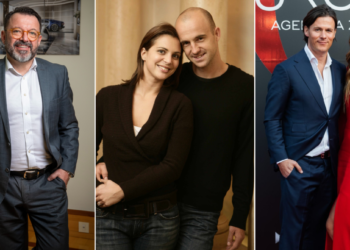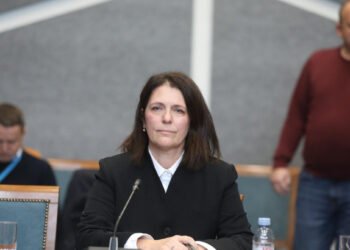
The Split premiere of the documentary film “U titraju svetla” will take place on May 2nd at the “Kinetec”. They co-edited the documentary Ivan Perić and Alvaro Congosto. She is a co-screenwriter and protagonist Marija Gabrijela PerićIvan’s wife. The story is triggered by the legacy of Gabriela’s deceased great-aunt photographer Gee Cohen, which takes the protagonist to New York to take over things. Auntie lived in the largest artist colony in the world, the Westbeth housing complex. Gabriela discovers her aunt’s life and that artistic world. After we Gabriel was interviewedit was her turn to hear what her husband had to say about the film.
– When you’re a child, you perceive the world as a magical place, full of hidden secrets waiting to be discovered, great adventures and faraway journeys. Everything is interesting, everything has a spark. Then one day you grow up and realize that most of the time you are doing things that are far from that: sitting in a queue, paying bills, filling out forms. Days pass and you slowly forget that view of the world you once had.
And then sometimes, in the midst of that repetitive everyday life, a ray of sunshine breaks through and illuminates the gray for a moment. It’s as if a short window opens, an opportunity for something magical and unexpected. But too often we walk with our heads down and don’t notice that moment. He disappears, and we never find out what could have happened if we had been more careful or braver. Something similar happened with this adventure of ours, which eventually became a movie – started Ivan.
– In 2017, I met my girlfriend at the time, and now my wife, Marija Gabrijela. Not long after, she learned that her great-aunt Gea Koenig from New York had passed away and that she should go there and take care of her ashes and personal belongings. As she told me about her, I immediately understood that she was an exceptional person.
Gea was a travel photographer who collaborated with some of the world’s most respected media (“The New York Times, “Chicago Tribune”, “Travel + Leisure” and “National Geographic”). Helmuta writer, traveled almost all over the world at a time when such trips were rare. I had to travel to New York urgently, and since I already had a visa for the USA, Marija asked me to go with her to help with packing and selecting photos, since I work in film – reveals Perić and continues…
– We arrived in New York, in the Westbeth apartment complex, where Gea lived. That building was originally part of Bell Laboratories, once the largest research center in the United States. It was in this research system that some of the key technologies of the 20th century were created and developed, including the transistor and communication satellites, as well as important improvements in television and sound.
After the laboratory moved, the city of New York allocated the building to artists, and in 1970 one of the largest artist housing complexes in the world was created. Today, Westbeth includes gallery and projection spaces, dance and music studios, theater halls and more than 300 apartments where artists live exclusively. The complex is architecturally unusual because it was originally designed as an industrial laboratory, not for housing.
He led the conversion Richard Meier, winner of the Pritzker Prize, a kind of Nobel for architecture. Westbeth, thus, soon became one of the central places of the New York art scene. Some of the most important artists of the 20th century passed through Westbeth, such as Andy Warhol, Roy Lichtenstein, Nam June Paik, Merce Cunningham, Martha Graham and John Lennon. Actor Philip Seymour Hoffman he had his acting studio there, a Lou Reed musical – points out Ivan.
– Among all these artists lived Gea Koenig, Maria Gabriela’s great-aunt. Marija had already visited her before, and on that occasion she met Gea’s neighboring artists. When she told me who Gea was, what she did for a living and what kind of iconic building she lived in, I thought it would be a shame not to bring a camera and somehow record the whole process of packing up her legacy. At the same time, it became clear to me that it was also a unique opportunity to talk with Gea’s artist neighbors.
At that moment, the idea that it could be made into a movie began to take shape. I decided to make a documentary about everything that took place: about the building, about the artists who live in it, but above all about Gea and her extraordinary life. The film also deals with issues of transience and aging, topics that concern us all. However, the goal was to make a film that, despite these themes, remains warm and talks about the joys of life. I helped in the packing process, but also filmed. The approach was documentary, “fly on the wall”, without intervening in the situations that were unfolding – says Ivan, who in such an unplanned rhythm of filming also encountered an unforeseen situation.
– It was Christmas time, the first snow was falling and everything seemed unreal. From the apartment you could see the Empire State Building and the Statue of Liberty on the roof. One evening I decided to go up on the roof and shoot New York under the snow. The building was heated, so I went out in short sleeves, without a cell phone, through Merce Cunningham’s dance studio, a space that was once used for the presentation of new inventions and where one of the first public demonstrations of television was held in 1927.
The door closed behind me. After a while my hands started to freeze and I could no longer operate the camera. I tried to go back, but the door could not be opened from the outside. It was late at night, no one was there. I began to move across the snowy rooftops of the compound, with New York City traffic humming and the Hudson River flowing below me. In the end, I saw an open window, jumped to the other side and crawled back into the building through it – said Perić.
After returning to Croatia, Ivan showed the materials to his friend, director from Madrid Álvaro Congost.
– He agreed to edit the film, and we co-directed it together. We presented the film in Amsterdam, where we also found Italian co-producers. It had its world premiere at the International Film Festival in Rabat, Morocco, where it won the jury prize for the best documentary film.
After that, he was awarded in New York and Sweden and is broadcast on Swedish television. The film has since been screened at festivals around the world. It was also shown in the Vatican at the Mirabile Dictu festival, an international exhibition founded with the encouragement of the Pope Benedict XVI., which views film as a combination of art and spiritual reflection and emphasizes its role in conveying values - says Perić and concludes…
– Most of the seats for Saturday’s Split premiere are already reserved, but there will be an additional screening on Thursday, May 21 at 6 p.m. in the “Cinema”.