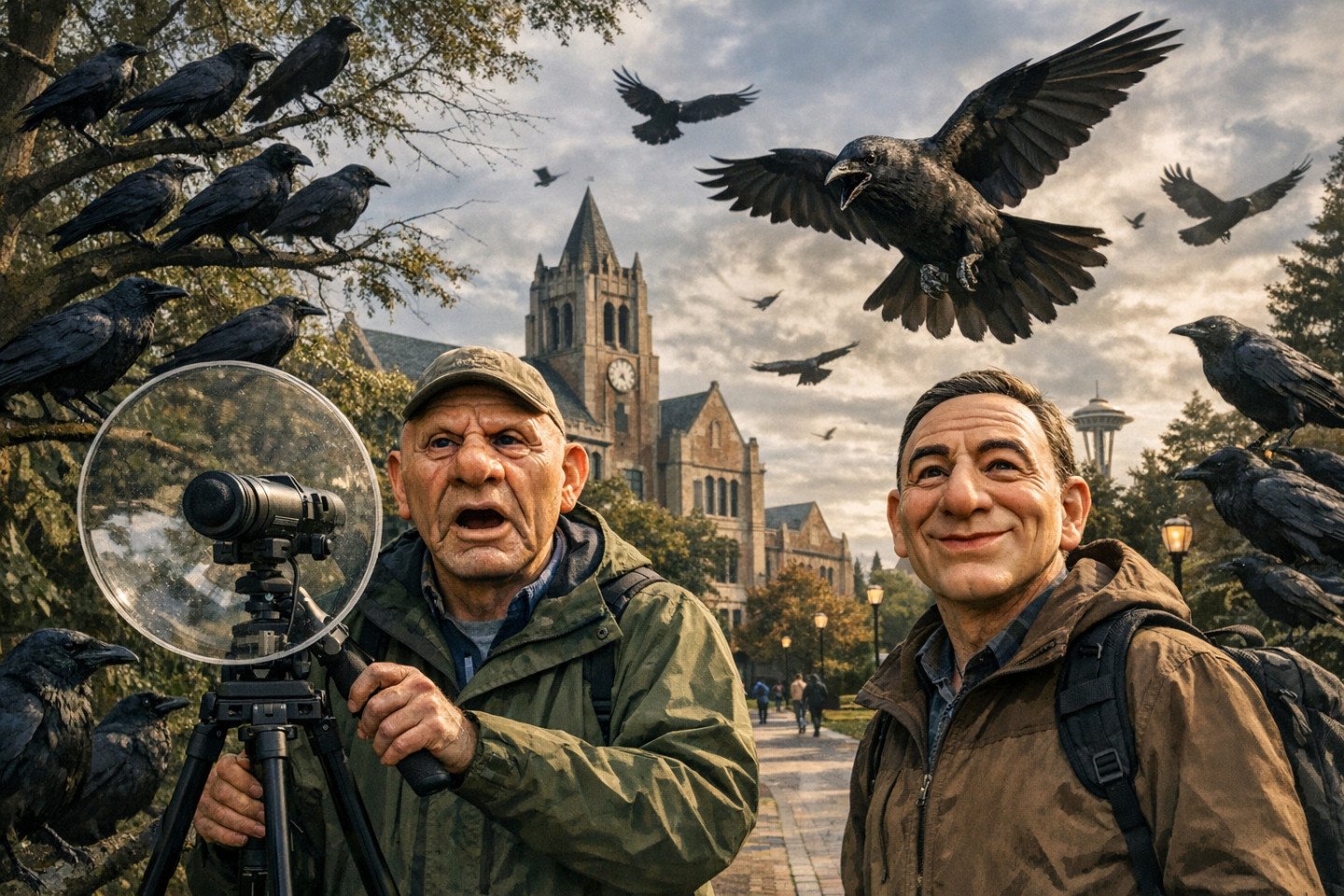
Scientists have discovered that these birds are intelligent enough to remember the faces of their abusers and pass this information on to other members of the flock.
When talking about the smartest animals, dolphins and dogs often come to mind. But did you know that crows are also very smart? Posted by “DoctorPeter”.
Scientists at the University of Washington’s School of Forest Resources in Seattle conducted an intriguing experiment and discovered that these birds do not forget wrongs and are capable of revenge.
An experiment
Professor John Marzluff, one of the authors of the study, observed crows in his city. He was amazed that over the years the birds were able to track people they didn’t like for various reasons.
For example, the crows seemed to hold a grudge against university ornithologists who regularly caught and tagged the birds. Moreover, the specialists were tracked not only by the crows they had caught, but also by other crows in the flock.
All this made Marzluf think that crows could somehow “complain” to each other about their abusers.
He conducted the experiment with colleagues Heather Cornell and Shannon Pecoraro. The researchers deliberately caught the birds in five different locations. In addition, the scientists went “hunting” wearing special rubber masks.
These masks resembled a human face, but with exaggerated details such as bulging eyes or large cheeks.
During the experiment, the ornithologists worked in pairs. They wore identical masks, doing it so that the birds could not see the transformation process. The scientists chose a different mask for each zone.
After capturing the bird, the scientists weighed it and attached a special identification ring to it. This procedure took an average of 10-30 minutes. Meanwhile, a flock of 15-40 crows continued to circle above the scientists’ heads, loudly expressing their indignation and emitting alarm calls.
Interestingly, only one place had a very small flock – only 4-5 birds. Scientists found out that a homeowner had once killed several crows there.
What did they learn?
At each site, the study authors caught and marked 7-15 crows. After the end of this phase of the experiment, they asked the volunteers to walk around the same places wearing either crow hunter masks or other, neutral masks. The volunteers were asked to take a leisurely walk for a couple of hours along a certain route near the places where the ornithologists had caught the crows. The scientists were interested in how the crows would behave and whether their reactions would change during repeated walks.
It turned out that the birds perfectly remembered the appearance of crow hunters and reacted aggressively to these masks. The neutral masks did not elicit such a response in most birds. This means that birds can both remember and distinguish human faces.
Moreover, over time, they did not forget the faces of their attackers. What’s more, the number of birds that reacted negatively to the hunters’ appearance steadily increased. Before the hunt, only 3% of the crows reacted negatively to the masks. After hunting and nine masked walks, 26% of the crows reacted aggressively. After five years of research, almost all birds encountered along the route responded to the attacker’s facial features. On the other hand, the number of crows intimidated by the neutral mask did not change over the years.
The scientists concluded that crows can remember the appearance of their enemies and pass this information on to their relatives, who in turn pass it on. Eventually, the whole flock is warned and the birds remember their offenders.
When the birds saw the hunter’s mask, they squawked angrily. Interestingly, if the flock saw one bird with such a reaction, the other crows joined in and chased the enemy. During such joint attacks, they can memorize the appearance of the enemy, and younger birds can learn how to deal with attackers.
Originally, chaser flocks were birds captured by ornithologists. Later, however, crows, which had received information about the enemy from their relatives, began to form similar “flocks”.
Moreover, the birds retained this knowledge for a long time. Within five years, the number of crows that recognized the features of the hunter’s mask only increased.
More about animals read here.