The week began loaded with crime reports. Early Monday morning, in Los Olivos, Pedro Vega was sleeping inside his vehicle, parked in the Primero de Pro sector, when a group of criminals broke the windows of the unit, He murdered him and then set him on fire. The attack, preliminarily attributed to extortionists, was recorded on video.

Bus driver is murdered by extortionists in Los Olivos. A minivan driver died after his vehicle was set on fire
That same morning, in Comas, Angelo Reyes was intercepted by two individuals who were traveling on a motorcycle while he remained inside his motorcycle taxi with two other people. The hitmen shot up to 12 times. Reyes was transferred to the Sergio Bernales Hospital, where his death was certified due to the severity of his injuries.
Hours later, Marco Antonio Vílchez Arapa, entertainer and member of Los Reales de la Cumbia, was murdered with more than ten shots outside a bar on Morales Duárez Avenue, in Cercado de Lima. In San Juan de Lurigancho, two other young people died after being shot while trying to tow a vehicle in Canto Chico.

Marco Antonio Vílchez Arapa was an entertainer of a cumbia orchestra and also a clown.
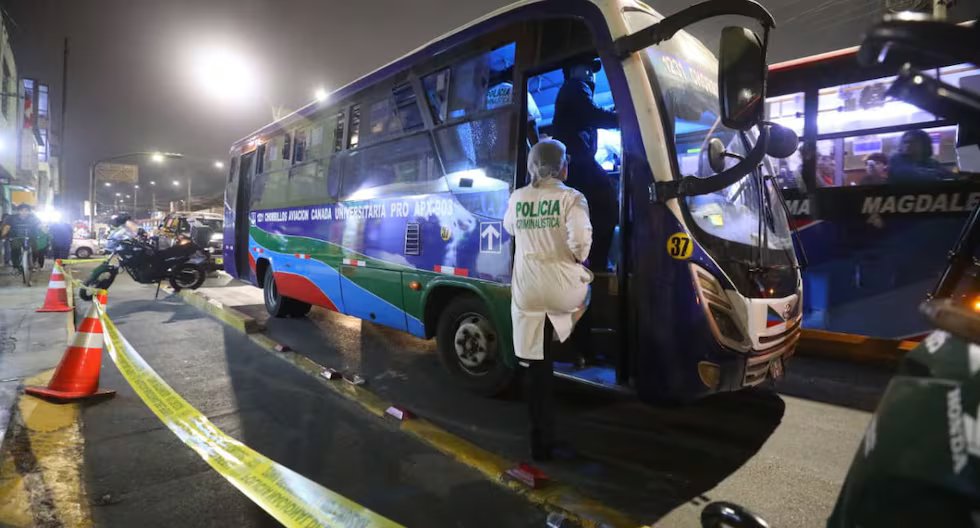
The attacks continued throughout the day. Around 10:00 pm, two individuals attacked a Machu Picchu company bus with bullets at the intersection of Morales Duárez and Universitaria avenues, leaving the driver and a passenger seriously injured. In La Perla, a driver and a conductor were also injured during an armed attack against a public transport unit. In Mi Perú, a young motorcycle taxi driver was murdered and, in the Dulanto sector, another young man was shot to death near his home.

Extortionists shoot Machu Picchu company bus. In the attack, the bus driver and a passenger were seriously injured and were taken to the hospital by local residents. Photos: Antonio Melgarejo/ @photo.gec
In parallel to these cases, the records show a variation in the proportion of homicides depending on the type of weapon used. In 2019, firearms were present in 51% of the 1,140 registered homicides. Between September 2025 and August 2026, they represented 73% of 2,147 cases, according to information from the National Information System of Deaths (Sinadef) processed by the Peruvian Institute of Economics (IPE). In proportional terms, it went from around five out of every ten homicides committed with firearms to more than seven out of every ten. The difference between both periods is 22 percentage points.

73% of the homicides recorded between September 2025 and August 2026 were carried out with firearms, according to information from Sinadef analyzed by the IPE. Source: IPE
In approximate figures, the records are equivalent to about 581 homicides with firearms in 2019 and about 1,567 between September 2025 and August 2026. The total number of homicides registered between both periods increased around 88%, while those in which a firearm appears increased by approximately 170%.
Christian Campos Vásquez, associate researcher at the ICEV Criminology Institute, warns that these figures must be read considering the limitations of the source used. He explained that the health system’s death registry was not built specifically to count homicides and may present under-registrations. “We need to recognize the limits of the sources of information that exist. Not necessarily because the data exists, we are going to use it for whatever and we have to be very careful with that,” he said.
For Campos, a count for public policy purposes should integrate information from the different institutions involved in the registration and investigation of deaths. “Never referring to a single source has been the Solomonic way out of public policy, because none of the institutions by themselves is capable of counting homicides well,” he said. His proposal points to an inter-institutional committee that evaluates cases with police, prosecutor, judicial and medical-legal information.
During 2025, 13,997 firearms were legally brought into Peruvian territory and another 3,865 during the period from January to March 2026 included in a presentation made by the National Superintendence for the Control of Security Services, Weapons, Ammunition and Explosives for Civil Use (Sucamec) before Congress. These include 998 .223 caliber carbines, AR-15 type, during 2025 and another 313 in 2026.

Weapons interned in Peruvian territory. Source: Sucamec
In the case of ammunition, in 2024 19.3 million units were imported and in 2025 the figure reached 31.4 million. During that last year, 9mm Luger and 9x19mm ammunition represented 31% of the total. By 2026, Sucamec’s presentation counted another 7.9 million units.

Ammunition interned in Peruvian territory. Source: Sucamec
The entity’s records also show weapons that were later declared lost, stolen or stolen. Between 2022 and March 2026, 10,407 weapons were reported under one of these three conditions: 5,046 as lost, 4,429 as stolen, and 932 as stolen. In 2025 alone there were 2,158.

Stolen, lost or stolen weapons. Source: Sucamec
Pistols represent 65.5% of property card requests by type of weapon, followed by revolvers, with 16.3%; carbines, with 10.1%; and shotguns, with 8.2%. In its presentation, Sucamec also indicated that during 2025 there was an increase in the acquisition of pistols and identified them as the most requested type of weapon and also the most declared as lost or stolen.
The information available does not establish how many of the 10,407 weapons reported as lost, stolen or stolen subsequently entered illegal markets or how many were used in homicides. Regarding possible supply routes, the specialists consulted by El Comercio identify more than one mechanism.
From the legal to the illegal market
Wilfredo Pedraza, former Minister of the Interior, identifies the loss of weapons for civilian use as one of the supply routes to crime. He recalled that previously cases of owners accumulating several loss reports were detected.
“The loss of firearms is one of the main variables through which weapons are supplied to crime,” he noted. Pedraza recalled that there were people who recorded “four or five firearm losses” and that, when a report was required, this situation “had become a mechanism for transferring firearms to third parties, usually crime.”
The former minister considers that one way to restrict this possibility would be to prevent access to new weapons when there is a repeated history of loss. “Recording two firearm losses should be a cause for not having access to a firearm because it is precisely about cutting this variable,” he said.

Weapons seized in Pataz. Photo: PNP
Frank Casas, a security expert, agrees in identifying problems in the tracking of formally acquired weapons, although he warns that there are no figures that allow us to determine what proportion of the weapons that reach the illegal market correspond to each route.
“The sources are multiple, there is no accurate data to identify exactly how much in terms of percentage of where it comes from,” he explained. Among them, it mentions “regulation problems” in the formal system of acquisition, use and carrying. These are, according to Casas, “weapons that have been legally managed, registered in Sucamec, but unfortunately not much follow-up and monitoring is done and they end up being lost.”
More than one route
Casas identifies two other possible sources of supply: previously seized weapons that return to the illegal circuit due to deficiencies in their management and those that enter through cross-border trafficking.
Regarding the first, he pointed out that there is a history of weapons seized by the Police or the Armed Forces that are subsequently lost or sold. “Since there is no control, these weapons are immediately seized, they can automatically be manipulated and offered for sale,” he explained. According to Casas, these may end up joining the black market.
The third way mentioned by the specialist is traffic across borders. Casas referred to Bolivia, Ecuador, Brazil and Colombia. “Having borders so porous, so lax (…) the truth is that it is difficult to imagine that there cannot be arms trafficking that enters and leaves the country,” he said.
Casas also pointed out that, based on the seizures and presentations made by the Police, he mainly observes short weapons among those recovered in operations, although he specified that this point requires further verification. “The majority are, let’s say, short fist weapons, already at a certain level of age, although in normal operation,” he explained.
Follow-up after loss
Added to the difficulty of determining the origin of the weapons that end up in the hands of criminals is the possibility of subsequently reconstructing their route. Pedraza recalled that in 2013, during his tenure at the Ministry of the Interior, the IBIS system was acquired, intended for the ballistic registration of weapons used in criminal acts.
As he explained, the tool made it possible to maintain a digital reference file based on the characteristics left by the weapons after being hit. Pedraza maintained that the system was subsequently overwhelmed by the number of registrations and that its continuity faced problems related to the payment of the software license.
The project later contemplated registering not only the weapons linked to the commission of crimes, but also the characteristics of those for which Sucamec granted licenses.
“The Police, because it is a Police system, should have a registration system for its database of a firearm, because when a casing is fired it leaves a unique fingerprint, like DNA,” Pedraza explained.
“That characteristic is noted and unfortunately it is not what is being done these days. I think that in a situation like this it is worth recovering that project,” he added.
For the former minister, resuming this capacity would allow us to know what happens later with the weapons reported as lost. “Security has a cost and that must be assumed to precisely have a greater margin of traceability and finally know where the lost weapons end up,” he concluded.