The National Office of Electoral Processes (ONPE) reported that at 6:56 pm this Friday, June 12, it reached 100% of records processed in the second round of the 2026 general elections.
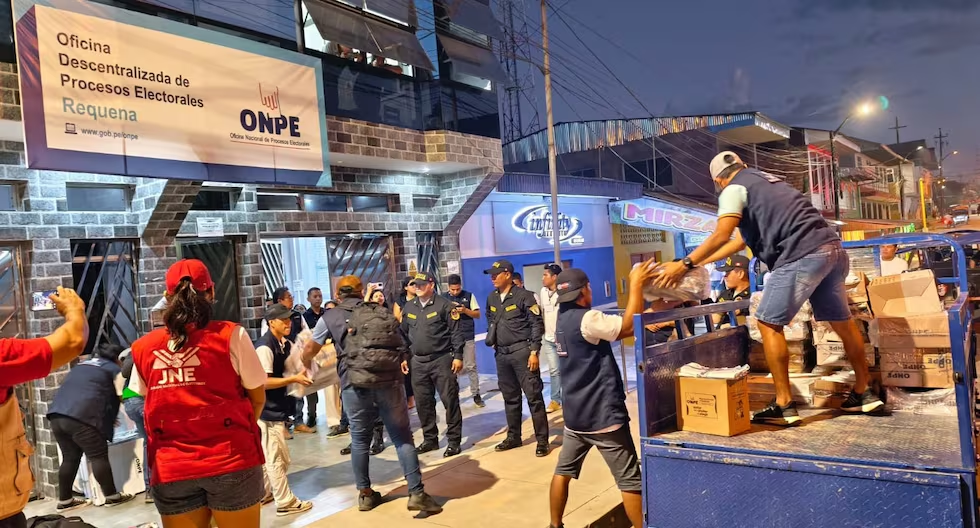
It was by pointing out that today the 9 minutes generated at the voting tables where Peruvians who live in the district of Yaquerana, province of Requena, on the Amazon border with Brazil, voted at the Decentralized Office of Electoral Processes (ODPE) of Requena.
As Yaquerana is not connected to the rest of Peru by road, to transport the electoral material it was necessary to use different means: first a small plane, then a vehicle and finally a boat; always counting on police protection.
The trip, which lasted approximately eight hours, could not be completed earlier due to poor weather conditions. While waiting for these to improve, the material remained at the Yaquerana Police Station.
The bad weather recorded in certain areas of the country has delayed the transport of records by land, air or river. For this reason, only yesterday were the 7 records from the district of Yurúa – province of Atalaya, bordering Brazil – and the 4 records corresponding to two native communities in the Loreto province of Datem del Marañón, bordering Ecuador, able to be transferred to their respective decentralized offices: Puranchin (district of Andoas) and Yankuntich (district of Morona).
In these cases, boats and a National Police (PNP) helicopter were used for transportation. With the arrival at the ODPE Requena, the withdrawal of the material used in the second round has ended.
READ MORE: Observed minutes and vote counting: the ABC of these mechanisms and their impact on the second round
As soon as this finishes being processed in the respective computing center, what will remain pending is the incorporation of what the Special Electoral Juries (JEE) resolve on the contested votes and the observed minutes.
With respect to the records corresponding to the polling stations that operated abroad, the Ministry of Foreign Affairs on Wednesday completed the transfer by air, as a diplomatic bag, of the electoral material.
READ MORE: The south was Roberto Sánchez’s stronghold in the runoff: What are the reasons for this vote?
This was taken, under police custody, from the Jorge Chávez International Airport to the Decentralized Office of Electoral Processes (ODPE) Lima Center 1 for processing.
In the first round, the ODPE Lima Centro 1 received the electoral material in the same way, but was able to advance the processing of records from the day after election day, since the consulates sent it the scanned records. This was possible thanks to the ONPE implementing a technological solution, which has not been used in the second round.
For the 2026 General Elections, the ONPE and the Foreign Ministry had planned to install voting tables in 210 cities around the world.
Due to the lack of logistical and security conditions, in April there were no elections in Venezuela, Iran, Israel, Lebanon, Jordan, Saudi Arabia, Kuwait, United Arab Emirates and Qatar.
For the second round, only the opening of tables in four countries was ruled out: 34 in Venezuelaone in Iranone in Lebanon and one in Ghana.