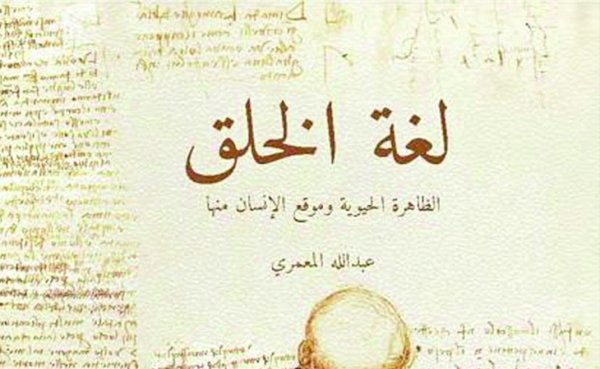
The origin of life has fascinated humanity throughout history. Myths, religions and philosophies have all sought to explain how living beings came into existence, often blending faith with imagination. In The Language of Creation, published by Al Farqad in 2018, Omani writer Abdullah al Maamari approaches this enduring question from a scientific perspective, proposing a conceptual framework that explores humanity’s place within the living world and argues that the scientific method offers the most reliable path to understanding life’s greatest mysteries.
Al Maamari originally set out to study the origins of human language and the reasons behind the diversity of languages. As his research progressed, however, he realised that this question could not be answered without first asking a more fundamental one: how did the being capable of language come into existence? This shift led him beyond linguistics towards the broader story of life itself.
The book is not intended as a specialist work in biology filled with technical data and laboratory evidence. Instead, it is written for the general reader, introducing scientific ideas through clear explanations and drawing on biology, geology, physics, palaeontology and history to address three essential questions: What is a human being? How did humans originate? And how are we related to the rest of the living world?
To answer these questions, Al Maamari first examines the different ways people have understood their relationship with nature. He identifies three broad conceptual approaches. The first is animism, which regards humans, animals and the natural world as spiritually connected. At the opposite extreme is mechanism, influenced by René Descartes, which treats animals as biological machines without consciousness. Between these two lies anthropomorphism, the tendency to attribute human emotions and intentions to animals and other living beings.
According to the author, none of these approaches provides a complete explanation. Scientific inquiry, based on hypotheses tested through observation and experiment, offers a more objective way of discovering reality and avoiding assumptions rooted in tradition or imagination.
From there, the book turns to one of its central ideas: the remarkable unity of life. Humans share striking similarities with countless other organisms, from skeletal structures and internal organs to tissues and cells. The question, therefore, is not why living things resemble one another, but what accounts for their differences.
Al Maamari argues that the answer lies in proteins, whose enormous diversity arises from DNA — the chemical code shared by every living organism. DNA is composed of just four chemical bases arranged in different sequences. Like letters forming different words, these four components create the extraordinary diversity of life. Changes in their arrangement give rise to wings, feathers, claws, leaves and human hands. For the author, DNA is the true “language of creation”, the universal language in which all life on Earth is written.
The book then traces the history of life over more than four billion years. Throughout this immense span of time, living organisms have continually changed in response to environmental conditions. Species emerged, evolved and disappeared, while humanity itself became part of this long evolutionary journey rather than standing outside it.
Natural selection occupies an important place in Al Maamari’s argument. Genetic variation within populations, he explains, allows organisms to adapt to changing environments. Food availability, climate, disease and competition constantly shape which genetic traits survive. Those best suited to their surroundings pass their genes to future generations, gradually altering the characteristics of the species over time.
Another distinctive feature of the book is its attention to scientific terminology. Al Maamari frequently proposes new Arabic equivalents where he believes existing translations fail to capture the original scientific meaning. Among his innovations is replacing the conventional Arabic translation of Homo sapiens with a term he believes better reflects the Latin concept of knowledge rather than simply rationality. He also introduces new terminology to distinguish between biological groups that Arabic translations often merge under a single label.
Despite tackling complex scientific ideas, The Language of Creation is written in elegant, literary prose. Al Maamari combines the precision of scientific reasoning with the narrative skill of an accomplished essayist, making the book engaging as well as informative. Clear illustrations further assist non-specialist readers in understanding difficult concepts.
Equally impressive is the structure of the work. Each chapter builds logically upon the previous one, leading readers step by step towards the book’s central conclusion. Rather than presenting isolated scientific facts, Al Maamari constructs a carefully reasoned argument in which every chapter serves as a foundation for the next.
The result is a work that successfully bridges science, philosophy and literature. It invites readers to reconsider humanity’s place within nature while demonstrating that scientific inquiry and elegant writing need not exist in separate worlds.
Abdulrahman al Maskari is an Omani writer. Translated and adapted by Badr al Dhafari
This is an adapted translation of the original Arabic article published in the print edition of Nizwa Magazine on April 26, 2022.