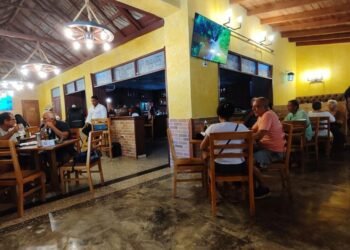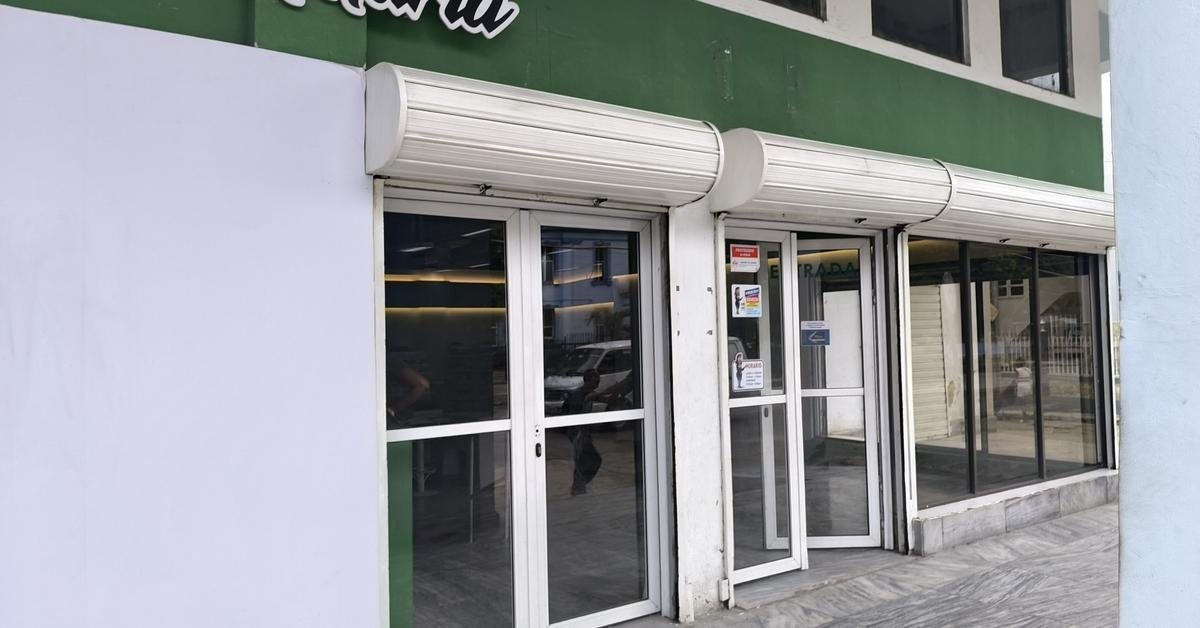
Havana/There has been no official announcement, but the scene speaks for itself: the store on Infanta and Santa Marta, in Centro Habana, which managed Vima along with Gaesa’s Cimex corporation, it no longer has the sign of the Spanish firm anywhere. Neither on the façade nor in the numerous points of the establishment where it could previously be observed. This Wednesday, in fact, the traces of having torn off the name here and there were still visible.
Asked about this, two employees confirmed: “No, the store is no longer Vima, the company is in the process of withdrawing.” On the shelves, however, there are still Vima products – so criticized by Cubans for their poor quality – although none fresh: all canned, packages, knobs. The interior color also continues to be the corporate green and white of the Spanish conglomerate.
The workers could not explain why Vima is leaving or which company they will “go to now,” but one of the employees ventured that “it may be because of the blackouts,” which have been the trend in recent months. For this reason, they justified in the store, the meat area was completely empty. This same Wednesday there was no connection and therefore it was not possible to pay by card, hence the low clientele.
The Vima plan, published by the official press in May 2024, to manage, together with Tiendas Caribe, 20 stores on the Island, is very far away.
This newspaper confirms that, at least since June, there have been very few days in which the store on Infanta and Santa Marta has had power. Unlike other businesses, it also does not have a generating plant for those cases, so the usual scene was to see it closed.
Vima’s plan, published by the official press in May 2024, to manage, together with Tiendas Caribe, is very far away. 20 businesses on the Island. From this agreement only the establishment of Infanta and Santa Marta, one of the first food stores, materialized. payment only in dollarsinaugurated in January 2025.
However, its division in Cuba, Vima Caribe SA, continues to appear on the Galician company’s website, with warehouses on Carretera de Berroa, on the outskirts of the capital.

/ 14ymedio
These facilities, not very visible within the immense complex, are in operation. Vima has three warehouses in Berroa, and only one still has merchandise. The other two are empty. Inside the full warehouse, employees move around in green corporate sweaters.
Beyond the energy crisis, which certainly deeply affects companies that do not have alternatives to generate supplementary electricity, the reason for the withdrawal of the Vima name from Centro Habana must be sought in the latest news that has come from the United States.
On August 30, the US-Cuba Economic and Trade Council (US-Cuba Trade) revealed that Vima World SL had hired the lobby Continental Strategy LLCwhose team included former US officials and advisers linked to Donald Trump and Secretary of State Marco Rubio. The contract, registered with Washington in July, stated as its objective the search for “project opportunities in Latin America.”
Just five weeks later, Continental Strategy – which claimed to have been paid $37,742 for its work – broke the contract.
However, just five weeks later, Continental Strategy – which declared that it had been paid $37,742 for its work – broke the contract. The consulting firm did not explain why in its final report presented to Congress, but it did explain that the State Department was among the government agencies contacted during its efforts.
Both that breakup and the withdrawal of the Central Havana store occur at a time when the United States does not stop bombing with expansions of sanctions against Havana. The most recent, effective today, include the ban on professional travel and the freezing of accounts of private Cuban companies in US banks.
It is not surprising that Vima finds itself in the crosshairs of sanctions for its association with the military conglomerate Gaesa. The commercial link it has with the Island passes directly through the northern country. According to US-Cuba Trade, Vima World exports American agricultural products and foods to Cuba through Vima USA Ltd, which maintains operations in New York and Miami. The company itself confirms both offices on its website.
/ 14ymedio
Cuba is also the Spanish group’s main market. The latest disclosed accounts of its Galician subsidiary show a turnover of almost 106 million euros, with around 49 million from operations with Cuba.
The origins of the emporium are, however, less transparent. Although Vima presents itself as a company linked in its beginnings to the Galician fishing sector, its founder, Víctor Moro Suárez, has never hidden his relations with the Island. In Havana, on the other hand, in December 2023, his son got married in styleVíctor Moro Morro-Sarda, who holds the position of vice president of the group but is the one who currently holds the reins.
Son of Víctor Moro Rodríguez – a politician of the Spanish Transition who died in 2021 and who was also in charge of a frozen conglomerate –, Moro Suárez lived on the Island for 25 years, where he was president of the Association of Spanish Businessmen in Cuba until 2014. In a 2006 interview, he acknowledged his friendship with Fidel Castro and the origin of the business on the Island: “I found a work niche in the Caribbean area, starting from Cuba, and that circumstance led me to organize this group of companies.”
Despite boasting rapid expansion in its 32 years of experience throughout different regions of the world, Vima World does not have its own food factories.
Vima World Ltd. was incorporated in January 1994 in the British Virgin Islands and appeared years later in the Panama Papers among the companies registered through the Mossack Fonseca law firm. This law firm, precisely, decided to break its relations with companies linked to Moro in 2016, after concluding that its operations in Cuba could expose the firm to United States sanctions.
Despite boasting rapid expansion in its 32 years of experience throughout different regions of the world, Vima World does not have its own food factories, except for some stakes in associated companies. Its business model is based on buying products from suppliers in more than 40 countries – such as Chile or India – and then placing a label with its name on them and distributing them in the markets where it operates.
/ 14ymedio
Regarding the situation of the company in the face of the current crisis that the Island is going through, with the withdrawal of the majority of foreign hotel companies that operated in Cuba’s tourism sector, the Vima manager acknowledged in an interview with The Country: “The situation is complex, we have been in the country for a long time trying to serve the hotel sector, which is now in a major depression.”
According to the data communicated by the company, Vima expects to invoice $250 million in 2026 worldwide, more than double what was reported in 2024. The Spanish company assures that it also expects to double that income in five years, thanks to the expansion of its businesses in America and the “jump” to markets in Europe and Africa.
In 2001, its income had been 25 million euros. That is to say, in a quarter of a century, business multiplied almost tenfold. How a company could be founded in Cuba, run by a foreigner, in the mid-nineties, and reach those figures in a few years, is one of the unknowns posed by Vima, which began to appear in establishments on the Island just at that time, that of dollarization and the desperation of the Special Period.