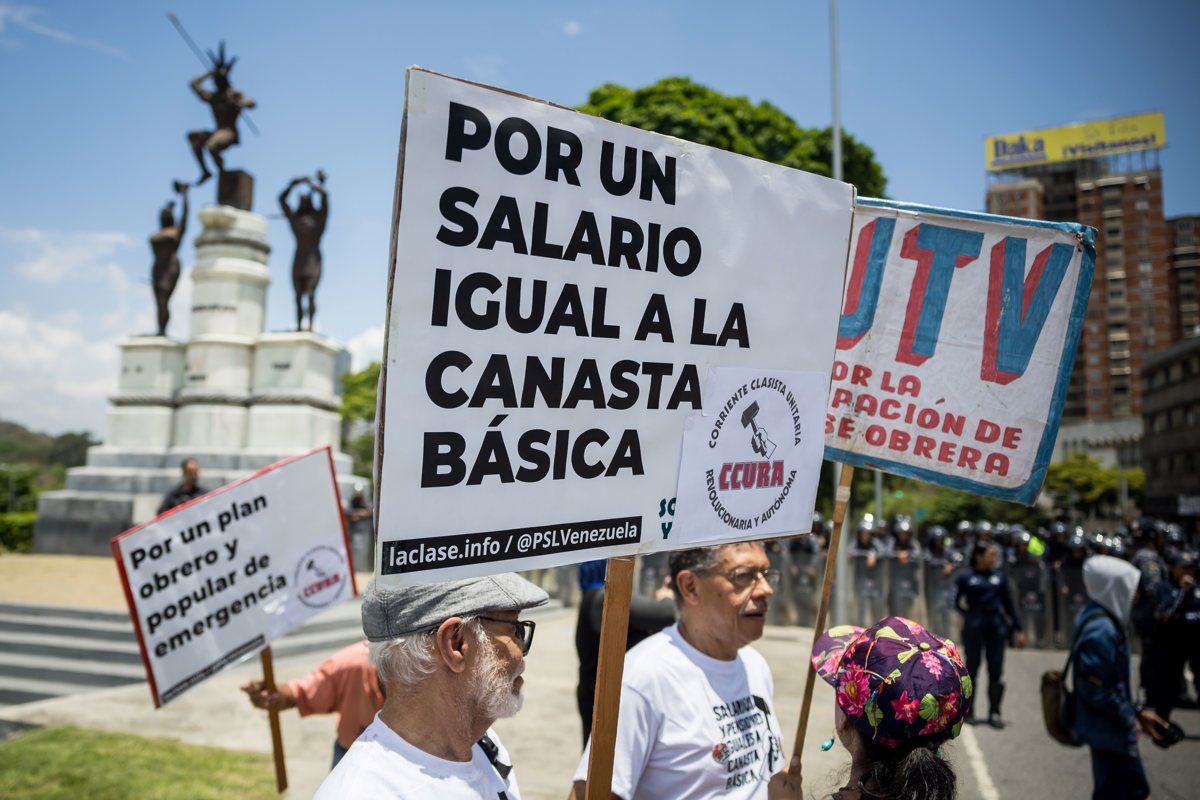
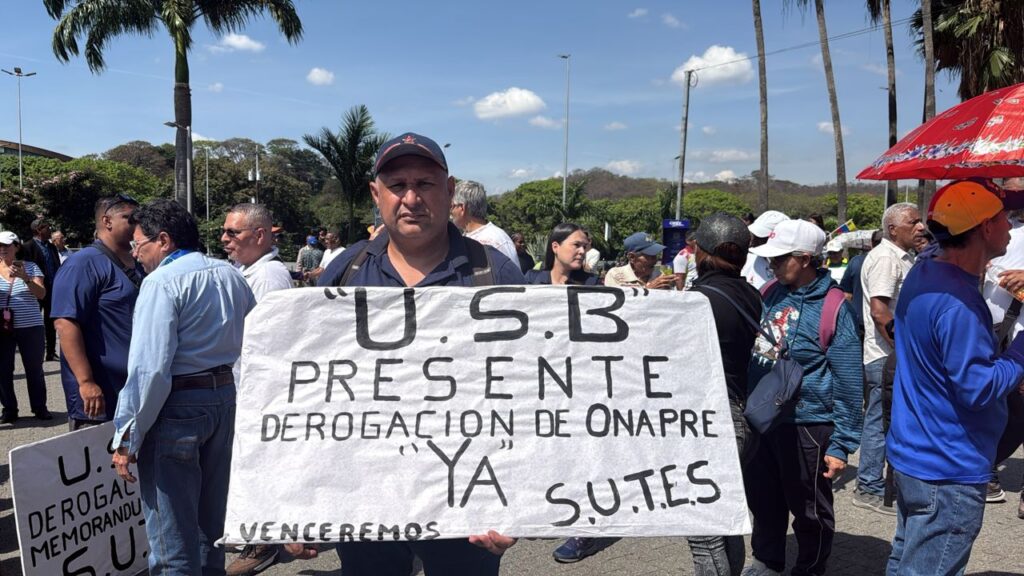
Last Thursday, April 9, more than 2,000 protesters gathered in different parts of Caracas with the intention of marching towards the Miraflores Palace to demand decent wages for Venezuelan workers from the National Executive. The mobilization in the capital occurred simultaneously with at least 29 protests in 14 states of the country, according to the Venezuelan Observatory of Social Conflict (OVCS).
The day before, in an attempt to weaken the workers’ call, interim president Delcy Rodríguez appeared on national television late at night. The message, announced during the day and amplified by official spokespersons and state media as “urgent” and “important”, sought to focus the attention of Venezuelans. However, expectations were not met: the speech was limited to announce a “responsible increase” effective as of May 1, reiterate that the minimum comprehensive income was around $190 and call for the rejection of international sanctions.
Far from defusing social unrest, the Executive’s pronouncement—without exact figures and concrete amounts—was received by the unions as insufficient and as a maneuver to demobilize the protest. Consequently, the effect was the opposite of what was intended: it ended up reinforcing the mobilization the next day, as the workers perceived that the interim was not willing to concretely address their salary demands.
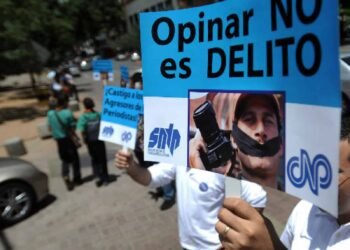
Faced with the workers’ determination to march to Miraflores, Rodríguez ordered the police forces to repress the demonstrations and prevent their advance towards the presidential palace, which left multiple people injured and detained. Human rights organizations confirmed the arbitrary detention of at least four young people, while the National Union of Press Workers reported physical attacks, use of chemical agents and destruction of work equipment against a dozen journalists who were covering the protest.
Faced with the violent response of the Executive, the unions warned that the protest would not stop and that, on the contrary, it would intensify until “they conquer all rights” and obtain concrete answers to their salary demands. In this context, they called a new day of protest for next Thursday, April 16, with the purpose of taking their salary claims and complaints of repression to the United States embassy in Caracas, under whose tutelage the interim regime is currently.
How and why wage protection was destroyed in Venezuela
In Venezuela, the salary must comply with the “principle of sufficiency”, enshrined in article 91 of the Constitution, according to which remuneration must guarantee the worker and his family a dignified life and coverage of their basic needs, not only material, but also social and intellectual. Furthermore, the salary is not limited to the monthly income: a good part of the economic protection associated with employment is calculated and constructed from it, such as social benefits, paid vacations and profits, rights designed to guarantee stability against unemployment, the effective enjoyment of rest and the worker’s participation in the fruits of the company.
In practice, as of 2022, this labor protection framework stopped working in Venezuela. That year the National Executive froze the minimum wage and replaced compensation adjustments with non-salary bonuses as a mechanism to compensate for the impact of inflation.
This measure was conceived by the Nicolás Maduro regime as a political solution to reduce social pressure, by occasionally increasing – always insufficient – the income that the worker received monthly, but without increasing the rights associated with the base salary, as established by law.
Since then, this wage policy has progressively eroded workers’ long-term economic protection. After four years of repeated application, social benefits and workers’ pension assets—calculated on the basis of a frozen salary—have lost almost all of their real value.
Survival income for public workers, retirees and pensioners
In concrete terms, since March 15, 2022, the legal minimum wage remains at 130 bolivars, which is equivalent to 0.27 US dollars at the official exchange rate of the Central Bank of Venezuela (BCV). At the same time, the National Executive shifted the policy of increasing remuneration towards the so-called “Indexed Minimum Comprehensive Income” (IMII), which for April of this year amounts to 190 dollars per month for active workers in the public administration and is composed mainly of non-salary bonuses: 40 dollars for Cestaticket and 150 dollars corresponding to the Economic War Bonus.
In the midst of an annualized inflation that reached 617.94 percent in February of this year, the $190 of the IMII barely covers 29.4 percent of the family food basket, which in February reached $645.67 according to the CENDA-FVM.
On the other hand, in the public administration, the freezing of the base salary and the introduction of practically equal non-salary bonuses for all workers has given rise to the phenomenon of “flattening” of income. This means that, in practice, regardless of position, seniority, training or level of responsibility, the remuneration of public officials ended up leveling downwards, around a minimum survival threshold.
The situation is even more serious for public administration retirees and Social Security pensioners. The first, who total around 5.5 million beneficiaries, currently receive an income close to 60 dollars. While the second – who according to unofficial estimates are between 700,000 and 1.2 million people – receive an approximate amount of 131.86 dollars. These incomes barely represent 9 percent and 20 percent, respectively, of the family food basket.
The private sector worker is also unable to cover the family food basket
In the private sector, the situation improves slightly. This sector employs around 2.2 million people and offers more competitive conditions to attract and retain talent. According to the most recent survey by Nayma Consultores (April 2026), the median income of a worker is $180 per month, while that of administrative professionals registers $490.
Although the private sector also uses bonuses as a complement, most of the remuneration remains salary, between 44 and 61 percent of total income. Even so, salaries remain insufficient compared to the cost of living: the median income of a worker covers only 28 percent of the family food basket, while that of an administrative professional reaches 76 percent, without being able to cover it in its entirety.
Workers and pensioners took to the streets to demand higher payments on March 23. Image: Javier Campos/NurPhoto/picture alliance
Faced with this profound distortion of the salary system, the most recent communications from unions and unions agree on at least four central demands: an increase in the base salary —and not only bonuses—; the salaryization or incorporation of these bonuses into the salary base; periodic salary review to avoid depreciation; and the opening of a real dialogue that guarantees collective bargaining, instead of unilateral announcements from the Executive.
Delcy Rodríguez’s dilemma
In this context, Delcy Rodríguez’s room for maneuver is narrowed between the just and urgent social demands and the severe fiscal limitations of a country whose productive system has been devastated for almost two decades.
Although public income, after Washington’s tutelage was imposed, has shown a slight recovery, it is estimated that the national budget today does not have sufficient capacity to sustain increases that equal the minimum wage to the cost of the family food basket. The private sector is in a similar situation, which remains fragile and, faced with very reduced operating margins, would end up transferring significant salary increases to prices or employment.
In addition to this, given that Venezuelan legislation establishes a system of retroactivity of social benefits, the salaryization of the bonuses – with the accumulated gap of four years – would have a financial impact of enormous magnitude for both the public and private sectors. The problem is complex and its solution requires, as labor specialists such as Yair de Freitas have pointed out, broad consensus that makes possible profound reforms of the country’s productive system.
However, the Venezuelan experience shows that lasting consensus on labor matters has only been possible when there has been a government with sufficient legitimacy and trust to bring together business unions and legitimate workers’ representatives, and arbitrate stable agreements between them, such as the one reached in 1997 under the presidency of Rafael Caldera, then recklessly dismantled by Hugo Chávez in 2012.
Today, without a point of institutional balance, with an interim president whose legitimacy is widely questioned, who is also co-responsible for the salary debacle suffered by workers and who does not enjoy the trust of the labor sectors, it is difficult to imagine that salary tensions can be channeled constructively and the necessary consensus can be reached to undertake profound transformations in the country’s labor and production system.
With information from DW News