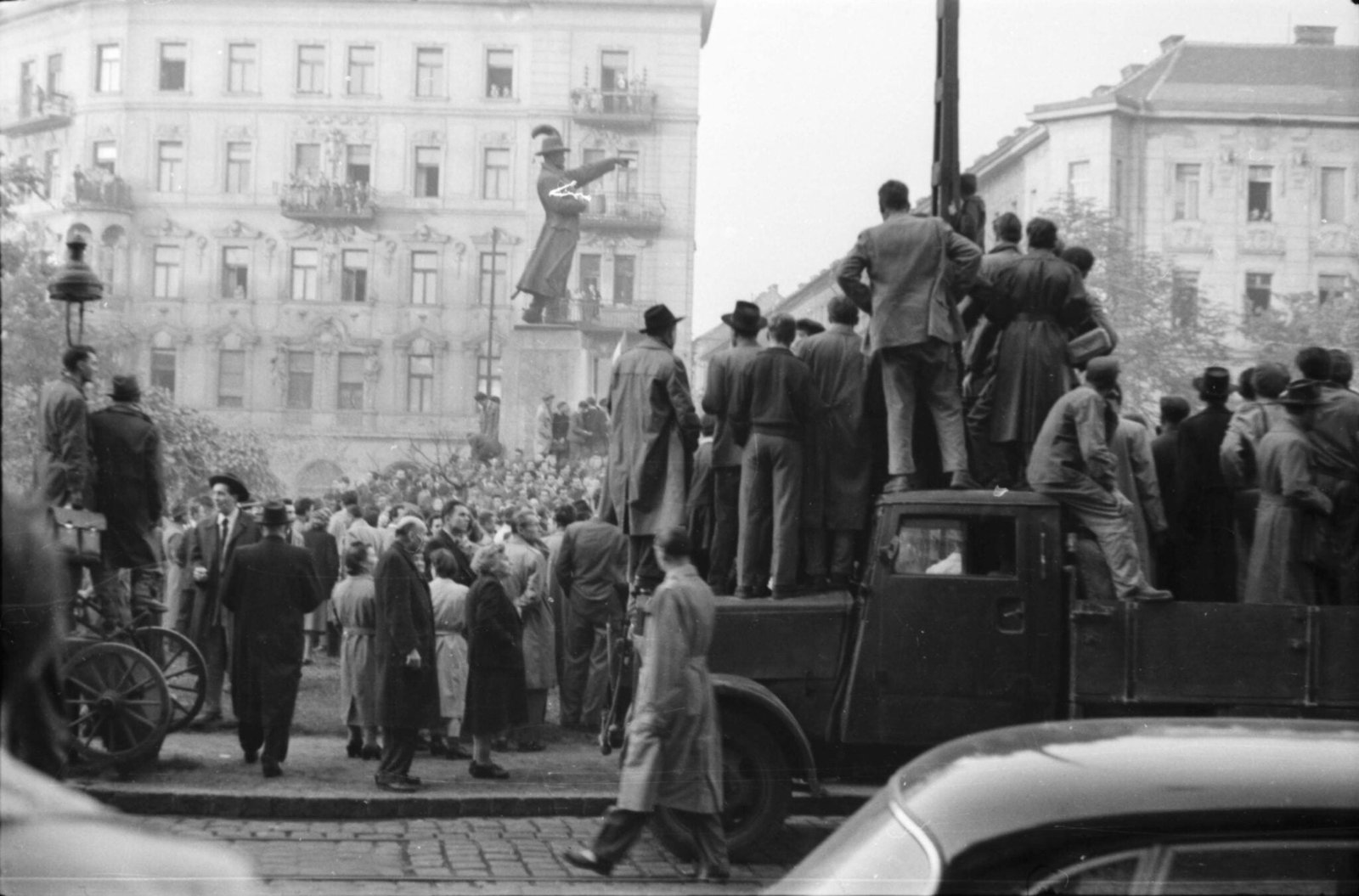

Demonstration on October 23, 1956, at the Bem Monument in Budapest
The revolutions in Hungary and Poland in 1956 have become the most important milestone in the collective memory of the 20th century, as that year became a symbol of the quest for freedom among societies subjugated by the Soviet Empire, explained the chair of the Committee of National Remembrance (NEB) at a conference in Budapest.
At the opening of the conference titled “Revolution on Two Fronts – The Year 1956 in Poland and Hungary,” the French writer Albert Camus, who believed that the workers’ uprising in East Berlin, as well as the 1956 revolutions in Poland and Hungary, constituted a colossal myth that led to the collapse of the myth of communism. Dr. Réka Földváryné Kiss emphasized that the struggles for freedom around the world had provided a cross-generational experience and a new moral force, which makes the events of 1956 in Poznań and Budapest still relevant 70 years later. One commonality among the 1956 uprisings is that the youngest victims, Romek Strzalkowski and Péter Mansfeld, are commemorated in Poznań and Budapest with a street and a memorial plaque, respectively.
Karel Polejowski, Vice President of the Polish Institute of National Remembrance (IPN), recalled the commonalities between Polish and Hungarian history and concluded that Hungarian-Polish friendship was cemented by the revolutions of 1956, as communism was never successfully reestablished thereafter.
Jacek Śladewski, Chargé d’Affaires at the Embassy of the Republic of Poland in Budapest, expressed the view that the conference was one of the most important events of the year in the field of Polish-Hungarian relations. In 1956, he noted, both nations had shared aspirations:
freedom, dignity, and the attainment of greater autonomy for their societies.
Thus, Poznań and Budapest had become symbols of the courage of Central European societies and resistance against the communist system, he said.
Jarosław Bajaczyk, director of the Polish Institute in Budapest, recalled that in Poland thousands donated blood to help the fighters in Budapest, that medical supplies and other aid were sent to Hungary, and that the events inspired the Polish intelligentsia.
Karol Biernacki, chairman of the board of the Wacław Felczak Foundation, stated: “We stood by one another” over the centuries wherever it was necessary to demonstrate the desire for freedom.
The two-day conference continued with panel sessions in which researchers analyzed not only the two revolutions but also the path leading up to them, as well as the subsequent stabilization and consolidation. Other Central European movements against communism were also discussed. During this time, the exhibition “Bombed Cities – Poznań-Budapest 1956” is on display in Hungarian, Polish, and English in the NEB exhibition space.
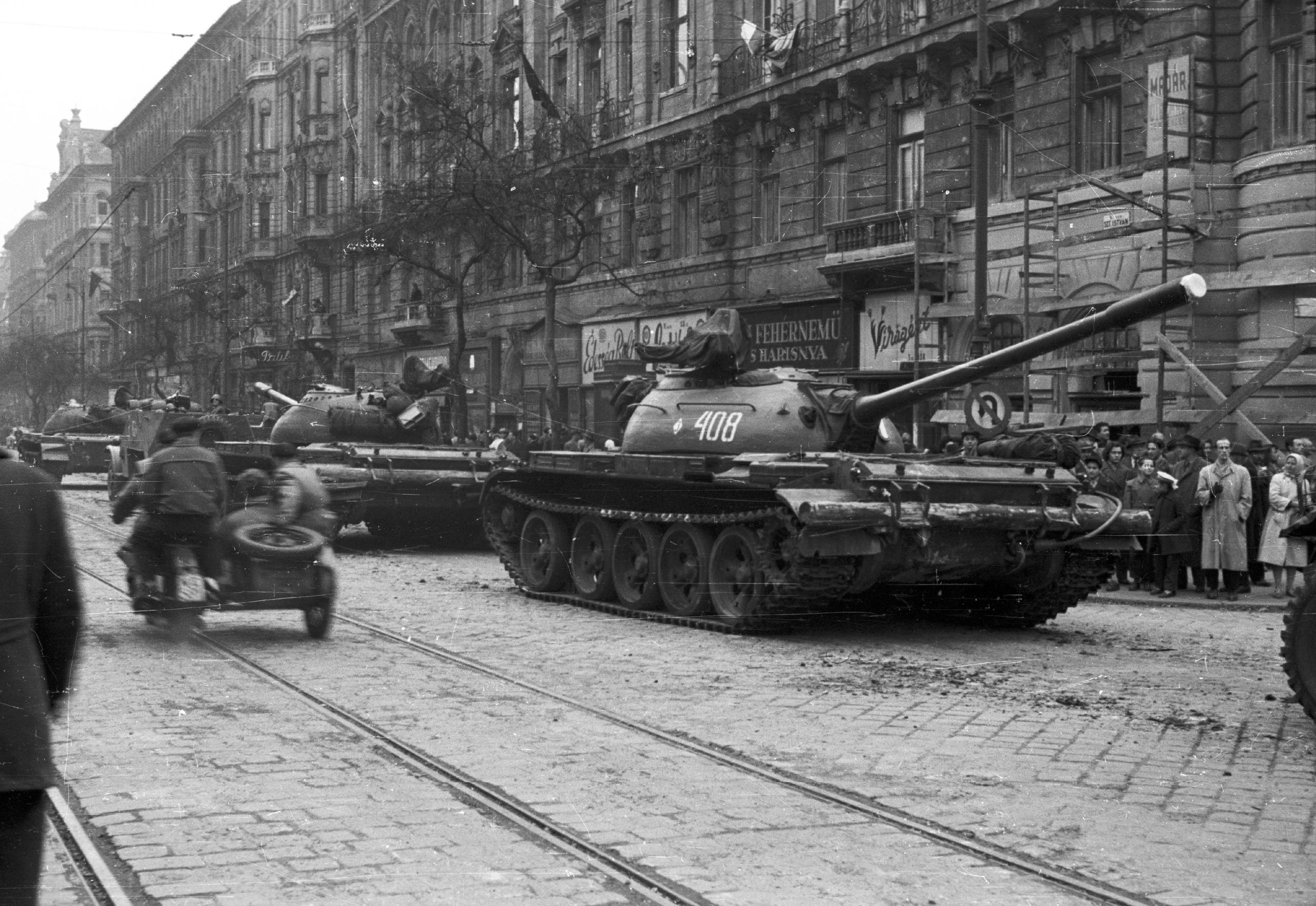
Via MTI; Featured image: Fortepan/Faragó György