Despite all the wonderful plans, this government has also postponed everything and put it on hold. Resolutions therefore remain resolutions, not only because of a lack of money but also because of a lack of political will. A lot of money has been borrowed in the meantime, but it is hardly spent on necessary projects. It is mainly intended for the government to be able to survive financially until 2028, or at least that is what is – completely wrongly – assumed.
Text Armand Snijders
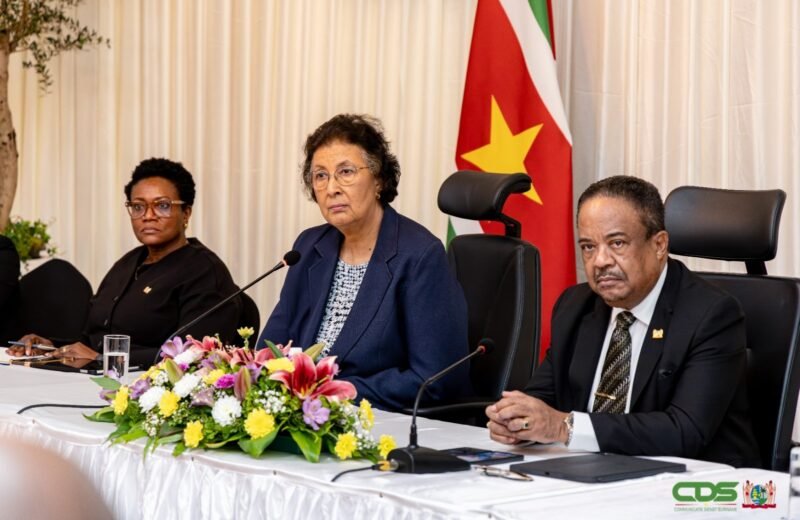
Image CDS
When the refrigerator of the Geerlings-Simons cabinet is opened, an icy wind of stagnation blows. What is immediately striking is the lack of pace in the promised economic expansion. Last year there was a lot of shouting about the fatal dependence on raw materials. Tourism and agriculture would become the new drivers of the economy.
“The VES puts its finger on the sore spot: after more than a year, the so fervently preached slogan ‘kenki a system’ is still nothing more than an empty marketing slogan”
What is the reality twelve months later? An impressive collection of committees, working groups and discussion groups, but no tangible change in the Surinamese fields or in the hotel sector. It stays with paper.
Path of least resistance
The same applies to the promised fiscal discipline. The restructuring and reorganization of the cumbersome, inefficient government apparatus – an absolute must to make this country financially healthy – has been quietly parked. Coalition partner A20 is now quietly sounding the alarm, but within government offices they prefer to take the path of least resistance.
Major infrastructure projects have been put on hold under the guise of ‘first getting the administration in order’. It is classic Surinamese procrastination, wrapped in bureaucratic jargon. And then we haven’t even talked about tackling corruption; it is also not a visible priority of this government.
Of course, the Geerlings-Simons cabinet has a handy alibi. President Jennifer Geerlings-Simons and her ministers point an accusing finger abroad. After all, geopolitical tensions in the Middle East pushed international oil prices to record levels last year. To protect Surinamese citizens from a fatal blow at the pump, the cabinet said it had to immediately switch to crisis management. A price ceiling on fuel was introduced, causing the state treasury to receive hundreds of millions of Surinamese dollars every month government take went wrong.
Electoral peace
It is an argument that makes no sense at first glance. To maintain social peace, a little money was distributed to vulnerable groups, civil servants and disabled people; not enough, but enough to keep them happy. But this ad hoc policy puts its finger on the sore spot: this government also only reacts to fires that have arisen instead of preventing them.
The ambition to tightly rein in state spending was thrown overboard at the first whiff of headwind. People opt for short-term electoral peace at the expense of long-term structural health.
Criticism from society is therefore increasing rapidly. VHP faction leader Asiskumar Gajadien has a point when he states that after a full year the government has still not presented a clear, detailed policy direction. Plans remain stuck in general principles and ideological perspectives.
But it is especially the damning judgment of the Association of Economists in Suriname (VES) that hits hard. The VES puts its finger on the sore spot: the so fervently preached slogan ‘kenki a systemAfter more than a year, ‘ is still nothing more than an empty marketing slogan. Tangible results at the macro level are painfully lagging behind.
A political illusion
The head of state’s defense is as predictable as it is transparent. According to Geerlings-Simons, the past year was a ‘repair year’. Fires had to be extinguished, payment arrears cleared and debts refinanced to avert an impending state bankruptcy. But the assumption that Suriname will be able to survive financially until 2028 without taking drastic measures is a political illusion.
The billions in loans taken out by the couple President Geerlings-Simons/Minister Adelien Wijnerman of Finance and Planning are just an expensive way to buy time. If this spare time is not used for tough, structural reforms, the country will be an oil producer in 2028, but at the same time financially unmanageable, (international) experts warn.
The Geerlings-Simons government has actually pressed the pause button. Crisis management has taken the place of the promised transformation. And for the distant future? There is now the ‘Roadmap 2029-2050’ for this purpose. A beautiful document, but visions that extend to the year 2050 have virtually no value for the Surinamese citizen who cannot pay his electricity bill today.
Soak and keep wet
What has been seen in the past year is not a system change, but a continuation of the Surinamese political tradition: stick it out and keep it wet. That is comfortable for the political elite, because real reforms cost votes.
However, Suriname cannot afford this standstill. If the government continues on this path, the current icebox will soon prove to be too small for all unexecuted plans. Then the country is indeed ready for a larger refrigerator, but one in which the future of Suriname is permanently frozen.