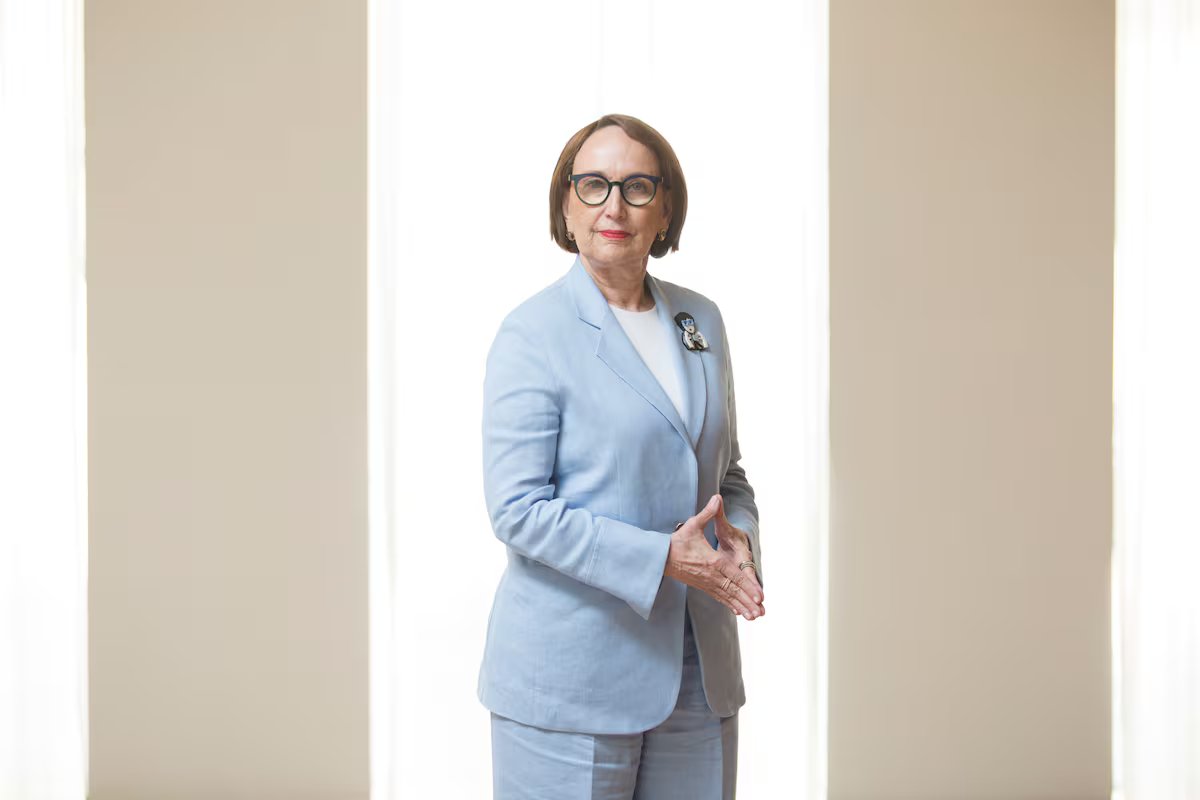
Rebeca Grynspan (San José, Costa Rica, 70 years old) aspires to be secretary general of the UNa position that António Guterres will vacate on December 31. Just two days after his public hearing before the United Nations General Assembly in New York, he landed in Madrid to begin his international campaign. Then he will go to London, Paris, Rome, Berlin… to hold discreet political meetings in some and communicate massively in others, as appropriate. He has come to Spain for the latter: he wants to communicate his project “first in Spanish.”
“I lived seven very happy years of my life here,” he remembers his time at the head of the Ibero-American Secretariat (2014-2021)based in Madrid. He left that position to take charge of the United Nations Conference on Trade and Development (UNCTAD). In both cases she was the first woman in the position. A milestone that could be repeated in the UN General Secretariatwhich has always, in its 80 years of history, been led by men. She is convinced that she can revive the United Nations, which is suffering from a crisis of credibility and which some want to consider dead.
Ask. Everybody talks about reform the UNbut what real room for maneuver does a Secretary General have to do so when the Security Council is blocked by the great powers?
Answer. The United Nations system is complex. The secretary general has much more authority over the secretariat, which is not a small number of people, and less over independent agencies or technical organizations. It is not that a decree from the Secretary General can reform the different families of UN organizations. And some decisions have to be made by countries. However, the proactive and purposeful attitude of the secretary general is a fundamental element of any reform.
Q. What do you propose, beyond spending less?
R. It is no secret to anyone the moment that the United Nations is going through in terms of its budget, for the non-payment of responsibilities by some members. You have to focus on the main objectives, refocus on the fundamentalsto be more effective.
Q. What is more urgent: achieving a more compact structure or changing priorities?
R. There is an urgency to once again put peace and security as a fundamental objective. The office of the secretary general must give greater space for the topic of prevention and mediation.
Q. Are there organizations that today duplicate functions, that have lost meaning and that must be reduced?
R. There are mandates that perhaps have lost their meaning because they are very old and that perhaps should be reviewed. That is up to the countries. But yes, in the United Nations there is duplication and often unhealthy competition between organizations.
Q. You present yourself as a consensus candidate. Where do you draw the line between reaching consensus and avoiding making difficult decisions, especially when the political cost may be high?
R. I have a lot of experience in that. I have had a very extensive political life and I have managed to have an independent profile, make difficult decisions and at the same time ensure that the differences that may arise do not become irreconcilable, that they do not prevent maintaining a constructive dialogue. It’s part of any leader’s job.
Q. The Security Council does not represent today’s world but rather that of 1945. Is reforming it inevitable if the UN wants to regain legitimacy?
R. I think so. The United Nations Charter was signed by 51 countries, today we have 193; That is to say, there are 142 who were not there at the time the institution was formed. They joined later. There is a clamor from those countries to have a voice.
Q. Reforming it would imply, sooner or later, opening the United Nations Charter. Are you willing to take on that debate or do you think that right now it is more dangerous than useful?
R. It has been renovated three times, it is not true that it cannot be done, but it is a complex process. The Charter can only be opened by countries, not the Secretary General.
Q. It does not seem that the great powers are going to give up their right to veto on their own. The countries that exercise the veto have to explain it to the entire membership
R. It’s true. But at least a resolution passed in the General Assembly, by which The countries that exercise the veto have to explain it to the entire membership. Improves transparency of Security Council decisions.
Q. Among the various proposals, from including more countries as permanent members to changing working methods, which one do you align with?
R. A secretary general should not align himself with a particular reform. What I have said is that the Security Council would have greater weight if it better reflected today’s world.
Q. What can a general secretary change then?
R. It cannot be that, at a time when there is a very worrying increase in conflicts in the world, the United Nations is not at the negotiating table. The UN has to be there. Avoiding war, human suffering and the dehumanization that it entails is a responsibility that is given by the United Nations Charter in its article 1. The tasks of preventive diplomacy and mediation are part of what is called the good offices of the secretary general.
Q. Ten years ago there were 13 candidates to occupy the General Secretariat and now, for the moment, there are four. Is running the UN a less attractive position now?
R. I think you have to have a lot of courage to assume this position and this responsibility at this time. I am brave.
Q. Don’t you think that this reduction in applicants means an erosion of the position?
R. All institutions, after years, have to assume that there is natural wear and tear. Many people say that it is not an era of change but a change of era, where institutions in general lag behind reality. Even so, I believe that the United Nations is an institution today more necessary than ever. We must not fall into fatalism because fatalism only leads us to inaction.
Q. He conflict in Gaza has exposed the UN’s inability to stop a massacre, and many people ask: if the UN can’t stop this, what good is it?
R. It’s true. We have a very deep concern for the violations of international law and international humanitarian law which precisely arises after World War II. But having a world with law is not the same as having a world without law, even if that law is violated on some occasions, because at least we have the standard, the moral compass. And, at some point, there may be a call to account. The world cannot lose that voice and that voice is in the United Nations.
Q. How would you explain to someone the usefulness of that moral compass when they see images of destruction and death on their phone?
R. Always in history we have had tension between law and power. And precisely we need the law and institutions to put a limit on the indiscriminate use of power over people. If we weaken them we are not going to have something better, we are going to have the unrestricted use of power, which leads to barbarism.
Q. Are you worried that the war in the Middle Eastalso in Ukraine and other forgotten conflicts, irreversibly damage the moral credibility of the UN and reduce it to a powerless witness?
R. Yes, it worries me. Sometimes I worry more about the possibility of ceasing to exist, the irrelevance.
Q. Beyond statements and appeals, what would be the first conflict in which you would try to demonstrate that the position of secretary general can make a difference?
R. We cannot make a ranking of conflicts because in all of them there is human suffering. We have to pay attention to everyone. Of course, there are two on which the entire world has focused its attention due to its global consequences: the Middle East and the war in Ukraine. But I also want to draw attention to the conflict in Sudan, where there is more death than anywhere else on earth.
Q. The UN is accused of using convoluted and abstract language. Do you share that criticism?
R. Completely. I remember very well, when I arrived at the United Nations Development Program, that they gave me several things to read and I did not understand anything. I told my family: “I am an intelligent, prepared, experienced person—I had already been vice president of my country—: how is it possible that I cannot understand what they are telling me?” Two years later, I spoke the same. We have to make an effort to communicate in a different way.
Q. Is clearly naming those responsible for violations of international law compatible with diplomacy?
R. You have to talk to all parties. If you exclude one, you cannot mediate or open spaces for understanding. And that doesn’t mean we don’t name things by their name. Being impartial does not mean being silent.
Q. If she becomes the first woman to be UN Secretary General, what would that change in practice and not just in symbol?
R. Men and women have the capacity for leadership, but it is true that, due to our own practice, we (women) have a greater predisposition to open spaces for dialogue. And the only thing I ask is that there be no discrimination. I have suffered it, it is not something conceptual. I am not asking for preferential treatment, but for equal treatment.
Q. For decades, women faced a glass ceiling in the general secretariat. Now, not without irony, there are those who propose that being a woman acts as a springboard because “it’s time.”
R. Could it be that women reach the top only when it is an impossible job? Well, I don’t believe that. I think it’s underestimating ourselves. Women are not a vulnerable group, we are a group whose rights have been violated, which is different.
Q. The next secretary general is very likely to be from the global south. Does it mean that there is a moment of crisis in Western leadership?
R. No. There are two facts to explain this transformation: today 75% of world growth comes from the global south and south-south trade is as large as north-north trade. There are different economic poles that must be recognized.
Q. What would you say to the countries of the global south that feel that the UN has been asking them for patience for decades, without changing the real rules of power?
R. In the General Assembly we have seen a change, there the global south is represented in an equitable way, and in the General Secretariat my commitment is to respect geographical diversity. The issue is more in the Security Council.
Q. You often cite the Black Sea agreement (achieved by UNCTAD at the beginning of Russia’s war in Ukraine) as proof that negotiation is possible even in war. What lessons do you draw for other peace processes?
R. He Black Sea agreement It is an example of creativity. First, we made relevant the fact that not only the countries around the conflict were being affected, but all of them. Second, it was an example of prevention, because the negotiation was to prevent a food security crisis in the world.
Q. Do you prefer a discreet UN that survives or a UN that is exposed, even if it has costs?
R. Both things are necessary. Subtle diplomacy, out of the spotlight of the cameras, is a very important part of the good offices of a general secretary. But sometimes it is inevitable to be in front of the cameras, to be visible. And say what needs to be said.
Q. What wouldn’t you be willing to do even to win this election?
R. The only person with whom one has no choice but to live one’s entire life is oneself. He wouldn’t betray me.