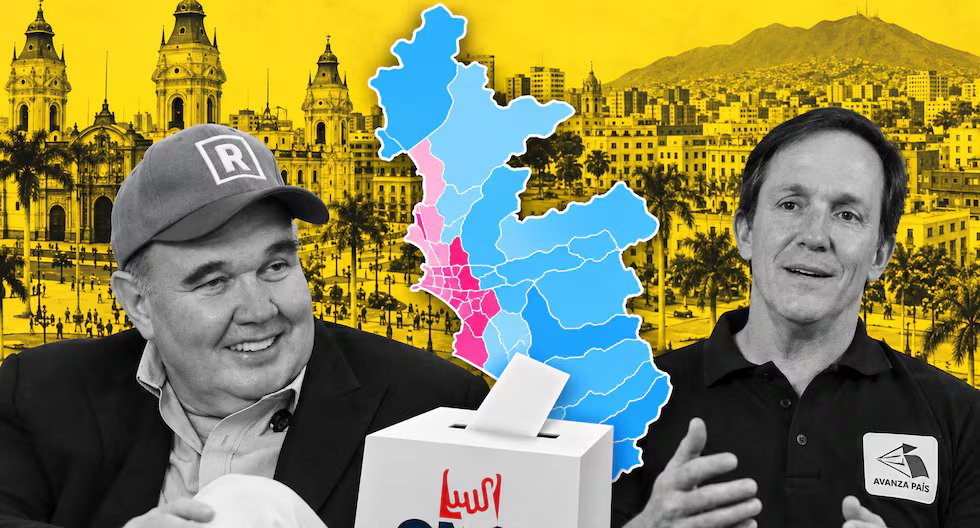
The map of districts in which the party of Lopez Aliaga It changed substantially between 2022 and 2026. While four years ago it prevailed mainly in Central Lima and Modern Lima, this time it had greater support in districts of Northern Lima, former stronghold of Daniel Urresti.
According to the National Election Jury (JNE), despite the victory of his group, the leader of Renovación Popular will not be able to hold the position of mayor for the next four years. The electoral body argued that the first elected councilors who have held the position of mayor between 2023 and 2025 will not be proclaimed nor will they be able to nor will they receive the credentials to serve as mayor in the next municipal period. This task would be entrusted to Jeanette Alonzo, second councilor on the Popular Renewal list.
What changes in the voting pattern led to the victory in Metropolitan Lima of Renovación Popular? Districts such as Ancón, Santa Rosa, Carabayllo, Comas, Independencia, Los Olivos and San Martín de Porres – where Daniel Urresti had obtained the largest vote in 2022 – preferred López Aliaga’s group in 2026. The same change occurred in Rímac, Cieneguilla, San Juan de Miraflores and Lurigancho.
These additions were joined by Puente Piedra and Lurín, where Somos Perú was the organization with the most votes four years ago.
In contrast, Renovación Popular stopped winning in eight districts, including Breña, La Victoria, Cercado de Lima, Pueblo Libre, San Luis, San Miguel, Magdalena del Mar and Surquillo, where Francis Allison’s Avanza País now obtained the largest vote.
In total, Renovación Popular won in 26 of the capital’s 43 districts, five more than four years ago.
Migration
Of the 21 districts where Renovación Popular had obtained the highest vote in 2022, it retained 13 and lost eight to Avanza País. However, it won 13 other jurisdictions: 11 where Podemos Perú won four years ago and two led then by Somos Perú.
On the other hand, eight of the 15 districts where Francis Allison obtained the largest number of valid votes in 2022 mostly supported Renovación Popular. In the other seven, Podemos Perú had been the group with the most votes for the provincial mayor’s office.
Although in these elections Somos Perú did not win in Puente Piedra or Lurín, it did maintain Pachacámac and also won San Bartolo. In this town, four years earlier, Daniel Urresti obtained the highest percentage of valid votes.
The most pronounced territorial decline corresponds to Podemos Peru. The group, which had won 19 districts in 2022, did not win any districts in these elections.
Less support
Together, the candidacies of Renovación Popular and Avanza País concentrated 54.49% of the votes of Lima residents.
The figure is slightly higher than the 51.7% obtained between the first two places in the 2022 elections, but it is also the second lowest concentration of the vote in the last 20 years.
Furthermore, the 27.68% obtained by Renovación Popular represents the lowest figure achieved by a group in its re-election.
The factors behind
What events helped reconfigure the Popular Renewal vote in these four years? For Alejandro Boyco, political scientist and researcher at the Institute of Peruvian Studies (IEP), in 2022, López Aliaga was perceived as the main opposition figure to former president Pedro Castillo, especially in the districts of central Lima or Modern Lima. In 2026, however, the vote was defined by the evaluation of his previous management, marked by the inauguration of works, mainly in the periphery.
“Unlike Francis Allison and Carlos Bruce, López Aliaga has had an explicit position during four years of campaigning. It should also be said that several of the district mayors of Renovación Popular, who arrived almost by accident, made poor efforts. This wear and tear may be explaining the lower support for López Aliaga (in Lima Centre). On the other hand, his main policies promoted were aimed at Lima Norte and Lima Sur. For example, the cancellation of tolls, the Southern Expressway. That generated an impact, “People talked about him.” explains.
Boyco adds that in a scenario of high electoral fragmentation and unpopularity of politicians, the figure of the candidate for first councilor stands out for having less anti-vote or for being a little better positioned than the rest.
“López Aliaga is not someone who has had or will have massive approval numbers throughout his entire administration. Carlos Bruce, almost at the end of the campaign, upon seeing the results, said: ‘70% of Lima does not want López Aliaga’. That, let’s say, may be true. But that percentage did not go to someone else either. In general, now in Peru there are no popular politicians”he opined.