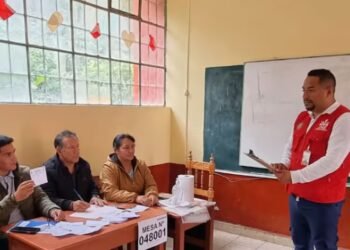
The General Elections 2026 are about to develop in Peru, and more than 27 million eligible citizens will go to the polls to choose their next political rulers: president and two vice presidents, representatives before the Andean Parliament, as well as senators and deputies for the period 2026-2031. In this way, the National Office of Electoral Processes (ONPE) urged the national population to participate responsibly in this important day, whether by informing themselves through the media about the career of the candidates or political organizations, exchanging opinions with family or friends, or entering their official platforms. Thus, as in every electoral process, the National Election Jury (JNE) reported on the restrictions or prohibitions that will govern this weekend, especially the application of the dry law at the national level. In the development of this note we will tell you more details about it.
Within the framework of the 2026 Presidential Elections and in accordance with article 351 of the Organic Law of Elections (LOE), the National Elections Jury established a series of restrictions with the aim of guaranteeing safe and normal elections. Therefore, on this occasion, the so-called Prohibition Law will come into effect from this Saturday the 11th at 8:00 am until April 13 at the same time throughout the national territory. That is, during this short period the sale of alcoholic beverages of any kind will be prohibited, and the closure of the establishments, or the spaces within them, dedicated mainly to their marketing, is ordered. On the other hand, the JNE indicated that failure to comply with the provisions is punishable by a custodial sentence of no more than six months and a fine of no less than 10% of the minimum vital income, calculated on a 30-day fine, equivalent to S/ 3,390.
In an interview for Andina, the deputy director of Links and Registry Archive of Reniec, Jorge Puch Pardo Figueroa, announced that the National Identity Document is the only valid document that allows voting in these 2026 Presidential Elections, so voting with any other document, such as, for example, passport or certificate, will not be allowed. Thus, according to the public worker, in the event of theft or loss on election day, it will be essential for the citizen to file a police report with the aim of obtaining a waiver or being exonerated from the fine for not going to vote on April 12. On the other hand, he indicated that on this occasion voters will be able to vote with the DNI that is about to expire or has expired; However, he urged them to keep their IDs updated to be able to carry out other important procedures. “It is solely and exclusively so that they can vote on April 12, so don’t worry because with the expired DNI you will be able to vote,” he explained.