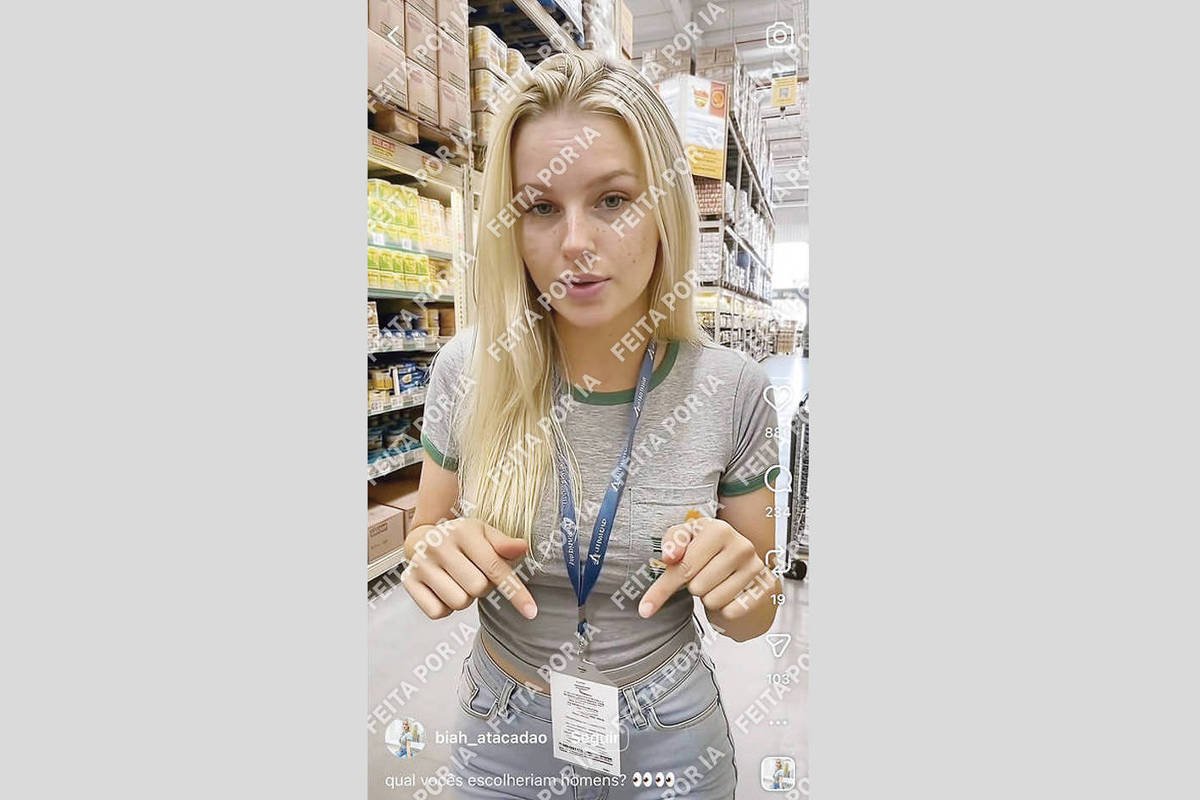
A profile that uses images created through artificial intelligence (IA) is posing as an employee of a supermarket chain and attracting thousands of followers with the aim of selling sexual content. Bia do Atacadão presents herself as a 24-year-old woman, white, blonde, with light eyes who lives in the city of São Paulo. The company says it repudiates the misuse of the brand and visual identity “in content of this nature”.
In the report, Atacadão said it had activated the information security team to adopt the appropriate measures. He further stated that he sought the Goalwhich manages Instagam, and Tiktok to delete the pages, “in addition to reinforcing monitoring to prevent the creation of similar profiles”. Node Instagramthe profile accumulated more than 75 thousand followers (including current and deleted), while the reach on Tiktok was smaller, restricted to 500 followers, which has since been deleted by the platform.
The pages on which Bia appears aim to take followers to the group’s private group. Telegramin which there are more than 12 thousand subscribers (in March, it reached 40 thousand) and sexual content is sold without mentioning that it is about an AI. “I just look like the blonde at Atacadão, but don’t be fooled. I spent a lot of time being just the nice blonde at the cashier… But there’s a side of me that doesn’t appear among the shelves”, says the welcome message in the group.
Prices for images range from R$22 (weekly) to R$75 (annual). “Beautiful”, “elegant” and “wonderful” are some of the comments made by men on her profiles, as if they were praising a real woman.
THE Sheet tried to contact Bia’s profiles on Instagram and Telegram this week, but received no response.
There are characteristics that show that the profile was created using AI, explains David Nemer, an anthropologist at technology and professor at the University of Virginia, in the United States.
He analyzed Bia’s content at the report’s request and mentioned flaws that prove it was content generated by AI. “In some videos, she has spots or moles on her skin that do not appear in other content. Furthermore, the backgrounds in the videos are always static, with the same lighting.”
Nemer also mentioned that the movements of her mouth do not follow exactly what she says. “The aesthetics as a whole suggest that it is AI because it seems very artificial, but this conclusion is made by me, as I am used to making these analyses,” he said.
The report sought out Instagram to comment on the case and questioned the network’s policies on AI profiles. However, Meta declined to comment on the topic.
TikTok said in a statement that it deleted Bia’s profile, as it “violates the platform’s community guidelines.” The network stated that it requires content creators to identify publications made with artificial intelligence.
Even with labels, according to TikTok, there are rules for this content. “Any form of misleading content on matters of public importance or harmful to people is prohibited,” he said.
Bia’s group remains active on Telegram. The messaging platform did not respond to the report’s contacts.
Practice can constitute embezzlement and extortion, experts point out
To induce payment in the Telegram group, Bia’s profile sends a message that falsely states that the user’s CPF was registered in a charge for her sexual content, which must be paid so that the person does not have their name included on public lists of debtors.
In Brazil, there are no crimes specifically related to acts related to the misuse of AI, says lawyer Marcelo Crespo, professor and coordinator of the ESPM law course. In this way, criminal law is applied based on what already exists in Brazilian legislation.
The sale of adult sexual content in itself is not a crime. But Bia’s case can be classified as embezzlement, pointed out Crespo, who specializes in digital law.
Fraud can be characterized when a user feels injured because the profile pretends to be a real person to obtain money. The same applies if you have made payment for the image package and have not received it. The crime can also be configured by using the Atacadão supermarket brand “to generate credibility and mislead consumers”, commented Crespo.
Extortion, according to him, can be considered because of the false statement that the group member needs to pay for the images or their name will be included on a public list of debtors.
Profiles like Bia’s could become more common amid the advancement of artificial intelligence tools, says Crespo.
For victims, the recommendation is to keep evidence, such as prints of messages and proof of payments, and seek police authorities.
Crespo stated that cases of this type represent an urgent problem in the digital economy: the creation of monetizable artificial identities. “The central point is the lack of transparency that it is a virtual person. It is possible that the legal debate will advance to require clear identification that content is generated by artificial intelligence, especially if there is commercial exploitation.”
For Nemer, it is essential that there is a clear explanation that these are images generated through AI, so that people subscribe to such content aware of their origins.
Billing companies deny involvement
The charges on Bia’s profile are addressed to two companies: R Torres Participações LTDA and Sync Pay Escolhas LTDA.
Both have hundreds of accusations of scams on Reclame Aqui in recent weeks. Platform users report bank transfers to Pix numbers from these companies to purchase different items, such as clothes, food or gas, but that they never received these purchases.
In Reclame Aqui there is no report about Bia.
In responses to Sheetthe companies denied any link with the profile and said they had no relation to the various scams reported on Reclame Aqui.
Sync Pay stated that it “acts as a payments sub-accreditor, providing technological infrastructure for financial transactions”. The company said it works to “identify and ban any user who uses our services inappropriately or in violation of legal guidelines.”
R Torres Participações argued that it is a holding company and does not make any type of sales. In a statement, he explained that his data has been used to carry out scams and said he was unaware of any illegal transactions in his name.