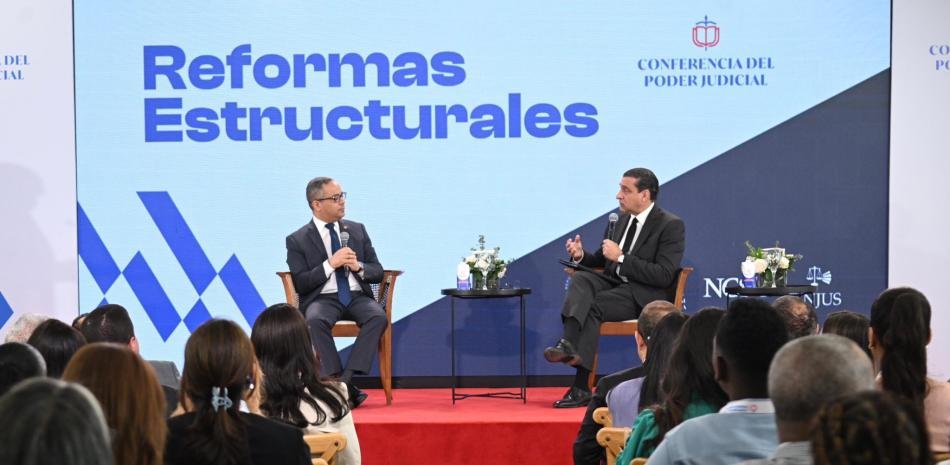
The president of the Constitutional CourtYesterday, Napoleón Estévez raised a problem registered by that court, which may affect the knowledge of the cases filed: the void in substitution.
He article 186 of the Magna Carta establishes that the TC will be made up of thirteen members and its decisions will be adopted with a minimum qualified majority of nine.
Is It is precisely this last mandate that worries to Judge Estévez, since the operation of the constitutional body does not contemplate a dynamic to replace judges when they cannot participate in the hearing, due to a valid excuse.
“Whether for any of the permitted reasons: that he is on vacation, that he is inhibited, on leave; if the nine votes are not there, the decision cannot be given,” said the magistrate when participating in the 2026 Judiciary Conference held in the Judicial City of Santo Domingo Este.
Given this situation, Estévez understands that holding a reform process to the Magna Carta could serve as a solution.
“Because it is the constitution that must allow it, it cannot be the law. Right now I have a bank of 17-18 retired judges; I can be authorized a substitution mechanism with a minimum that I can call retired judges to meet that quorum, or they can be judges of the Supreme Court of Justice. Those are the two formulas that I have thought of and I throw them out to see,” he highlighted.
However, he also recognized that these options could allow the titular judges of the TC decide to be absent so as not to vote for some files.
“I also say well: if you find a substitution formula for the judges, we can lose something that constitutional justice does not want either, that a constitutional judge runs away from a file, that is very dangerous,” he explained.

First lady Raquel Arbaje listens to children during the activity.
However, the magistrate clarified that he agrees with nine being the number of judges obligatorily established by the supreme norm present for a vote.
“Because I cannot imagine that less than nine judges could have the power to annul sentences of the Judiciary, annul acts of the Executive Branch and annul acts of the Legislative Branch. That is what legitimizes the decisions,” he indicated.
As he specified, his intention with these statements seeks to provoke the Constituent Assembly to “see how to resolve the problem that the Constitutional Court has with the issue of quorum, that sometimes we do not have a quorum to make decisions.”
“Sometimes, decisions do not come out, not because the decisions are kept, but because there are no votes for the file to come out,” he reiterated.
On the other hand, Estévez also stated that they urgently need a modification of the legal framework with the objective of guaranteeing that “constitutional, jurisdictional and amparo review resources are deposited directly at the headquarters of the TC, not in the Judiciary.”
“ANDthe secretary of the Supreme Court of Justice is not my secretary, he is not secretary of the Constitutional Court. This was understood because at the time the TC was established it had no headquarters and the SCJ was used as an auxiliary. Today it doesn’t make any sense,” he explained.
Estévez recalled that in 2025 the CT failed 1,814 filesexceeding the 1,258 published in 2024. Although this could be reflected as an achievement of effectiveness, he indicated that this should not happen, since the Supreme Courts of Justice and the Constitutional Courts in other countries are only “to act in an exceptional manner.”