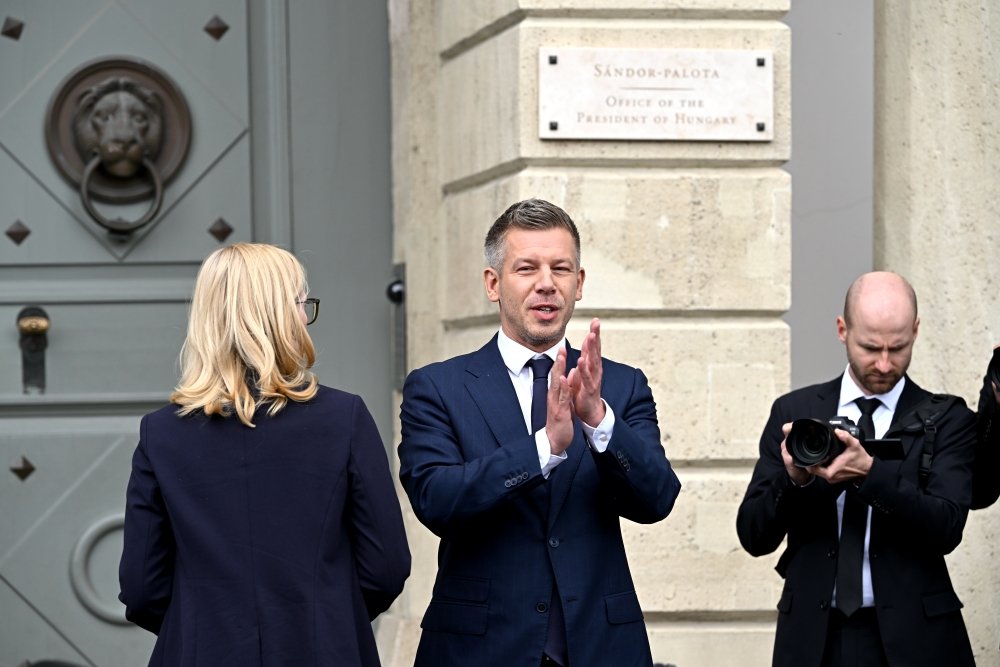

Péter Magyar (pictured here Monday in front of the Sándor Palace) does not deserve applause
The head of government is not letting the deadline for the head of state’s resignation—May 31, which he unilaterally set immediately after the election victory—pass without consequences. Today, Monday, at 8 a.m., he intends to appear at the Sándor Palace accompanied by his Minister of Justice.
True to his governing style, he has announced his intention—in a very statesmanlike manner—on Facebook. The coffee cup emoji does not hide the fact that this is not a social gathering, but rather an attempt at intimidation—unprecedented in recent Hungarian history—against the state’s highest dignitary.
Earlier on Friday, President Tamás Sulyok announced that he had asked the Venice Commission, the Council of Europe’s constitutional advisory body, for an assessment of the contradictory situation and for its cooperation in resolving it.
In a video released Sunday evening, the head of state made it clear that he would continue to exercise his office and fulfill the duties prescribed by the Fundamental Law and the relevant legislation.
The office of head of state requires me to face up to my responsibilities (…) My oath to the Constitution binds me equally to the entire Hungarian political nation, both to the majority and to the minority,”
said the president. He added that, under the current constitutional order, the president must cooperate with the respective government in the exercise of his powers, just as the government must cooperate with the president elected by the previous parliament.
This grave disregard for the separation of powers and the checks and balances between them—last exemplified in 1948 by the communists through the forced resignation of President Zoltán Tildy—not only undermines the institution of the presidency, but also constitutes an attack on the foundations of the domestic rule of law. The fact that Márta Görög, a respected legal scholar who heads the Justice Ministry in the TISZA government, is putting her professional reputation on the line and assisting in a questionable, unconstitutional exertion of pressure raises questions regarding the moral tolerance threshold of some cabinet members.
Former Minister for European Affairs János Bóka and Fidesz parliamentary group leader Gergely Gulyás, however, spoke out clearly against intimidation as a political tool. “According to the Venice Commission, which operates under the auspices of the Council of Europe, legislation tailored to a specific individual with the aim of discrediting that person or placing them in a specific situation is clearly contrary to the rule of law,” Bóka noted.
Forcibly removing a president from office is common in a dictatorship,”
former minister of the Prime Minister’s Office Gergely Gulyás made unmistakably clear.

Featured image: MTI/Hegedüs Róbert