— Amelia Earhart’s plane probably went down on July 2, 1937. It has never been recovered.
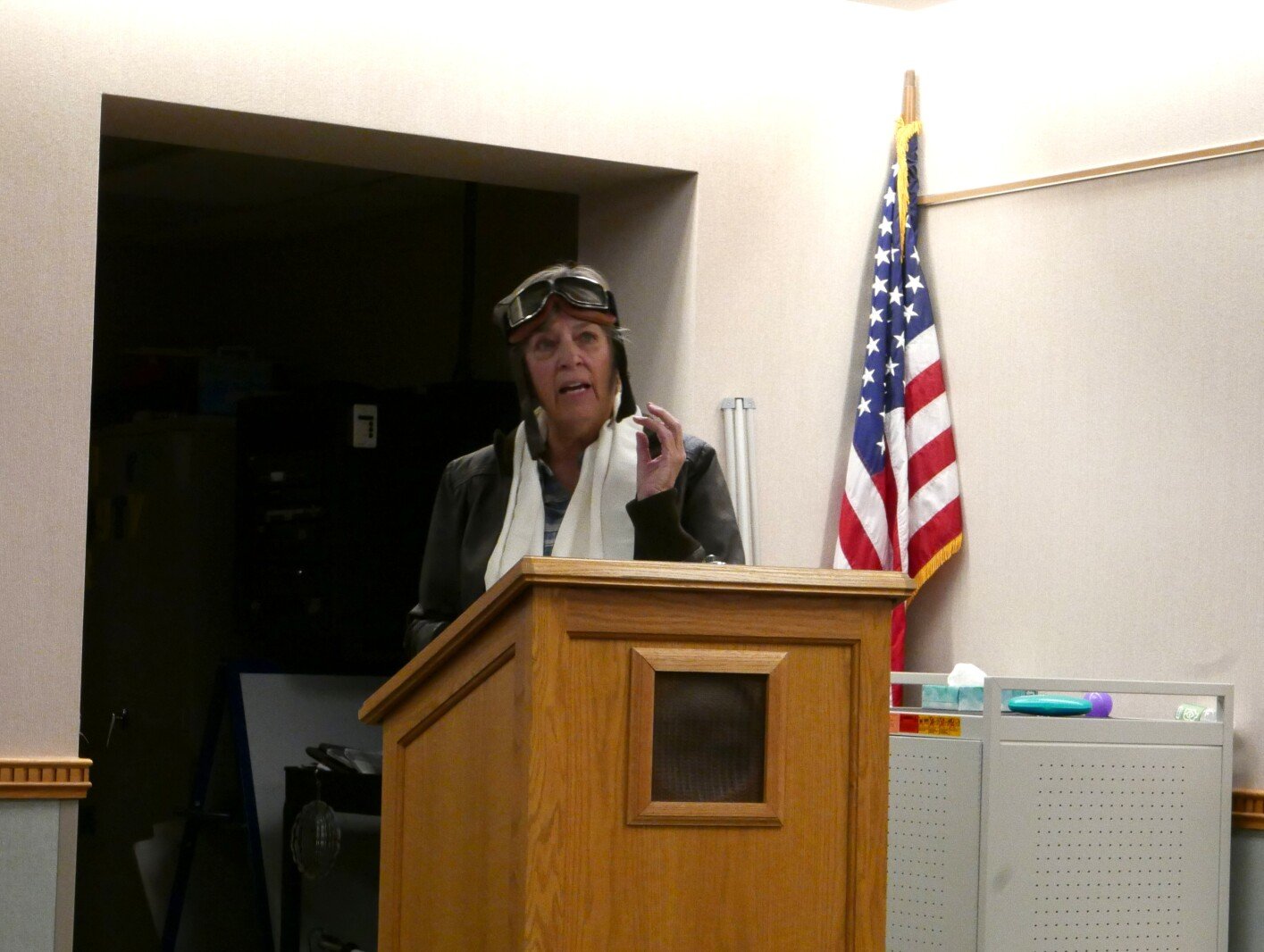
Last week, visitors to the Douglas County Library had a chance to hear about Earhart’s life from one of her relatives, and what might have happened to her.
Nancy Earhart Burt is Amelia Earhart’s second cousin three times removed, and gave an hour-long presentation at the library on Friday, April 17.Amelia Earhart was on the second-to-last leg of an around-the-world journey when her plane disappeared near Howland Island in the Pacific Ocean.
“She would have been 40 in 22 days, so she didn’t make it,” Burt said. “The most logical theory is that she got lost, that (her navigator Fred) Noonan is drinking again, and she’s doing most of the navigating and the piloting. They run out of gas and the plane goes down in the Pacific Ocean.”
This is the theory that is believed by both the United States government and the Smithsonian Institution, Burt said.
“That’s what I think probably happened,” she said.
But because the plane was never recovered, there are a multitude of other theories as to what might have happened to Earhart.
One of these theories is that Earhart was doing spy work for the government, but Burt said this has been discounted by a recent release of government files pertaining to Earhart.
“There was nothing in there that was controversial or would shake you up,” Burt said. “She was not a spy.”
Another theory is that Earhart and her navigator landed in the Marshall Islands and were captured by the Japanese, but this has not been substantiated, either, Burt said.
“There was a group that maintained she survived a rough landing on a remote coral reef out in the Pacific, but died soon afterward as a castaway,” Burt said. “There were people who maintained they heard radio frequencies (saying,) ‘This is Amelia Earhart talking,’ and that she had crashed and she needed help.”
Other theories are more far-fetched, such as one that stated Earhart survived and lived on a South Pacific island as the wife of a local fisherman.
But the question remains, what went wrong?
“There wasn’t just one thing that went wrong,” Burt said. “There was a comedy of errors.”
For one thing, Fred Noonan, Earhart’s navigator, was drinking again.
For another, the second to last stop on the trip was the hardest to find, being a small island in the middle of the Pacific Ocean.
“You would need precise navigational skills, and she’s doing most of that because he’s too drunk,” Burt said. “There’s confusion. … Radio communication is not good, it’s very sporadic. Neither of them knew Morse code, which maybe would have helped.”
Earhart’s last words by radio were, “We must be on you but cannot see you. Gas running low. We’re unable to reach you by radio. We’re flying at 1,000 feet. We are on the line of position 157-227. We are running north and south.”
The crew of a nearby ship scanned the sky but didn’t see anything.
“The U.S. government funded a search for several weeks after she went down,” Burt said. “They found nothing. Nothing at all.”
While other pilots of the era have long been forgotten, Earhart’s name and legacy live on. Burt thinks she knows why.
“I think she was a woman ahead of her time, and she inspired women and girls everywhere to reach for the stars,” Burt said. “She was out there moving and shaking in a man’s world.”
The story of her disappearance only heightens her appeal, Burt said.
“You think about the time of it, 1937,” she said. “The world kind of needed a hero. We’ve just gotten out of World War I, there’s a Great Depression — we’re in the midst of coming out of it. I think maybe we needed a hero, somebody to look up to.”