
Listen to this article
Estimated 4 minutes
The audio version of this article is generated by AI-based technology. Mispronunciations can occur. We are working with our partners to continually review and improve the results.
WARNING: This story references sexual assault allegations and may affect those who have experienced sexual violence or know someone affected by it.
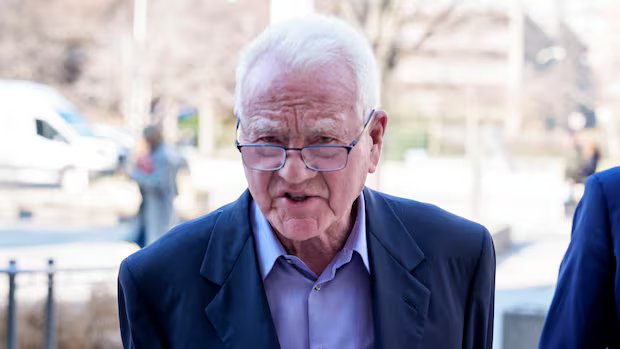
Poor and incomplete note-taking by police during preparatory meetings with the complainants and Crown prosecutors in the sexual assault trial of Frank Stronach was “unacceptably negligent,” Stronach’s defence lawyer argued on Thursday.
“Valuable, critical pieces of disclosure are gone forever. Statements, discussions, pieces of evidence relevant to the trial are gone not because someone misplaced them or they got lost in a fire or destroyed. It’s that the police deliberately chose not to capture what was said,” Leora Shemesh told a Toronto courtroom.
Shemesh said the meetings were not recorded using audio or video, that the manner in which there was an attempt to preserve them was “careless” and that police did not capture the entirety of the meetings in written form.
She said, instead, they were left with “small bread crumbs” of what might have been said.
“The notes are deficient, and to use the legal standard, unacceptably negligent,” Shemesh said.
She argued that in these types of cases, words, phrases, utterances, newfound memories and information are all relevant to assess the overall credibility and reliability of the complainants.
She alleged that often times new memories or new details emerged from the complainants during these meetings and that based on the deficient notes from police, there’s no way to know how this information came about.

Shemesh also argued that without knowing details of what was said during these meetings, her client was deprived of a proper cross-examination of the complainants.
Ontario Superior Court Justice Anne Molloy asked Shemesh if she was looking to implement a new standard on how preparatory meetings with witnesses before trial should be recorded in every criminal case.
Shemesh said these meetings don’t all need to be recorded using audio or video but that, at least, detailed notes should be taken.
When Stronach’s trial began in February, the 93-year-old founder of auto-parts giant Magna International faced 12 counts related to seven female complainants, whose allegations included sexual assault and the historical charges of rape and attempted rape.
But throughout the trial, the Crown withdrew a number of charges. Last week, during closing arguments, Molloy said she would not be able to convict Stronach on the charges related to one of the complainants in his sex assault trial. She said her evidence did not rise to the level of “being even remotely reliable.”
This means Stronach now faces five counts related to three female complainants.

Canadian billionaire Frank Stronach now faces seven sexual assault charges from four women — a sharp decrease from the number of charges and alleged victims when the founder of Magna International was first charged in 2024. CBC’s Jaime Strashin walks you through the trial so far to explain how we got here.
Allegations go back as far as late ’70s
The allegations against Stronach date back almost 50 years, spanning the period between 1977 and 1990. Two of the initial 12 counts, rape and attempted rape, were considered historical charges, as they were abolished when the Criminal Code was amended in 1983 to create the offence of sexual assault.
All of the initial seven complainants testified in court, offering an emotional account of the sexual offences they say they experienced at the hands of Stronach.
Stronach, who was in court every day but never took the witness box in his own defence, has denied the allegations and pleaded not guilty to all charges.
Many of the women told similar stories — meeting Stronach at Rooney’s, the Toronto restaurant he used to own, and then accepting an invitation back to his Harbourfront condo. It’s there that they allege he sexually assaulted them.
Stronach is set to face another trial in Newmarket later this year involving six complainants after the case was split into two proceedings.