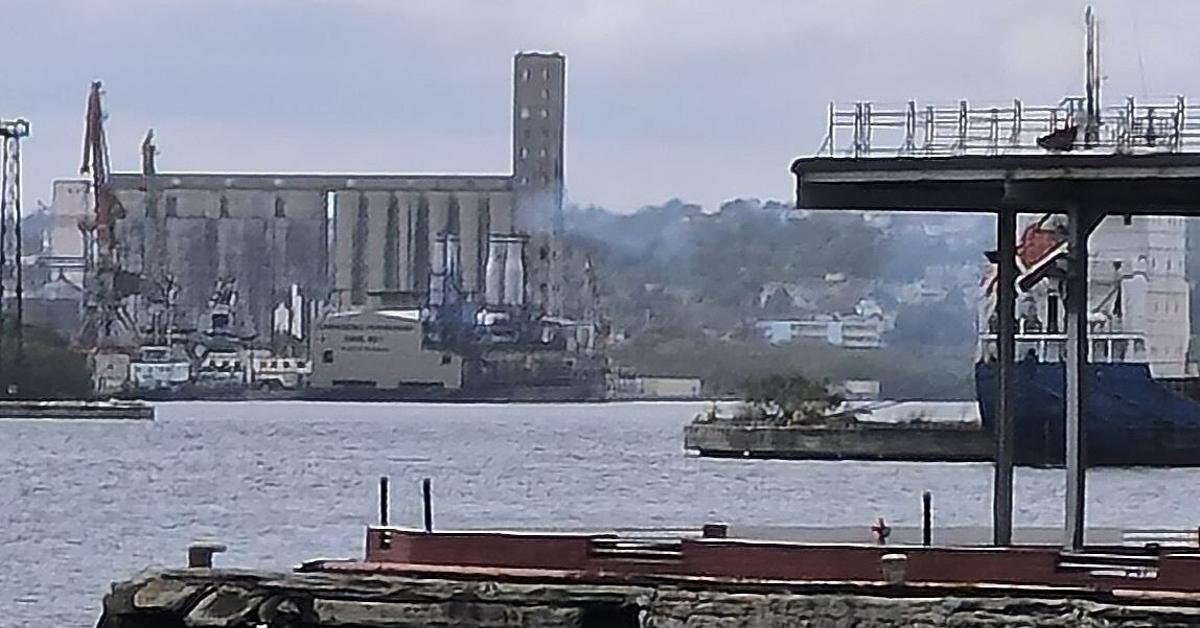
Havana/The Erol Beythe floating power plant installed in ReglaHavana, has emitted smoke again this Monday. The return to the system of patana Turkish plant, with a capacity of 63 megawatts (MW) and which runs on fuel oil, coincides with the Government’s announcement this weekend that they are already beginning to distribute the derivatives obtained from the Russian crude oil that arrived almost three weeks ago on board the Anatoly Kolodkin. That could explain the “rarity” that in some areas of Havana neighbors report 48 hours of electricity without cuts.
On Saturday afternoon the ship docked in Havana Nicos IVcoming from Cienfuegos, where Russian oil has been refined without the regime having given any explanation for the breakdown that the refinery is clearly suffering. Nico Lopez of the capital. Their contribution was noted from that same day, when the maximum impact, which in the last weeks prior to the arrival of Anatoly Kolodkin permanently close to 2,000 MW – for a demand of about 3,000 MW – it dropped to 1,413 MW. For this Monday, the Electrical Union (UNE) foresees an impact on peak hours of only 1,165 MW.

/ 14ymedio
The Cuba-Petroleum Union (Cupet) optimistically reported that the derivatives obtained will cover “around a third of the national demand for a month,” and are expected to be distributed first to distributed generation, the state apparatus, hospitals, vital services and certain logistics chains. It won’t be enough for much more.
To face this crisis, the Government has carried out a loud campaign in the official media about the alternative to generate energy from photovoltaic parks. However, the project faces basic limitations that, this Monday, were recognized by the official press.
The project faces basic limitations that, this Monday, were recognized by the official press
“The SEN remains so weak that it is unable to assimilate the frequency oscillations of renewable energy sources. For this reason, the photovoltaic parks – not only in the province, but throughout the country – stop being exploited to the maximum,” explains an official from the National Load Dispatch, Julio César Roche Bacallao, to the newspaper ‘Invasor’. This means that the photovoltaic solar parks spread across the Island, whose capacity is always 21.8 MW, are not even contributing that amount during daylight hours and with clear skies.
This is done, explains the official, to avoid “drastic consequences”, such as total drop of the SEN, the “zero”, in technical vocabulary.
The paradox of generating more electricity than the system can support is not only the Island’s heritage. Just a year ago, that was the cause of the massive blackout in Spain and Portugal. According to a report published last March by the European Network of Electricity Transmission Network Managers, a “surge” phenomenon, a frequent event but which this time was out of control due to lack of sufficient support from more stable nuclear or thermal energy, was the origin of the “perfect cocktail” of unfavorable factors that caused the mega blackout.
The paradox of generating more electricity than the system can support is not only the Island’s heritage.
During that incident, “the key phenomenon was the ineffectiveness of voltage control within the Spanish electrical system,” summarized the 49 experts consulted in that report.
The “sequence included voltage fluctuations and oscillatory phenomena, which led to widespread disconnections of production in Spain, mainly of installations based on converters,” a technology used in renewable energy plants, according to the report.
“In Spain, most renewable energies were connected with a fixed power factor, which does not allow them to contribute to dynamic voltage control,” explained Klaus Kaschnitz, one of the leaders of the group of experts, during a presentation to the press. In other words, these facilities were unable to adapt to surges in voltage, causing them to crash.