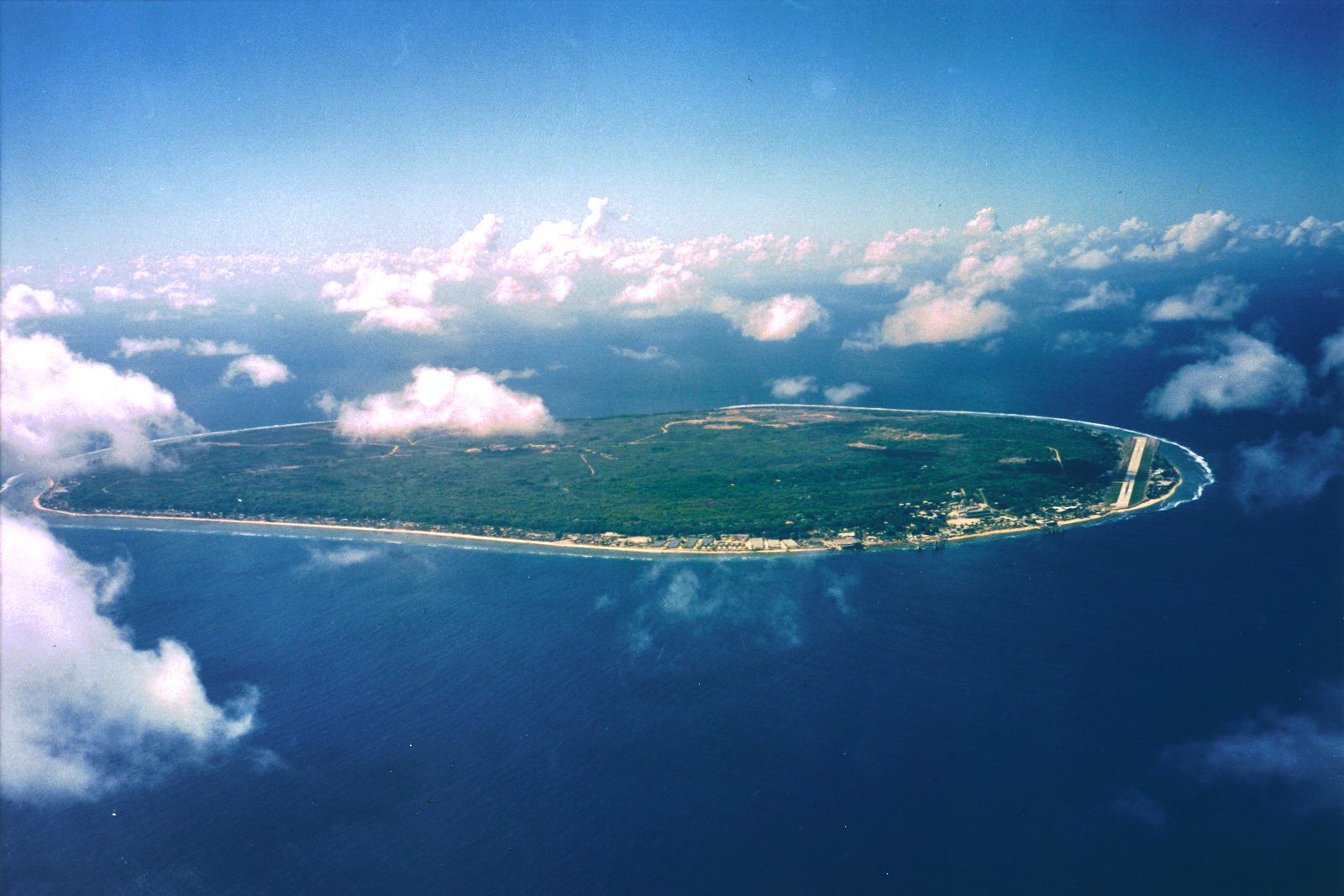

The Pacific island nation formerly known as Nauru is now officially Naoero, after Parliament approved a constitutional amendment. President David Ranibok Adeang described the change at the United Nations as restoring the country’s traditional name.
Adeang addressed the 81st session of the UN General Assembly in New York on Sept. 22, nearly three months after Naoero notified the United Nations of the change. He said the name Nauru emerged as foreigners adapted the island’s name to their own pronunciation, while Naoero remained the name its people used.
“For many years, the world has known our country as Nauru,” Adeang said. “Nauru is how our name sounded to those who found it hard to say, and the world kept it. But it is not the name our people used among themselves.”
H.E. David Ranibok Adeang, President and Head of State of the Republic of Naoero @UN #GeneralDebate
🔗Access the recording and transcript of the statement here: https://t.co/m4MunJEY23#UNJournal #UNGA81
© UN Photo/Manuel Elías pic.twitter.com/qpp9ovMGui— Journal of the United Nations (@Journal_UN_ONU) September 22, 2026
Adeang described the change as an affirmation of the country’s heritage and language. He concluded his address with a short appeal to the international community: “Say our name.”
The name change followed a constitutional process that began in January and moved through several steps. Parliament approved the amendment in May, and the government formally announced the change in July.
Parliament approved the change in May
Adeang introduced the Constitution (Amendment) (No. 2) Bill 2026 on Jan. 29. The bill proposed replacing references to “Nauru” with “Naoero” in the constitution and written laws. In the government’s explanation, the change would more faithfully reflect the country’s heritage, language and identity.
After the constitutionally required 90-day period, Parliament voted unanimously to amend the constitution. Speaker Marcus Stephen certified it on May 13, completing the constitutional process.
The government had initially expected the change to go to a referendum. It abandoned that plan in July, arguing that Naoero was not a new name being proposed to the population. The name was already used in the community, appeared on the national coat of arms and was permitted under the constitution.
The formal name is now the Republic of Naoero, with Naoero as the short form. The government also announced that the country’s three-letter international code would change from NRU to NRO and that citizens would be known as dei-Naoero.
Naoero notified the United Nations of the constitutional change on June 26. International organizations and countries have subsequently begun updating their records. Under ISO 3166-1, the English short name associated with the country’s code changed from Nauru to Naoero on Aug. 26.
A single Pacific island with a long history
Naoero is a single raised coral island in Micronesia, covering about 21 square kilometers (8.1 square miles). It has no official capital; government offices and Parliament are in Yaren District, the administrative center. The population is roughly 12,000.
Micronesian migrants first inhabited Nauru thousands of years ago, forming twelve traditional tribal lineages that are represented on the country’s flag by a 12-pointed star. Government documentation notes that the island’s modern population reflects historic Micronesian, Polynesian, and Melanesian roots, while Nauruan itself continues to be classified within the Micronesian branch of Austronesian languages.
The discovery of extensive phosphate deposits in 1900 reshaped Nauru’s economy, leading to full-scale commercial mining by 1906. Exports eventually made Nauru one of the world’s wealthiest countries on a per-capita basis, before the resource declined. Mining profoundly altered the island’s interior.
Contact with European explorers reshaped the island’s international designation, replacing indigenous names in global maps and diplomatic records.
From pleasant island to Naoero
British captain John Fearn encountered the island in 1798 and recorded it as Pleasant Island. European sources subsequently used several spellings, including Naura, Nauru, Nawodo, Anaoero and Onawero.
While German ethnologist Paul Hambruch suggested Naoero originated from a local expression for heading to the beach, the theory quickly faced academic pushback. Linguist and missionary Alois Kayser rejected the derivation on grammatical grounds, keeping the term’s origins disputed.
What is clearer is how Nauru became the international form. When Germany established a protectorate over the island in 1888, German colonial records adopted Nauru as the official spelling. That spelling eventually became the standard English designation. It remained in the country’s official English designation after independence.
Germany, Australia, and Japan controlled the island
Germany annexed Nauru in 1888. Australian forces captured it in 1914 during World War I. The island then came under an international mandate administered by Australia, Britain and New Zealand, with Australia responsible for its administration.
Japan occupied Nauru from 1942 to 1945 during World War II. Japanese authorities deported about 1,200 Nauruans to the Chuuk Islands, then known as the Truk Islands, where hundreds died.
After World War II, Nauru transitioned into a U.N. trust territory jointly administered by Australia, Britain, and New Zealand. It became independent on Jan. 31, 1968, and joined the United Nations in 1999.
Arriving more than five decades after the nation gained independence, the official name change formally reinstates Naoero. The indigenous designation remained in continuous use in the Nauruan language throughout the period when “Republic of Nauru” served as the state’s official English designation. The government has presented the decision as a matter of language and national identity rather than a change to the country’s constitutional system or territory.