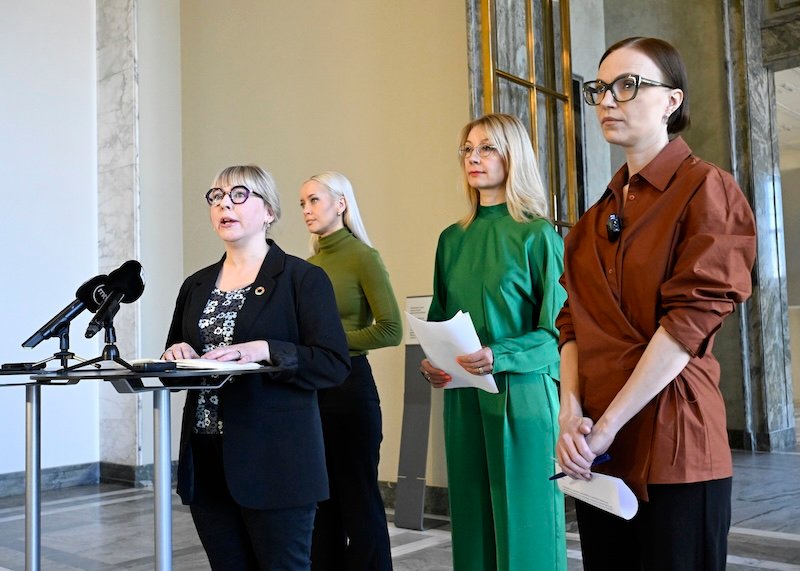
Finland’s opposition leaders have intensified calls for Prime Minister Petteri Orpo to step down, citing economic performance and rising social pressures, as parliament prepares to debate a motion that will trigger a confidence vote.
Left Alliance leader Minja Koskela said the government had failed to deliver on its economic promises and should resign. In a statement, she said the success of policy must be judged by outcomes for citizens. “When Finland’s situation is compared to its peer countries, the answer is clear: the situation is bad,” she said.
Koskela pointed to increases in unemployment, poverty, homelessness and inequality during the current term. She said the government had promised to stabilise public debt, create growth and improve living standards, but had not met those targets.
According to figures cited in the Left Alliance statement, unemployment has risen by about 100,000 people, while employment has weakened by nearly 80,000. The party said Finland’s employment trend ranks among the weakest in the European Union.
All five main opposition groups in parliament have submitted an interpellation on the government’s economic policy, a move that will lead to a full debate and a vote of confidence.
Green Party leader Sofia Virta also criticised the government’s record. In a statement, she said key pledges had not been met, including plans to reduce debt, improve employment and address social inequality. “The result is a failed economic policy,” she said.
Virta cited figures indicating nearly 300,000 unemployed people in Finland and warned that social impacts had grown. She referred to government estimates suggesting that 31,000 additional children risk falling below the poverty line.
Opposition leaders argued that spending cuts had reduced domestic demand and placed pressure on households, including single parents and people living alone. They said the effects had contributed to weaker economic growth.
Public dissatisfaction with the government has increased, according to a survey commissioned by the Foundation for Municipal Development and conducted by Verian.
The poll found that 76 percent of respondents rated the government’s handling of employment negatively, while 71 percent criticised its economic policy. Social and healthcare services also received low ratings, with 70 percent expressing dissatisfaction.
Only 17 percent said they were satisfied with the government’s ability to address the needs of citizens and families, while 48 percent reported dissatisfaction. The survey, based on responses from more than 1,000 participants, indicated a decline in confidence compared with the previous year.
The government has defended its approach, citing broader economic conditions in Europe, though opposition figures rejected that argument and said responsibility lies with national policy choices.
Parliament is set to debate the interpellation in the coming days, with the outcome of the confidence vote expected to determine the political direction of the government.
HT