Friday, Aug. 21, may go down in history as Canada’s Liberation Day. It was the day America came for us, and we said no.
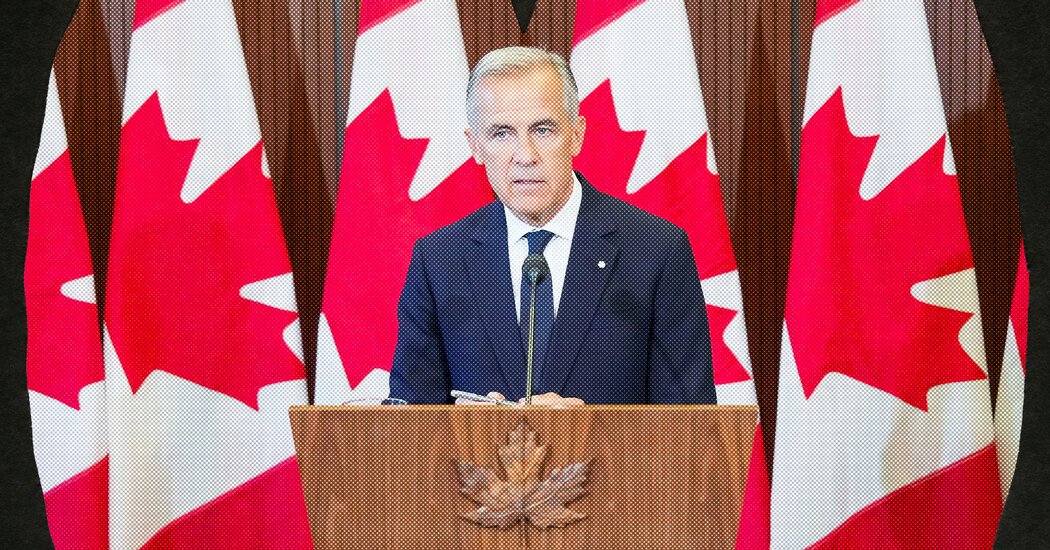
The trade negotiations between the United States and Canada had been moving forward in the weeks after President Trump first threatened 50 percent tariffs on Canadian goods, but just before midnight, Prime Minister Mark Carney rejected the American proposal. “Last-minute changes in the U.S.-proposed terms were unfair, uneconomic and called into question the reliability of any deal,” Mr. Carney said in a statement. “Canada will match those tariffs dollar for dollar to protect our workers and businesses.”
It was a decision made, seemingly, on the spur of the moment, but the deep history of this country paved the way for this one, critical gesture — a historic “no.”
Mr. Trump’s tariffs on some $20 billion of Canadian goods began immediately after his deadline passed. For Canada, the choice came down to either severe but temporary economic instability or binding itself to a pseudo-democratic fiscal basketcase of a nation, whose only apparent foreign policy objective has become domination for the gratification of its president’s slapdash vanity.
But Mr. Carney did not simply reject a trade offer on Friday. He was openly defiant of the new breed of American aggression. “We will not allow any nation to determine our future,” he said.
It was a unique statement for any leader in Canada to make. The country has long defined itself through its participation in global systems, seeing itself as a node in the larger orders of the world, the postwar trans-Atlantic order and, before that, the British Empire. Mr. Carney is taking Canada in another direction, emphasizing national sovereignty on every front — economic, political, military and technological.
While the prime minister’s approach is certainly new, it emerges from deep reservoirs of the Canadian spirit. For nearly a decade, I was a columnist at Esquire magazine. During that time, one of the greatest discrepancies I noticed between Canadians and Americans — and Canadian and American men in particular — was in their basic idea of what earned respect. For Americans, the capacity to project power, the ability to make things happen, to win, are the primary virtues. In Canada, the defining virtue is toughness, the capacity to endure.
The difference is subtle but profound. Margaret Atwood’s work of literary criticism that defined 1970s Canadian nationalism is entitled “Survival.” The coureurs des bois, the great New French traders who went into the impossible North on canoes looking for pelts, measured themselves by their ability to survive on the bare minimum in the midst of a vast indifferent wilderness.
These deep-running values, rarely openly expressed, are the undercurrent of Canada’s rejection of America last week. The offered deal, or at least the details that have emerged, veered significantly from purely economic matters. Apparently, one of the final sticking points was an American demand that Quebec undo its French language laws and French language cultural protections. French, in Canada, is not a business matter. Its place in our nation transcends absolutely any market-based consideration. It is not something that gets “put on the table.”
While the decision to tough it out is iconically Canadian, Mr. Carney’s gesture will resonate far beyond Canada’s border. A gray banker, and not just any banker, but one of the leading bankers in the world, has stood up and said that there’s more to life than a little bit of money. The power of that recognition alone, at this moment in history, cannot be overstated. Mr. Trump’s world — a world of transaction and submission — is not the only world we all have to live in.
The economic impacts of Trump’s tariff regime remain to be seen, especially given his history of reversing tariff policies on a whim. But we will suffer. America remains Canada’s leading trading partner. Mr. Carney has chosen suffering, but he did what Canadians elected him to do: stand up for Canada. It’s funny to wake up relieved that you’re about to take a beating. We will not go along to get along.
The American president clearly did not know whom he was dealing with. He is following in the grand tradition of American leaders starting wars with people they don’t understand, then wondering what went wrong.