Princeton was — in its own mind and in mine — a place of possibility, where I might participate in history rather than be steamrolled by it. The college encouraged this illusion. We freshmen were shown a cannonball mark on the walls of Nassau Hall left there during the Revolutionary War’s Battle of Princeton in 1777. We were told that one cannonball (aimed by none other than Alexander Hamilton) passed through a window and destroyed a portrait of King George II. We were told that Princeton’s motto was “in the nation’s service” and that 70-some senators, two presidents and Aaron Burr (killer of Hamilton) were alums. We were told we were special. That we were lucky. We were not told (but it was implied) that we should hide our poverty and our sweat, and to always wear shorts and untucked blue button-down Brooks Brothers shirts. In essence: We were told that America was made there. And the places we were from, the place I was from, was in comparison less important, less interesting, less vital.
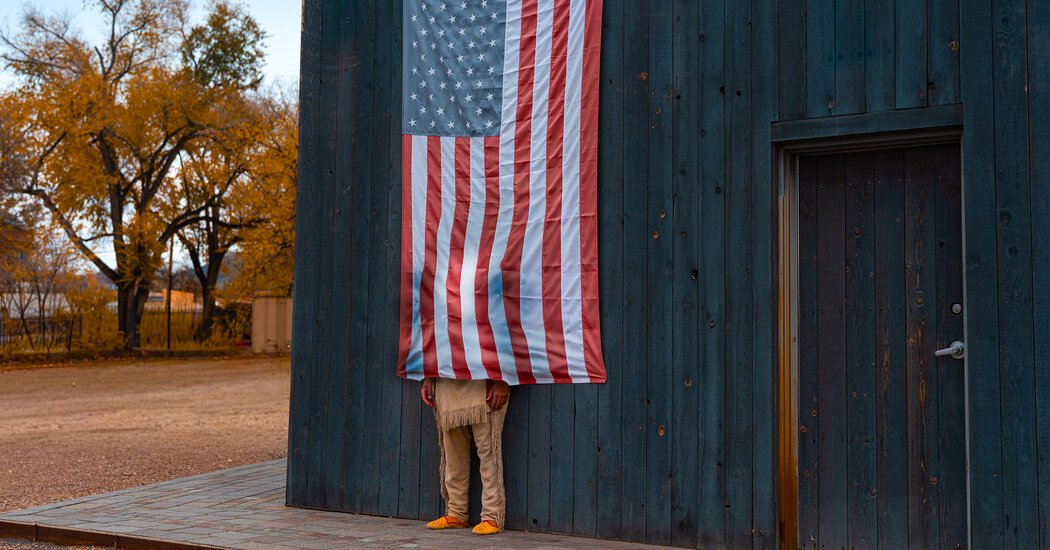
But of course I hadn’t left this lesser place, the reservation, behind; I had brought it with me without even knowing. There I was at Princeton, in the nation’s service, and indisputably Indian among a crowd of non-Indians. The indisputability of my Indianness was largely a matter of contrast. I realized that my classmates and my professors seemed to be shocked that I was there at all.
During the first couple of weeks, as I bonded with classmates, I’d announce that I was Ojibwe from the Leech Lake Reservation. Often the news was received much like the gift of a wounded bird — gorgeous and vulnerable and not long for this world. I’m so sorry, I heard more than once. You’re so lucky to have made it out, I heard as well. As though leaving the rez was a lot like John Carpenter’s “Escape From New York.”
Somewhat defensively I would offer the fact that it wasn’t so bad. We had two video stores. A supermarket. Enough racism to make you feel alive. But when I said so, my classmates were visibly disappointed. When it was clear I didn’t have a drinking problem (except that I was a lightweight) and that my family home did have running water and electricity, the attention I was coming to rely on would evaporate. I, to an extent, would evaporate. I felt this chasm between me and my classmates almost immediately. If there was no reason to pity me, there was less … of me.
I was coming to realize that in this country Indians were not supposed to be happy or to pursue happiness. We were supposed to suffer and to pursue suffering. Our social utility, as Americans and as Indians, was to define the outer margin of happiness and define it by opposite example. Evidently, if you didn’t suffer, you weren’t Indian. Everyone seemed to want — what the nation and my tribal nation seemed to want — was (a) for me to suffer (b) to serve them with my excellence and (c) to regale them with stories of my suffering and my excellence. It was confusing. I felt as if I were in a trance. When my dorm mates asked me, Who are you? Where are you from? What’s your deal? I would close my eyes and incant:
I am from a faraway land.
I am from a remote Indian reservation in northern Minnesota.
We don’t have electricity.
I just met a car for the first time, and it wouldn’t talk to me.
Our tepee gets incredibly cold in February.
We are so poor, I can’t even afford a spirit animal.
I could tell you my Indian name, but I’d have to kill you.
Things are so hard on my rez that Kevin Costner won’t even visit.
And let me tell you: It is a cold thrill when your bull turns into truth. People ate it up. They were ravenous for stories about how hard my life was. How “my people” suffered. The bigger the lie, the more extreme, the more believable.