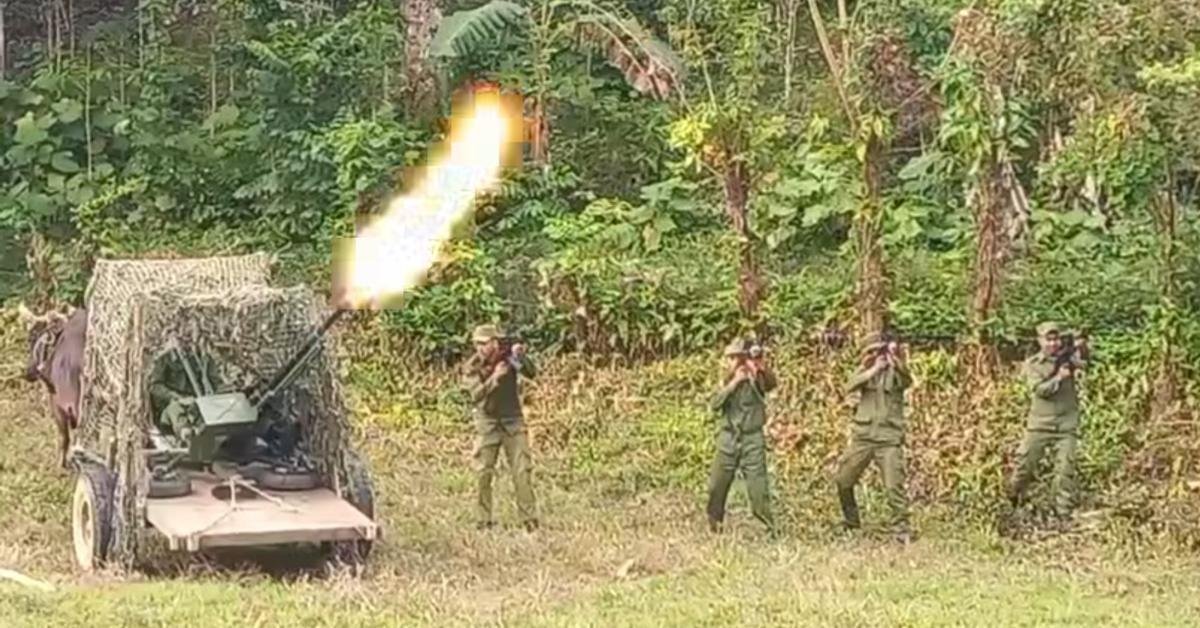
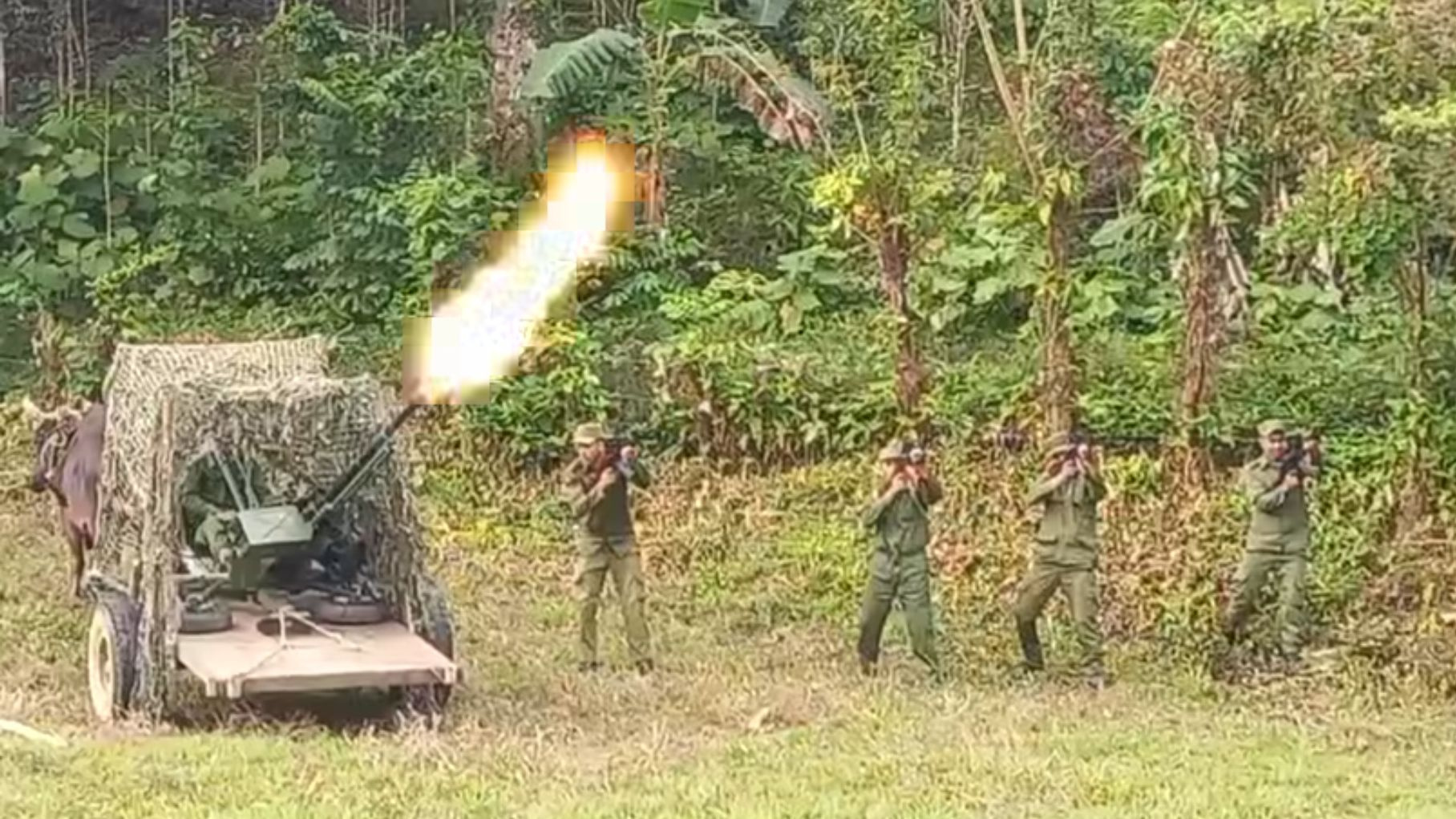
Madrid/The regime’s social networks have once again given away one of those images conceived halfway between parody, screwing around and Creole jokes. In the videos of the preparations for defense that circulate this Saturday, several semi-malnourished uniformed men spread out around a rural house, crouch down, take positions and simulate a military operation with the gravity of someone who believes they are participating in the prelude to the Normandy landings. Only, in the middle of the scene, a camouflaged cart arrives, dragged by a pair of oxen, as if it were a secret, decisive and impregnable weapon.
In some Pentagon office, one imagines American generals watching the videos in silence, first with bewilderment, then rewinding them to make sure they are not looking at a meme, and in the end wondering if this is a military exercise or a Gaesa agricultural fair. Perhaps some have concluded that there is no need to deploy drones, satellites or precision missiles against an adversary that still seems to fight its battles in the middle of the Middle Ages.
On the other hand, it is also easy to imagine the discomfort of Havana’s allies. In Moscow, perhaps someone will have averted their gaze to avoid admitting that, after sending weapons, oil and political support, the great showcase of the Cuban “resistance” ends up making such mistakes. Even in Tehran, perhaps some strategist will have thought that, following the same logic, the Strait of Hormuz could be closed with a couple of barracudas, three sharks and a boat lined with dry grass.
It is one thing to improvise in a ruined country and quite another to convert precariousness into military doctrine.
While the world discusses autonomous drones, electronic jamming systems, highly precision-guided missiles and wars fought thousands of kilometers away using screens, satellites and sensors, in Cuba the defensive epic seems to continue to rely on bovine logistics. The ox, slow and completely alien to the rhetoric of the “imperial enemy,” thus enters the cast of the “war of all the people.”
There will be no shortage of people who will say that it is about ingenuity, adaptation to shortcomings or a display of “creative resistance.” But it is one thing to improvise in a ruined country and quite another to convert precariousness into military doctrine and, on top of that, display it. In the images, soldiers run around, smearing mud on their faces, covering themselves with grass and bushes, as if thermal weapons, night vision and satellite surveillance had not yet been discovered.
The laughable, however, stops being nice when the context is observed. Since January, after the capture of Nicolás Maduro and the cutting off of Venezuelan oil shipments, the Cuban regime has intensified its military maneuvers and the staging of defense exercises. In parallel, the energy crisis has worsened to extremes that affect daily life, the electrical grid and essential services.
That’s where the Villa Clara oxen come into the picture, not as a tactical innovation, but as a prop resource to hide waste.
The Russian tanker Anatoly Kolodkin arrived with some 730,000 barrels of crude oila limited amount whose true dilemma is not its volume, but rather what power will decide to spend it on. This aid will last very little if it ends up wasted on absurd war simulations. While operations in hospitals are suspended, supplies are scarce and the health system is working at its limit due to blackouts and lack of fuel, the State continues to find thousands of liters, week after week, to move tanks, helicopters and heavy equipment, as has been seen in previous maneuvers.
Now the propagandists seem to have understood that it is no longer funny to denounce to the world that there is no fuel for pediatric hospitals, but there is for weekly military deployments. The narrative of permanent victimization stumbles upon the evidence of a power that, when it comes to shielding itself, always finds reserve, fuel, mobilization and staging. Perhaps this is where the Villa Clara oxen come into the picture, not as a tactical innovation, but as a prop resource to hide waste.
In a collapsed country, wasting fuel on useless exercises to calm a nervous leadership does not convey strength. Transmits fear. And also disconnection. The distance between power and the needs of the people is measured today in hours of blackout, in canceled bus routes, in lost crops and in exhausted hospitals. But it also, apparently, can be measured in the length of an oxcart and presented as if it were a strategic resource.
The scene provokes laughter, yes. But then it leaves something worse: the certainty that, while the country sinks, those in power continue playing war with the fuel that they deny to the population. And so, between the dry grass, the mud camouflage and the tired pace of military cattle, the Revolution ends up demonstrating that it no longer knows how to lead a country and barely manages to herd its own decline.