

Editor’s note: In economics, the “cost of money” refers to the interest rate on borrowing. In this report, the author explains that borrowing money in the Eastern Caribbean is often much more expensive than in other parts of the world, which may be slowing economic growth.
He also notes that credit unions often offer lower rates, showing that more affordable lending may be possible.
All views and claims in this article are solely those of the author and have not been independently verified.
Introduction
On 3 March 2026, at the CDB’s Annual News Conference in Bridgetown, President Daniel M. Best described the period now in front of the region as the Caribbean’s “decade of decision.” He framed the moment against US$65.2 billion in regional financing required between 2024 and 2033 to prevent economic stagnation, and against the three pillars of the CDB’s newly approved Strategic Plan 2026- 2035: Social Resilience, Economic Resilience, and Environmental Resilience. Two months later, on 4 May 2026, the Eastern Caribbean Central Bank’s Monetary Council recommitted to Governor Timothy Antoine’s “Big Push for Shared Prosperity and Resilience”— a call to double the size of the ECCU economies over the next decade through coordinated action on six pillars: Food and Nutrition Security, Energy Security, Digital Transformation, Human Capital Development, Financial Wealth Creation, and Trade Logistics and Shipping.
The parent commentary in this analytical series, “The ECCU’s Decade of Decision,” published in April 2026, argued that the next 24 months will determine the region’s economic trajectory for the next 20 years. The CDB’s framing and the ECCB’s strategic agenda articulate that same thesis through the region’s premier development bank and central monetary authority. The frameworks are aligned. The institutional ambition is in place. The analytical question this commentary engages — as a contribution to the work the ECCB, the CDB, the Monetary Council, the CAB, and member governments are leading— is whether the cost of money in the ECCU is set at a level that will allow these frameworks to deliver.
This commentary, the first installment in the Caribbean Banking Series, examines that question through three lenses: lending rate dispersion across the eight ECCU member states, comparison against international benchmarks, and the structural intermediation spread. It then considers the credit union sector as a complementary lens, connects the cost of money to the strategic initiatives the region has committed to, and previews the next piece in the Series.
One Currency, Eight Lending Markets
Exhibit 1 presents the average lending rates across the eight ECCU member states, sorted from highest to lowest. Within a single currency union — one in which the EC dollar is pegged to the U.S. dollar at EC$2.70 to US$1.00, the central bank is shared, and the regulatory framework is harmonized —borrowers face materially different lending costs depending solely on which island they happen to do business in.
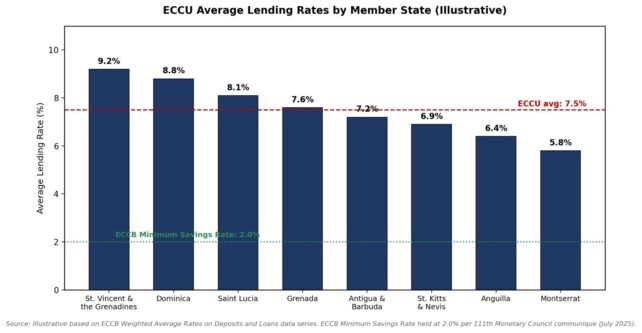 A note on scope. Exhibit 1 reflects commercial banks supervised by the ECCB. Credit unions, which fall under national regulatory authorities in each member state and are material providers of consumer and small business credit in several ECCU countries, are not included in this data series and are examined as a complementary lens in a later section.
The highest-rate member state sits roughly 340 basis points above the lowest. A small business owner borrowing in St. Vincent and the Grenadines pays materially more for the same loan product than an equivalent borrower in Anguilla or Montserrat. The ECCB minimum savings rate has been held at 2.0 percent since May 2015 and was reaffirmed at the 111th Monetary Council in July 2025. That floor applies uniformly across the union; the lending rates charged on the other side do not. Legitimate factors contribute to this dispersion — public debt profiles, fiscal positions, credit risk concentrations, sectoral exposures. The question worth engaging is whether the 3.4 percentage point spread within a single currency union is fully explained by these, or whether it also reflects market segmentation, limited cross-border competition among ECCU banks, and absent price discovery mechanisms that the institutional architecture of the union is well-positioned to address.
How ECCU Rates Compare Internationally
To place the ECCU lending environment in context, Exhibit 2 benchmarks it against the Euro Area, the U.S. prime rate, and Trinidad and Tobago.
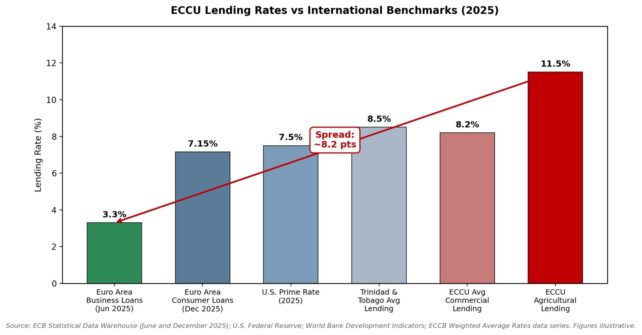
As of mid-2025, the Euro Area business loan rate averaged 3.3 percent and the December 2025 consumer loan rate 7.15 percent. The U.S. prime rate hovered around 7.5 percent; Trinidad and Tobago’s average lending rate approximately 8.5 percent. ECCU commercial lending averages 8.2 percent. ECCU agricultural lending — the segment regional frameworks identify as critical for food security — sits in the 10 to 12 percent range, with an illustrative midpoint of 11.5 percent. The spread between Euro Area business lending and ECCU agricultural lending is approximately 820 basis points — a structural cost-of-capital differential that materially affects the competitiveness of ECCU enterprises
competing with European producers in export markets. The ECCU farmer paying 11 to 12 percent on working capital operates with a cost of capital that European competitors have not faced in a generation.
This is where the regional rate environment moves from a banking matter to a competitiveness matter. The cost of money feeds directly into the cost structure of every business operating in the union, into housing affordability, into the viability of new enterprise formation, and into the diaspora’s decision about whether to invest savings back home.
The Intermediation Spread: The Margin That Defines the System
The spread between what banks pay depositors and what they charge borrowers — the intermediation spread — is the structural margin on which retail banking economics is built. Its size offers analytical insight into competitive intensity and the efficiency with which capital is being mobilized.
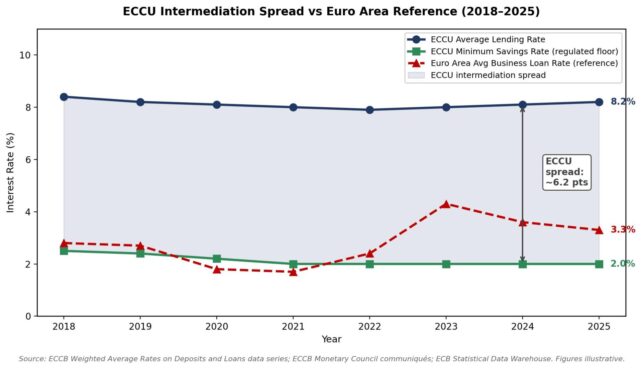
The ECCU intermediation spread has remained in the range of 6.0 to 6.4 percentage points across the 2018 to 2025 period. The Euro Area’s reference business lending rate has moved between 1.7 and 4.3 percent across the same period. ECCU savers earn a regulated floor of 2 percent while ECCU borrowers pay just over 8 percent on average — a margin that has held remarkably constant. Legitimate explanations exist for part of this differential: higher per-customer operating costs, higher correspondent banking costs, smaller economies of scale, and a more concentrated credit risk profile.
The 2026 IMF Article IV Staff Report acknowledged the region’s continued macroeconomic stability while noting the policy priorities the Monetary Council is engaging. The stability is real; the cost to growth is also real. The strategic conversation now in front of the region is how to preserve the first while addressing the second.
The Credit Union Sector: A Complementary Lens
The credit union sector is a material part of the regional credit landscape — particularly in consumer lending, small mortgages, and SME credit — and a complete picture of the cost of money in the ECCU requires examining it alongside commercial banks. The ECCB has acknowledged the importance of this sector through the regional Credit Bureau initiative, which integrates credit reporting from “banks, credit unions, other credit providers and government agencies’ across the union.”
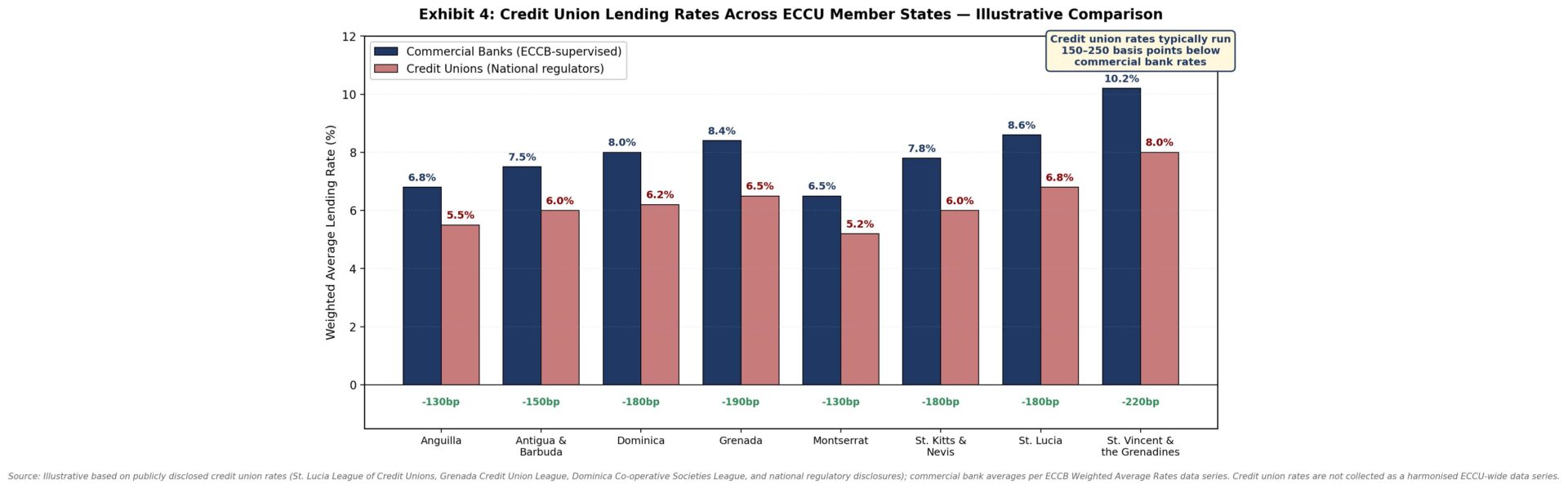
Credit union weighted average lending rates run 130 to 220 basis points below commercial bank rates across all eight ECCU member states, with the differential most pronounced where the commercial bank lending rate is highest. The credit union sector demonstrates that lower-spread Caribbean banking economics is operationally feasible. Credit unions, as member-owned cooperatives operating with different fee structures, lending model assumptions, and reserve requirements, offer borrowers materially lower lending rates while paying depositors competitive returns.
As a contribution to them work the ECCB and national regulators are jointly engaging through the Credit Bureau initiative, the observation worth offering is that the structural feasibility of lower-cost intermediation is empirically established. The question worth examining together is what regulatory, institutional, and capital-market design choices would allow comparable spread economics across the broader commercial banking sector while preserving financial stability.
Where the Cost of Money Meets the Strategic Agenda
The CDB Strategic Plan 2026-2035 calls for US$65.2 billion in regional financing across the next decade. The ECCB’s Big Push targets the doubling of ECCU GDP. CARICOM’s 25 by 2025+5 framework aims to reduce the region’s US$17 billion annual food import bill. The Bridgetown Initiative articulates a climate finance architecture for Small Island Developing States. The institutional consensus is established. The analytical question is how the cost of money connects to its delivery. Food security under 25 by 2025+5 requires capital investment in regional agriculture. Caribbean farmers borrowing at 10 to 12 percent cannot compete on a level playing field with European producers borrowing at 3.3 percent. The same logic applies to medical tourism, to climate-resilient infrastructure, and to the digital transformation pillar of the Big Push.
The same dynamic applies to the ECCB’s Trade Logistics and Shipping pillar, which connects directly to the work this analytical series has engaged in regional aviation. “Grounded: The Case for a Unified ECCU and CARICOM Transport Strategy,” published in May 2026, documented that approximately 52 percent of a typical intra-Caribbean airline ticket represents government taxes, airport fees, and landing charges.
What is true of the tax stack is also true of the capital stack. A Caribbean regional carrier financing aircraft at a cost of capital that exceeds international peer benchmarks by 400 to 600 basis points operates with a structural disadvantage that compounds the tax burden. Tax reform and credit-cost reform are complementary policy levers — both required, neither sufficient alone.
The Toolkit Is Already in Place
The ECCB’s mandate explicitly includes “promoting credit and exchange conditions and a sound financial structure conducive to the balanced growth and development of the economies of the territories of the participating Governments.” At the institutional level, that is a development mandate, and the Bank has been engaging it across multiple instruments. The discount rate — currently 3.0 percent for short-term credit and 4.5 percent for long-term credit per the 111th Monetary Council communiqué — is the instrument through which the central bank lends to governments and commercial banks. The Eastern Caribbean Partial Credit Guarantee Corporation addresses the credit risk premium in certain segments.
The Regional Government Securities Market has raised over US$20 billion since 2001, with the October 2025 Retail Bond Initiative widening the investor base by lowering the minimum investment to EC$500. The May 4, 2026, ECCB pivot toward CARICOM Payments and Settlement System integration is a fourth instrument in motion. The CDB’s expanded lending capacity is a fifth. Taken together, these represent more institutional capacity for engaging the cost-of-money question than the region has had in three decades.
The Strategic Question for the Next Phase
Three observations emerge, offered as contributions to the ongoing analytical work that the region’s central banks, finance ministries, the CDB, the CAB, and bank boards are leading. The first is that the institutional toolkit available to the ECCB is more extensive than the public conversation typically acknowledges. The discount rate, the ECPCGC, the RGSM, CAPSS integration, and the CDB’s expanded lending capacity are each genuine levers; continued coordination of their use, sequenced against the cost-of-capital pressure points in the region, would compound their effect.
The second is that the credit union sector’s narrower intermediation spreads, as shown in Exhibit 4, are an empirical demonstration that lower-cost intermediation is feasible in the region. The question worth engaging — already partly in motion through the Credit Bureau initiative — is what regulatory, institutional, and capital-market design choices would allow the structural feasibility demonstrated by the credit union sector to inform the broader commercial banking sector while preserving financial stability.
The third is that the cost of money in the ECCU cannot be fully addressed without simultaneously engaging the region’s connectivity to the global financial system. Correspondent banking, de-risking pressures, and regulatory frameworks set outside the region are inputs into the intermediation cost structure ECCU banks carry. The next piece in the Series will examine that dimension in depth.
An Invitation to the Conversation — and a Pointer Forward
The ECCU has more institutional capacity, more international partnership infrastructure, and more analytical sophistication available to it in 2026 than at any previous point in three decades. The ECCB and its Monetary Council, the CDB with its Strategic Plan 2026-2035, the CAB, the IMF through its 2026 Article IV engagement, and the regional credit union sector through its complementary credit provision collectively represent the institutional consensus that the next ten years require a different posture. The institutional pieces are in place. What now matters is the depth and pace of the analytical work that translates institutional capacity into operational outcomes.
This commentary launches the Caribbean Banking Series. The next piece, “Banked, But for How Long? Caribbean Correspondent Banking at a Strategic Inflection”, will examine the dimension this commentary has only gestured toward: the connectivity of the regional financial system to the wider world. The cost of cross-border banking, the structural attrition of Caribbean correspondent banking relationships over the past decade, and the convergence between that attrition and the maturing global stablecoin and digital-asset payment infrastructure are now reshaping the conversation about how Caribbean banks connect to the international financial system.
This commentary is offered as a contribution to the work the ECCB, the Monetary Council, member governments, the CDB, the CAB, and regional banks are leading. I welcome the opportunity to engage with regional finance ministries, central banks, financial institutions, the credit union sector, and private-sector partners on the strategic, financial, and operational dimensions of the cost-of-money question.
***
About the Author
Fletcher St. Jean, MBA, is a Finance and Business Strategist and Advisor who works with Caribbean banks, regional governments, and private sector partners on financial, operational, and strategic positioning. He served as Managing Director of 1st National Bank St. Lucia Limited, the first non-St. Lucian citizen to lead the 85-year-old institution; previously held executive roles at Citigroup; served as President of the Bankers Association of St. Lucia; and is a current participant in the Wharton Executive Leadership Program. He is the author of an ongoing regional analytical series covering ECCU and CARICOM finance, aviation, and economic integration, and brings senior practitioner experience to advisory engagements with regional central banks, development institutions, financial institutions, and private sector partners on strategic, financial, and operational matters where data-driven analysis defines outcomes.
The Caribbean Ledger
This commentary launches the Caribbean Banking Series, a sustained analytical program examining the cost of money, the structure of credit, and the connectivity of the regional financial system to the wider world. It builds on the parent commentary, “The ECCU’s Decade of Decision” (April 2026), and runs in parallel with the CaribbeanAviation Series, which includes “Grounded: The Case for a Unified ECCU & CARICOM Transport Strategy” and “The Caribbean Airline Realignment: A Financial Analysis.” To inquire about advisory engagements, request data behind the analysis, or express interest in subscribing when the platform launches, please contact the author.