By Dr. Sotiroula Vasiliou
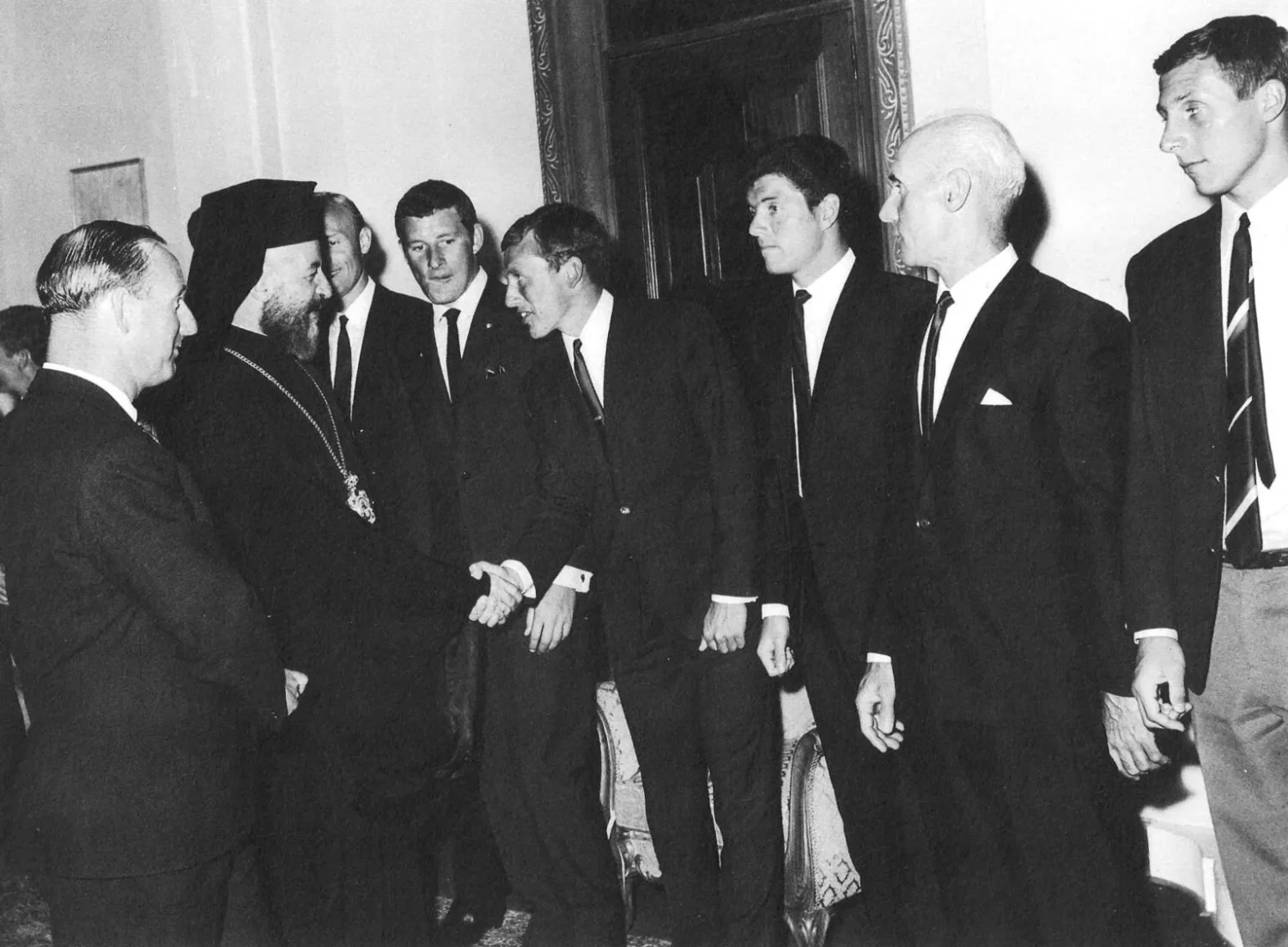
A unique photograph kept in both the Arsenal FC Museum in London and the archives of the Cyprus Press and Information Office captures a historic moment in Cypriot sports diplomacy. Dated 1 June 1967, the photograph shows the President of Cyprus, Archbishop Makarios III, shaking hands and conversing with players and officials of the London club at the Presidential Palace.
Arsenal was visiting Cyprus as guests of APOEL Nicosia for a series of friendly matches against APOEL, Omonia, a combined Limassol team (Apollon and AEL), and Nea Salamina. The historic tour marked a monumental chapter for Cobb football, headlined by APOEL pulling off two unimaginable results against the English giants.
APOEL in London: A win, a loss, and a historic draw
The exchange began with APOEL traveling to London from 24 April to 6 May 1967 to play friendly matches against a Cypriot Community XI, Charlton Athletic, and Arsenal. The matches were held under the auspices of the Greek Cypriot Brotherhood of London and the high patronage of the High Commissioner of the Republic of Cyprus in London, Costas Assiotis.
Thousands of Cypriot expatriates, alongside British fans and 120 traveling APOEL supporters, packed into the Hendon Football Ground, the Valley (Floyd Road), and Highbury Stadium to witness the games.

During the tour, the Nicosia team defeated the Community XI 8-1, suffered a heavy 9-0 defeat against Charlton, and miraculously secured a 1-1 draw against Arsenal at Highbury. The draw was celebrated as a triumph back home, with the Cypriot press running ecstatic headlines praising the unexpected and highly honorable result against the “Gunners of legendary Arsenal,” highlighting APOEL’s excellent defense and the grit of its players.
Describing the post-match scenes at Highbury, Philathlos correspondent AD Drakos reported that the chant of “APOEL” filled the atmosphere at Highbury and rose high into the London sky. Hundreds of Cypriot immigrants and English girls flooded the pitch of Arsenal’s stadium and surrounded the boys in the blue and yellow shirts. The cup was awarded as a trophy of achievement to the Cypriot team and was raised triumphantly in the hands of Pantelas. The players were lost in the embraces of the immigrants, Varnavas was on the shoulders of his admirers, and everyone, from the High Commissioner to the last Cypriot and the English, applauded the team that achieved the unthinkable, APOEL.
APOEL President Takis Skarparis expressed immense pride in the players, noting the value of the experience for each individual and the squad as a whole. Upon returning to Cyprus on May 6, the team received a hero’s welcome at the airport from Cyprus Football Association (CFA) officials and a massive crowd of supporters.
Preparing for Arsenal’s arrival
On the afternoon of their return, a press conference was held at the APOEL club house. Marcos Spanos, General Secretary of both the CFA and APOEL, emphasized that the tour had created opportunities for closer ties between UK-based Cypriots and clubs in Cyprus, paving the way for future exchange visits. He then announced Arsenal’s upcoming tour to Cyprus for friendly matches and leisure, which had been approved by the CFA.
The diplomatic significance of the sporting exchange was perfectly summarized in London by Arsenal’s organizing secretary, Jack Kelsey, who stated that APOEL’s visit to London and Arsenal’s descent to Cyprus were equivalent to a thousand political visits between the two countries.

Three British wins and a second Nicosia miracle
Arsenal, having finished seventh in the English First Division, landed at Nicosia Airport on the evening of 18 May 1967, where they were greeted by sports officials and a large crowd of football fans.
The visiting delegation stayed at the “Famagusta Palace” hotel in Famagusta. The traveling squad consisted of 18 players: C. Addison, G. Armstrong, T. Coakley, D. Court, J. Furnell, G. Graham, D. Howe, D. Jenkins, G. Johnston, J. McGill, B. McNab, F. McLintock, T. Neill, J. Radford, J. Sammels, Simpson, P. Storey, and B. Wilson. They were accompanied by club Chairman D. Hill-Wood, organizing secretary Jack Kelsey, manager and coach D. Sexton, his assistant, and the president of the Greek Cypriot Brotherhood, Sofronios Mantis.
The friendly matches played by Arsenal during their 1967 tour of Cyprus resulted in three victories for the English side and one draw. The tour opened on 20 May 1967 at the GSP Stadium in Nicosia, where Arsenal defeated Omonia with a score of 4-1. The match took place in front of thousands of fans, including interior minister Polykarpos Giorkatzis, labor minister Tassos Papadopoulos, commerce minister Andreas Araouzos, and British High Commission officials. Four days later, on 24 May, they secured a dominant 7-0 victory against a combined Limassol XI at the GSO Stadium in Limassol, with local newspaper Eleftheria noting that while Limassol played with enthusiasm, they naturally succumbed to a superior opponent.
The highlight of the tour took place on Saturday, May 27, at 4:30 pm back at the GSP Stadium, where APOEL managed a historic 1-1 draw against the visitors in front of around 8,000 spectators. APOEL lined up with Ch. Aloneftis, S. Andreou, A. Assiotis, A. Efstathiou, L. Leonidou, L. Louka, Nikakis, Nikaros, A. Pakkos, Pantelas, M. Papallos, L. Poulias (making his debut as APOEL’s first player from Greece), S. Charitakis, and D. Chiotis.
Arsenal opened the scoring in the 36th minute through John Radford, but Nikaros equalized for APOEL just ten minutes later with a well-placed shot. The match trophy, a valuable shield sponsored by the Littlewoods representative in Cyprus, A. Giles, was presented to Arsenal by Minister Giorkatzis.
In a lengthy feature, Philleftheros detailed that APOEL halted Arsenal’s winning streak with an unbelievable display of enthusiasm, competitiveness, and footballing worth. Exactly one month after the first match, they forced the great Arsenal once again to accept them as a worthy opponent, writing the 1-1 of Nicosia alongside the 1-1 of London with great honor into the history of Cypriot football.
That evening, the British High Commissioner to Cyprus, Sir Norman Costar, hosted a reception in honor of both teams, attended by government ministers and CFA officials.
Arsenal concluded their playing schedule on 31 May at the GSE Stadium in Famagusta, defeating Nea Salamina 2-0 in front of 6,000 fans. The Londoners had to work hard for the victory against an inspired performance by international goalkeeper Varnavas, described by press reports as a “panther.”
The historic tour officially concluded on 1 June 1967 with the squad’s visit to Archbishop Makarios III at the Presidential Palace, before departing for London the following day carrying four trophies and fond memories of the island.
Post script: Just two days after the Arsenal game, on 3 June 1967, APOEL played its final match of the Cypriot championship against Aris, sitting level on 52 points with Olympiakos Nicosia but trailing on goal ratio. Despite recording the biggest win in their history by defeating Aris 17-1, Olympiakos beat Pezoporikos 6-1 to claim the title on goal difference.
*PhD Historian, AUTH