Otto Carrington
Senior Reporter
State-owned oil company Heritage Petroleum says there is currently no evidence to support the presence of large amounts of hydrocarbons in the sea, following an immediate investigation into an alleged oil spill flagged by Venezuela.
The company said it launched a multi-agency response after receiving a report yesterday of a potential hydrocarbon sighting originating within Trinidad and Tobago’s waters.
In a media release, Heritage stated: “Currently, there is no evidence to support the presence of large amounts of hydrocarbons in the sea.”
Despite a diplomatic and environmental alert from neighbouring Venezuela, comprehensive sweeps by local authorities have yielded no signs of contamination, Heritage said.It added that a technical review of its SCADA online monitoring system confirmed all pipeline and operational parameters were normal. Additionally, emergency vessel surveillance dispatched across all company assets reported no abnormalities.
The investigation extended across the energy sector and national security assets were deployed in the tracking operation.Heritage confirmed it liaised directly with the Trinidad and Tobago Coast Guard, which deployed dedicated maritime surveillance to survey the Gulf of Paria and surrounding territorial waters.
“Surveys conducted by the Coast Guard have so far corroborated Heritage’s findings, reporting no visible slicks or marine abnormalities. While preliminary sweeps indicate no immediate environmental crisis locally, response units remain on high alert,” the release said.
Heritage noted that a multi-tiered tracking strategy, involving continuous vessel surveillance and aerial flyovers, will remain in place as the company awaits definitive field data.
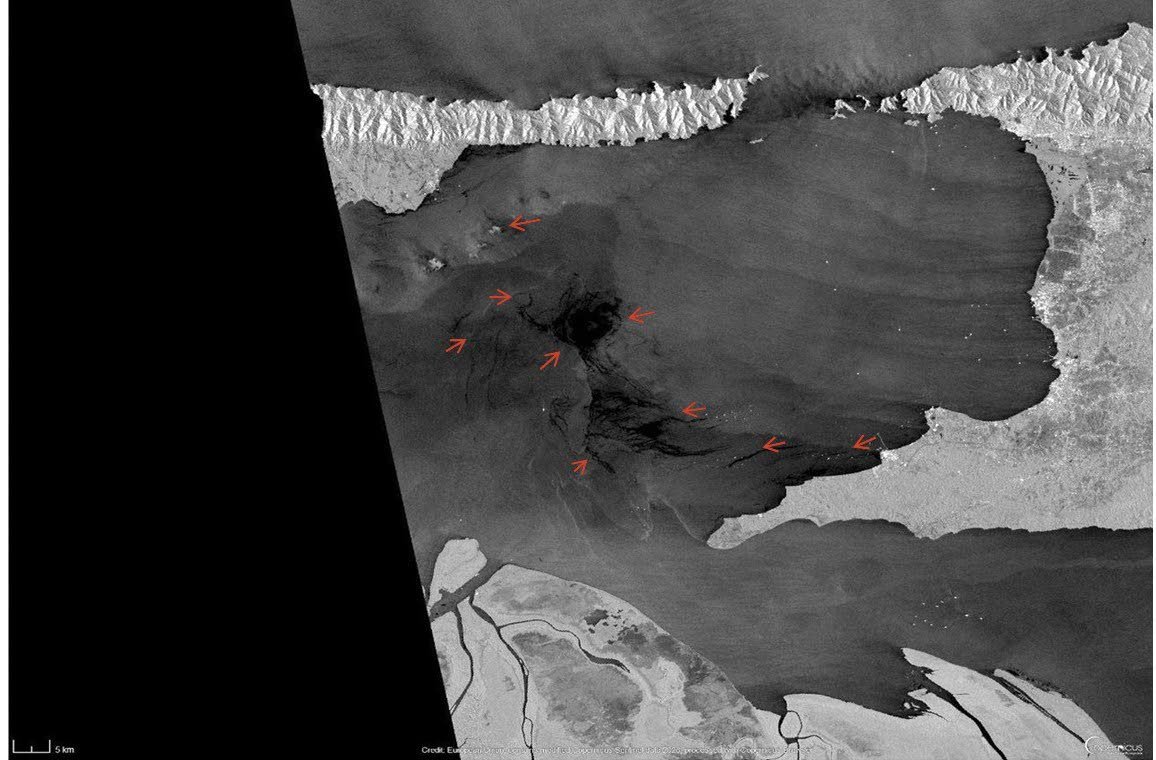
The mobilisation followed an official communiqué issued yesterday by the Venezuelan government, accompanied by multi-temporal satellite analysis that it claims shows a major hydrocarbon slick originating near Trinidad and moving northwest into the Gulf.
According to imagery released by Venezuela’s oil sector analysis arm, PDVSA INTEVEP, and derived from Sentinel-1 radar data operated by the European Space Agency, the affected marine areas appeared as dark anomalies consistent with potential oil presence.
Caracas warned that the contaminants are moving northwest toward both Venezuelan and T&Tobago waters, raising concerns about possible impacts on marine ecosystems, coastal communities, and commercial fishing zones across the Gulf of Paria.
The Venezuelan Foreign Ministry described the development as a renewed environmental threat and referenced what it claims is a significant cross-border pollution event affecting sensitive coastal and wetland systems.
This development follows an earlier dispute on May 19, when Venezuela’s Foreign Minister Yván Gil accused T&T of a “lack of communication” after a leak at Heritage Petroleum’s Riser Platform No. 2 in the Main Soldado Field.
At the time, Caracas cited satellite-derived estimates suggesting widespread environmental impact, while Port-of-Spain maintained the leak was contained at about ten barrels and treated with dispersants.
Despite high-level bilateral talks on May 22 involving Energy Minister Dr Roodal Moonilal and Venezuela’s Minister of Ecosocialism Freddy Ñáñez to strengthen joint spill response coordination, relations now appear strained again amid conflicting technical assessments.
Responding to the allegations, Energy Minister Dr Roodal Moonilal said yesterday that government agencies were monitoring the situation and had activated established response protocols.He said Government remains in continuous contact with Minister of Foreign and Caricom Affairs Sean Sobers, who has engaged the Venezuelan Mission in Port-of-Spain as diplomatic channels remain open.
Moonilal added that T&T has formally requested precise coordinates from Venezuelan authorities to assist verification efforts and support an independent assessment of the reported spill.He also confirmed meeting recently with Sobers and the Venezuelan Ambassador, describing the engagement as focused on information-sharing as both sides seek clarity on the evolving situation.
Meanwhile, Fishermen and Friends of the Sea (FFOS) corporate secretary Gary Aboud yesterday expressed concern over the latest reports.
He added that the situation mirrors the May incident, arguing that transparency should not depend on international pressure.FFOS also warned that repeated reports of oil spills are eroding public confidence in marine resources, with fishermen facing worsening economic conditions, declining catches, and growing uncertainty over seafood safety and market stability.
FFOS is calling for the immediate release of all satellite data, trajectory modelling, water quality assessments, and response measures. It also wants a full public inquiry into both the May and June incidents, as well as the establishment of a compensation mechanism for affected fishing communities.