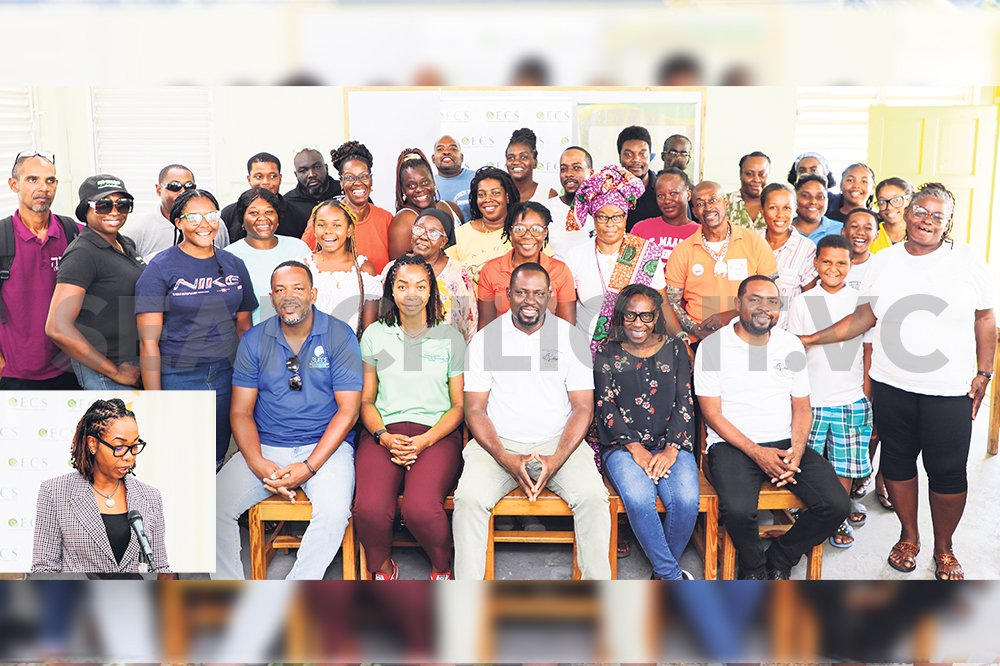
(OECS Commission) MINISTER OF FISHERIES Conroy Huggins (forefront centre), with officials and participants at the OECS three-day capacity-building workshop aimed at transforming the local sea moss industry into a cornerstone of the national blue economy.
The Organisation of Eastern Caribbean States (OECS) Commission, in collaboration with the Government of St Vincent and the Grenadines (SVG), and the Caribbean Biodiversity Fund (CBF), successfully concluded a specialized three-day capacity-building workshop aimed at transforming the local sea moss industry into a cornerstone of the national blue economy.
Held from July 21–23, 2026, at the Union Island Secondary School, the initiative brought together farmers, entrepreneurs, and government officials to elevate local production to international food safety and business standards. The workshop represents a key component of the Caribbean Regional Architecture for Biodiversity (CRAB) Project, funded by the CBF with support from the Agence Française de Développement (AFD) and Le Fonds Français pour l’Environnement Mondial (FFEM).
Minister of Fisheries Conroy Huggins, addressing participants, emphasized that sea moss cultivation is a priority focus area for the administration.
“Sea moss globally is a billion-dollar industry. Our focus has to be quality with efficiency,” stated Minister Huggins, noting that the government is currently amending the Fisheries Act to provide a stronger legislative framework for the sector while bolstering regional food sovereignty and community resilience following Hurricane Beryl.
Echoing this strategic focus, Officer in Charge of the OECS Economic Development Unit Natasha Deterville-Moise, highlighted that the initiative directly implements the OECS Food and Agriculture Systems Transformation (FAST) Strategy by supporting producers “not only to grow more but to grow smarter, and not only to participate in markets but to compete successfully in increasingly demanding regional and international value chains”.
To achieve these goals, the comprehensive programme delivered intensive, practical instruction designed to strengthen the entire value chain. Technical modules focused heavily on Post-harvest food safety and quality assurance, equipping farmers with Hazard Analysis Critical Control Point (HACCP) principles and sanitation Standard Operating Procedures (SSOPs) necessary to access high-value export markets. Complementing this technical rigour, business management sessions provided producers with financial tools for cost-of-production analysis, record-keeping, and strategic planning to transform seasonal farming into sustainable, generational wealth.
The practical focus resonated deeply with local business owners and participants eager to professionalize their operations. Ronita Oliver, Founder of Ocean Remedies, noted,
“I find the session very useful and timely as I’m in the process of creating SOPs, HACCP, and good manufacturing practices for my business to make sure that I’m compliant and sustainable”.
Another workshop participant reinforced the shift in mindset, sharing that the training inspired producers to “not think of this industry as a hobby, but as a business…that we could line ourselves up to be on the international market”.
Beyond immediate commercial gains, the initiative prioritized long-term sustainability by actively engaging the next generation. Youth participant Kylan Oliver, who works alongside her mother at Ocean Remedies and aspires to become a marine biologist, shared how the programme deepened her commitment to the sector: “While mommy is doing the sea moss and we’re helping, it makes me want to become a marine biologist even more because of the sea. I feel like the sea is where I belong”.
This milestone in Union Island forms part of a broader, coordinated regional effort to standardize the sea moss value chain across OECS Member States, following earlier successful training sessions in Grenada (January 2026), and Dominica (April 2026). (OECS Commission)