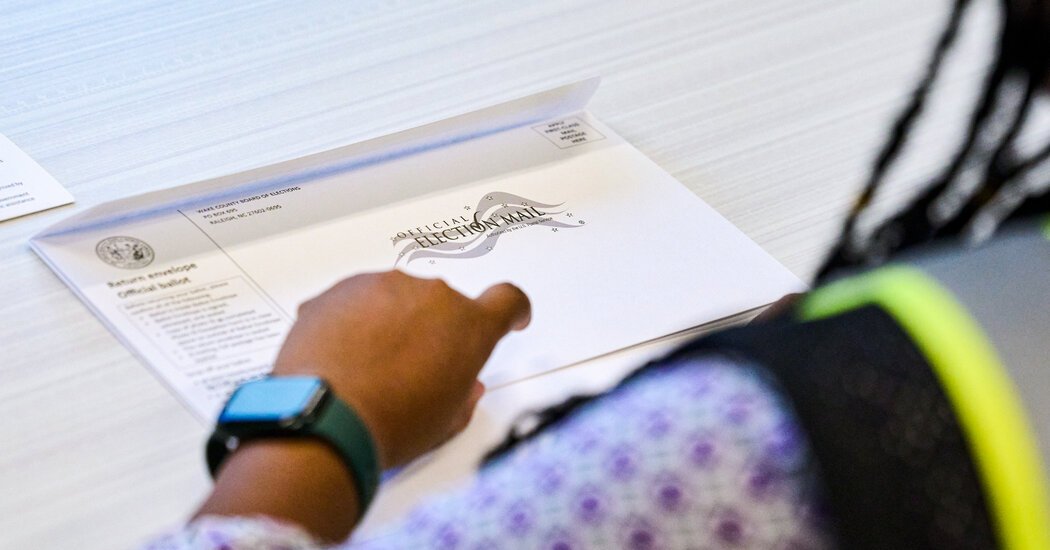
North Carolina was set to begin sending mail ballots to voters early on Friday, the first state to forge ahead with its standard vote-by-mail program as the Trump administration escalates its efforts to restrict the practice.
State election officials said they would send their first batch of absentee ballots to the more than 46,000 voters who have requested them. More ballots will go out as more requests come in.
The mailing of ballots could complicate the Trump administration’s effort to impose new restrictions on voting by mail, which it claims without evidence is intended to root out tens of thousands of noncitizens who are illegally registered to vote.
The administration is trying to apply a rule that calls for states to hand over voter data, and requires a particular ballot envelope design that would allow the U.S. Postal Service to scan a bar code as part of a voter verification process. The rule also threatens to withhold mail delivery of ballots in states that don’t comply.
However, with the fall election just nine weeks away and administrators already starting to send out mail ballots, a federal judge’s temporary injunction against the rule has put the government in a race against the clock. Nineteen other states are set to mail ballots to voters by Sept. 19.
Election officials in many of those states, including North Carolina, have said it wasn’t likely they could carry out the new rule if the courts decided to allow it to take effect.
“It is far too late in the election cycle to introduce such dramatic changes,” said Marc Brunton, North Carolina’s deputy attorney general, in a filing last week in the case, in which about two dozen states sued the postal service in federal court in Massachusetts to block the rule. The states argue that the rule violates the Constitution, which gives states and Congress, not the executive branch, the power to run elections.
A top election official in Wisconsin said in court filings this week that it would be “virtually impossible” for the state to comply with the new requirements. In Washington, more than five million voter ballot packets have already been printed, according to a court filing. Hawaii election officials said in their filing that it would be difficult to order new envelopes “from the continent on such short notice.”
Mr. Trump has repeatedly promoted false claims of widespread mail voting fraud, even as he voted by mail himself in two elections this year. In part because of those claims, Democrats in recent years have voted by mail in higher numbers than Republicans, which in turn has led opponents to believe that Mr. Trump is looking to control ballot delivery in order to interfere with the results in November.
They also fear that the president’s campaign will sow confusion and mistrust among voters, and prompt some not to vote at all.
While the president has said his purpose is to detect and disqualify ineligible voters to protect the security of U.S. elections, he has also suggested that restrictions on mail voting would help Republicans win elections.
On Thursday, the judge in the Massachusetts case said during a hearing on the matter that the rule, which resulted from an executive order issued by Mr. Trump, could cause “major disenfranchisement” of voters.
Later the same day, the Trump administration made an emergency request to the Supreme Court to clear the way for the new rule, arguing that the lower court’s freeze on the plan imposes “serious irreparable harm on the federal government, the states themselves, and the voting public.”
However, the emergency request also suggested that ballots that have already been sent to voters might not be subject to the rule change.
“Once those ballot envelopes enter the mail-stream, there is no retrieving them,” wrote D. John Sauer, the solicitor general.
Voters in North Carolina, unlike in many other states, are more likely to cast their ballots in person than they are by mail. Even in 2024, when Hurricane Helene swept away polling locations and displaced voters in the western part of the state, only about 5 percent of voters mailed in their ballots. But that margin could make a difference in a state with a Senate race that is key to the Democratic Party’s hopes of reclaiming the chamber.
State election officials said on Thursday that, whatever the courts decide, they will follow the law.
“It is business as usual as far as I’m concerned,” said Sam Hayes, executive director of the North Carolina Board of Elections, which has a Republican majority, during a news conference on Thursday.
Under the proposed Postal Service rule, the agency would examine ballots and could reject entire batches of up to 10,000 after finding just one ballot error.
Even if the Supreme Court green lights the rule, the federal government may not have time to fully exercise it. Although many states, including North Carolina, already use ballot envelopes that meet the new requirements, the Postal Service does not yet have the technology to screen ballots in the manner the rule would require. The agency has been trying to develop such a system swiftly, but a whistle-blower said this week that the development was rushed and sloppy.
Eileen Sullivan, Richard Fausset and Nick Corasaniti contributed reporting.