Muscat: The Ministry of Labour announced a new promotion system for Omani employees across units of the State Administrative Apparatus on Monday
Under the new policy, funds are distributed proportionally based on the number of eligible employees within each entity. The allocation for a specific entity is calculated using the following formula:
An amount of RO10 million has been allocated for distribution to the entities based on a mechanism that relies on proportionality and ratios according to the number of eligible individuals for promotion in each entity.
First, through the total number of eligible individuals equaling the sum of the number of eligible individuals across all entities, and second, the financial allocation for the entity equals (number of eligible individuals in the entity + total number of eligible individuals) × RO1 million.
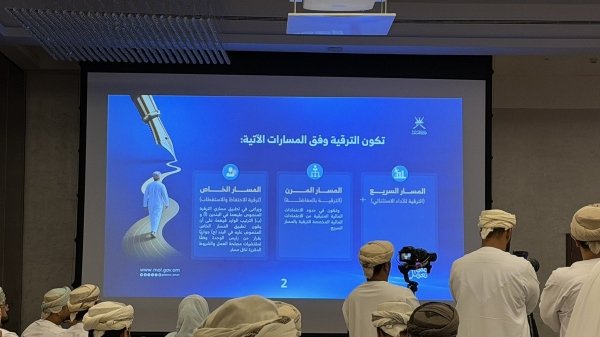
The system operates three distinct tracks:
Fast Track:
Flexible Track:
Special Track:
Fast Track Requirements
Promotion requires the passage of at least 3 years from the date of appointment to the grade immediately preceding the target promotion grade, along with receiving 3 performance efficiency evaluation reports graded as “Excellent” under the Ejada system. Additionally, the promotion must not exceed the maximum level of the job progression scale established by the Job Classification and Ranking System—issued by Civil Service Council Decision No. (10/2010)—and there must be no existing legal or administrative impediments to promotion.
Flexible Track Assessment
Promotions on the Flexible Track are awarded based on a competitive 100-point evaluation score:
Job Performance (up to 75 points):
Individual Competency (up to 25 points):
Up to 12.5 points for readiness to assume a higher-level position.
Up to 12.5 points for continuous skill development and expertise within their domain.
Direct supervisors shall evaluate the individual competency of employees nominated for promotion under their direct supervision across the two aforementioned criteria. To prevent all employees from receiving equal scores, evaluations must be distributed as a percentage of the total nominated employees under their supervision according to the following breakdown:
- First Tier (20 to 25 points):
- Second Tier (15 to 19 points):
- Third Tier (10 to 14 points):
- Fourth Tier (1 to 9 points):
Once completed, the evaluation shall be submitted to the higher-level supervisor for final approval.
Promotion under the Flexible Track requires the availability of allocated financial credits within the unit’s budget, along with the fulfillment of the following conditions: Time in Grade: Performance Rating: Hierarchy Limits: Clearance:
Special Track
Promotion via the special “Retention and Attraction” track is issued by a decision from the Head of the Unit, subject to the following conditions:
The proportion of promotions under this track must not exceed 1% of the budget allocated for the merit-based promotion track.
The employee to be promoted must occupy a position that substantially impacts the Unit’s core functions, requires rare competencies or highly specialized skills, and is difficult to fill or replace.
A period of at least 3 years must have elapsed since the date of occupying the grade immediately preceding the target promotion grade.
Reaching the top of the career progression scale shall not preclude an employee’s promotion, in accordance with the Job Classification and Grading System issued by Civil Service Council Decision No. (10/2010).
There must be no existing legal or administrative impediments to promotion.
Mohammed bin Mubarak al Kalbani, Director General of Development and Quality Assurance at the Ministry of Labour, highlighted that the Special Track focuses on organizational needs. By providing tailored promotion criteria, it enables administrative units to retain top talent and attract highly skilled professionals.
Promotion Committee
A promotion committee shall be established within each unit by a decision of its head. The committee shall consist of an odd number of members—no fewer than three—and its chairperson shall hold a rank no lower than Director General. The decision shall also designate a committee secretary, who shall have no voting rights.
The committee’s remit includes receiving promotion requests from the relevant department and verifying that candidates meet the requisite conditions and criteria.
In the event of a tie among candidates for promotion via the Flexible Track, priority shall be given to the candidate with the highest combined score from their last two job performance efficiency evaluations. If a tie persists, priority goes to the candidate with the highest score in the most recent evaluation. If a tie still persists, priority goes to the candidate with the earliest date of appointment to the financial grade from which the promotion is being made.
The Ministry of Labour noted that the committee is also responsible for discussing with the ultimate superior or direct supervisor, as applicable, the reasons and grounds for a candidate’s nomination if the request lacks sufficient supporting documentation.
Furthermore, it submits recommendations regarding eligible employees to the head of the unit within the limits of allocated financial appropriations. Based on the unit’s job budget records, the department responsible for human resources shall prepare an annual statement listing the nominated employees who meet the promotion criteria, which must be submitted before the end of January each year.
Restrictions on promotions
Regarding promotion restrictions, an employee may not be promoted while serving a prison sentence, nor while suspended from work or referred for administrative or criminal proceedings; however, the relevant job grade shall be reserved for them.
If the employee is not convicted, or if the penalty imposed is merely a warning or a salary deduction for a period not exceeding a specified threshold, the promotion may proceed.
An employee may not be promoted if subject to any of the penalties listed below until the specified period for each has elapsed: six months for a salary deduction exceeding five days and up to fifteen days, and nine months for a salary deduction exceeding fifteen days or a salary reduction of up to 10%.
Promotion decisions in January and July
Promotion decisions are issued by the head of the unit twice annually, taking effect on the second day of January and July.
If a promotion decision covers multiple employees with the same effective date, seniority is determined based on each employee’s seniority in the grade from which they were promoted.
The methodology for allocating promotion funds is based on equitable distribution—with each entity’s share directly linked to the number of eligible employees—transparent calculation using a unified, verifiable formula, and accommodation of varying organizational sizes, whereby entities with a larger number of eligible employees receive a proportionally larger share.
Additionally, the entire allocated amount is distributed among the covered entities.